

Police Cancellations, Thuggery, and the Threat to Democratic Participation
The NDC campaign disruptions 2027 have become a troubling pattern that threatens the integrity of Nigeria’s electoral process. From police cancellations of approved rallies to thuggery attacks on campaign offices (especially Benin), the warning signs are unmistakable. The federal and state governments must allow the Nigeria Democratic Congress (NDC) to carry out their campaigns freely, as long as they do not disrupt public peace. The police must provide adequate security for all parties and citizens, serving as a bulwark between civil duty and criminality. And INEC’s promise of a level playing field must be backed by action, not just rhetoric.
NDC Campaign Disruptions 2027: The Full Picture
The 2027 election season has barely begun, yet the Nigeria Democratic Congress has already faced a series of disruptions that raise serious questions about the fairness of the electoral environment. These incidents, police cancellations, thuggery attacks, and the vandalisation of campaign materials, are not isolated events. They form a pattern that suggests a concerted effort to frustrate the opposition’s ability to campaign freely.
The Police Cancellations: Akwa Ibom and Beyond
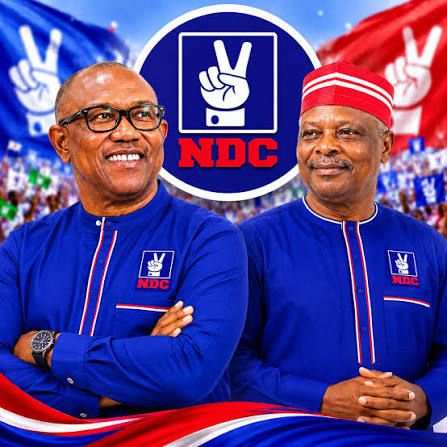
The NDC campaign disruptions 2027 are most visible in the police’s repeated cancellations of approved rallies and marches. The most dramatic incident occurred in Akwa Ibom State, where the police cancelled a two-million-man march organised by the Obidient Movement in solidarity with Peter Obi and Rabiu Kwankwaso .
The Two Million-Man March Cancelled
The Akwa Ibom State Commissioner of Police, Baba Azare, had initially granted approval for the march, scheduled for October 1, 2026, to coincide with Nigeria’s Independence Day celebrations. The organisers had spent over N20 million mobilising supporters across the 31 local government areas of the state .
But on the eve of the event, the police issued a statement cancelling all political rallies, meetings, and processions scheduled for Independence Day. The statement cited “credible intelligence” indicating plans by some individuals to exploit scheduled political activities to cause disturbances and threaten public peace .
The N20 Million Loss
Dr Benjamin Smith, the State Director of the Obidient Movement, expressed deep frustration at the cancellation. He revealed that the movement had committed over N20 million to mobilise supporters, secure vehicles, and coordinate logistics across the state .
“We want Nigerians to know that the police have violated the Police Act. It is a violation of the Nigerian constitution that gives the people the right of freedom of assembly,” Smith said. “We want everybody to know this and we would resist it next time the rally would be scheduled. We also want everybody to know that without the constitution of Nigeria and laws, we are just a banana republic” .
The PDP Rally Excuse
Smith accused the police of acting under political pressure. He noted that the same date had been approved for the PDP to hold its own rally from October 1 to 3, and the police cited security concerns and possible clashes between the two political parties .
“We know that this is the handiwork of the APC in Akwa Ibom,” Smith said. “We want everybody in this country to know that the APC was an opposition party. It was the law of Nigeria that guaranteed them the right to campaign and win elections. And it is the same laws that are available today that also guarantee other political parties the freedom to campaign and win elections” .
The police’s decision to cancel an approved rally at the last minute, after the organisers had already incurred significant costs, raises serious questions about the neutrality of security agencies in the electoral process.

The Benue Blockade: Peter Obi’s Convoy Attacked
The NDC campaign cancellations Nigeria pattern extends beyond police actions to physical attacks on opposition figures. On September 8, 2026, suspected thugs blocked the convoy of Peter Obi on Gboko Road, near the Air Force Base, in Makurdi, the Benue State capital .
The September 8 Incident
In a viral video of the incident, Obi’s convoy was seen turning back as thugs, wielding sticks, stones, and other dangerous objects, pursued the vehicles. Obi said he was in the state to show solidarity with communities affected by the Yelwata killings in 2025 .
The Benue State Commissioner of Police, Cletus Nwadiogbu, later clarified that the NDC had informed his office about Obi’s planned visit, and he had provided three patrol teams for security. He said the NDC never asked him to transmit a letter to the governor, and he had no involvement in the blockade .
The Police Commissioner’s Clarification
“The assumption is that they have finished every other aspect of what they want to do and how they are going about their movement. They came to inform me, that the information is basically for provision of security, and that was what I did,” Nwadiogbu said .
But the clarification did not address the central question: who organised the thugs, and why were they allowed to block a presidential candidate’s convoy?

IPAC’s Condemnation
The Inter Party Advisory Council (IPAC) condemned the attack, describing it as “an invitation to anarchy.” The council said restricting a citizen from entering a state was a “flagrant violation of the 1999 Constitution” .
The Labour Party called on President Tinubu to rein in “overzealous” governors, alleging that the miscreants who blocked Obi were sponsored by the state government .
Punch Newspapers, in an editorial, described the incident as an “ominous start to 2027 campaigns” and warned that the rising level of political intolerance ahead of the polls was cause for serious trepidation .
The Attack on NDC Campaign Office in Edo
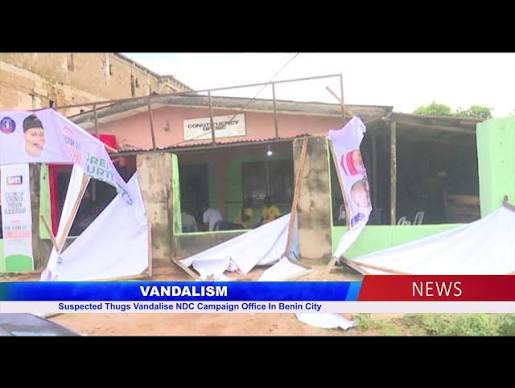
The NDC thuggery attacks have also targeted the party’s physical infrastructure. On September 29, 2026, the campaign office of the NDC candidate for Oredo Federal Constituency, Hon. Frank Uyi Omosigho, was attacked in Benin City .
Campaign posters, banners, and other materials were destroyed during the attack, which occurred at about 10 p.m. Omosigho, who represents Oredo East Constituency in the Edo State House of Assembly, said community members alerted him to the attack .
“My appeal to youths is not to allow politicians to use them to perpetrate violence or other illegal acts,” Omosigho said. “The campaign materials were meant to introduce candidates and political parties to the electorate. The voters had the right to make their choices independently” .
The lawmaker disclosed that the incident had been reported to the police and the Department of State Services. He also alleged that his campaign materials had been pulled down in different locations, including Stadium Road, Oguola, Oliha, Five Junction, and Ekenwan Road .
The Vandalisation of Opposition Materials in Lagos
The Nigeria 2027 electoral violence is not limited to physical attacks on people. In Lagos, the NDC senatorial candidate for Lagos Central, Ladipo Johnson, raised concerns over the persistent vandalisation of campaign materials belonging to opposition parties .
“APC campaign posters, banners and billboards are everywhere, but hardly will you see opposition parties’ campaign materials in the public space,” Johnson said. “This is an undemocratic and uncivil attitude that needs to be curtailed and stopped” .
Johnson described the alleged destruction of opposition campaign materials as undemocratic and indicative of intolerance toward political competition. He urged political parties and their supporters to respect the rights of other parties and candidates to campaign freely .
INEC’s Promises and the Reality
Against this backdrop of NDC campaign disruptions 2027, INEC has promised a level playing field. The Commission’s Chairman, Professor Joash Amupitan, has disclosed that INEC would activate intelligence operations against vote buying during the 2027 elections. He lamented that vote buying had become “clinical,” with perpetrators no longer operating at polling units but outside them .
The Level Playing Field Promise
Amupitan emphasised that election security depends on adequate funding and that the commission was committed to working with security agencies to ensure that voters, electoral officials, and sensitive materials were protected .
But highlighting challenges is not enough. The federal and state governments must allow for a level playing field. The police must provide ample security for parties and citizens, serving as a bulwark between civil duty and criminality.
The Intelligence Strategy Against Vote Buying
INEC’s plan to constitute a “giant task force” involving the Federal Ministry of Justice and the Attorney General’s Office to tackle vote buying is a step in the right direction. But the commission’s acknowledgment that it lacks the powers to arrest and investigate is a candid admission of institutional limitations .
Vote buying is not merely an electoral offence; it is a threat to the legitimacy of Nigeria’s democracy. INEC can provide the intelligence and the framework, but it cannot act alone. The police must investigate and arrest. The judiciary must prosecute and convict. Civil society must educate and mobilise. And citizens must resist the temptation to sell their votes.
Conclusion: The Warning Signs
The NDC campaign disruptions 2027 signal that unless urgent action is taken, Nigeria’s 2027 elections may be remembered not for the choices voters made, but for the choices they were prevented from making.
The federal and state governments have a responsibility to ensure that all political parties can campaign freely. The police have a duty to protect all citizens, regardless of political affiliation. And INEC must do more than promise a level playing field; it must ensure one.
As a formidable opposition party, the NDC has every right to accuse the ruling party of frustrating their campaign and their structure in a bid to win the elections through systemic sabotage. Whether that accusation is proven or not, the pattern of disruptions—police cancellations, thuggery attacks, and the vandalisation of campaign materials—is a warning sign that Nigeria’s democracy is under strain.
The collapse of the First and Second Republics, owing largely to political crises, intolerance, violence, and corruption, should provide a sobering lesson. Nigeria has enjoyed uninterrupted civilian rule since 1999, but politicians and their thugs are unwittingly placing that remarkable democratic run under unnecessary strain .
President Bola Tinubu should give clear directives to the security agencies to deal decisively with any candidate, political party, or supporter found fomenting trouble before, during, or after the 2027 elections. Those parading themselves as thugs must be arrested and prosecuted in accordance with the law. Political connections must not become shields against accountability .
A democracy without a vibrant opposition is a dead democracy. Nigeria must not descend to the level of some African countries where governments make a caricature of democracy by systematically undermining the opposition.
The warning signs are clear. The question is whether Nigeria will heed them.
- 2027 general elections Nigeria
- Akwa Ibom police rally cancellation
- Electoral violence 2027
- INEC 2027 elections
- INEC level playing field
- Lagos opposition materials vandalised
- NDC campaign cancellations Nigeria
- NDC campaign disruptions 2027
- NDC Edo campaign office attack
- NDC police disruption 2027
- NDC thuggery attacks
- Nigeria 2027 electoral violence
- Nigeria Democratic Congress
- Peter Obi Benue blockade
- Political thuggery Nigeria







Leave a comment