

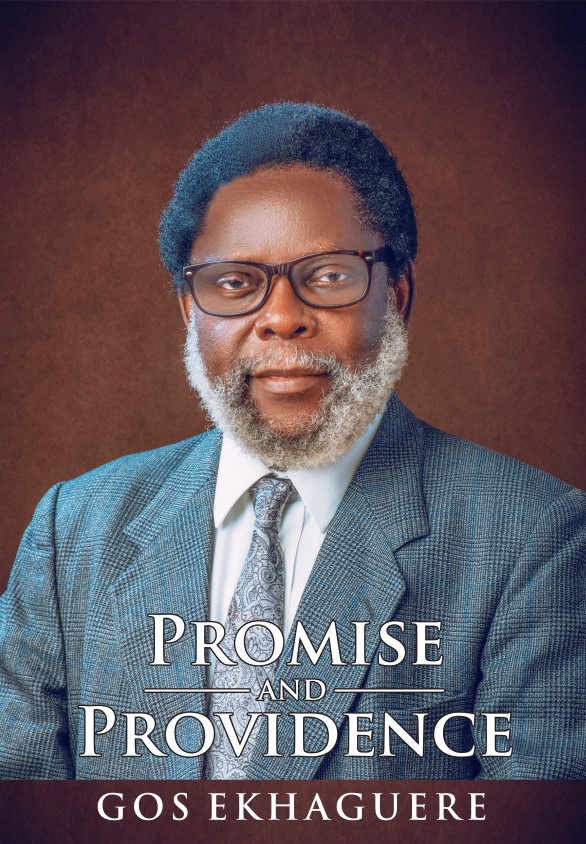
A Review of Promise and Providence by GOS Ekhaguere
Oka Martin Obono
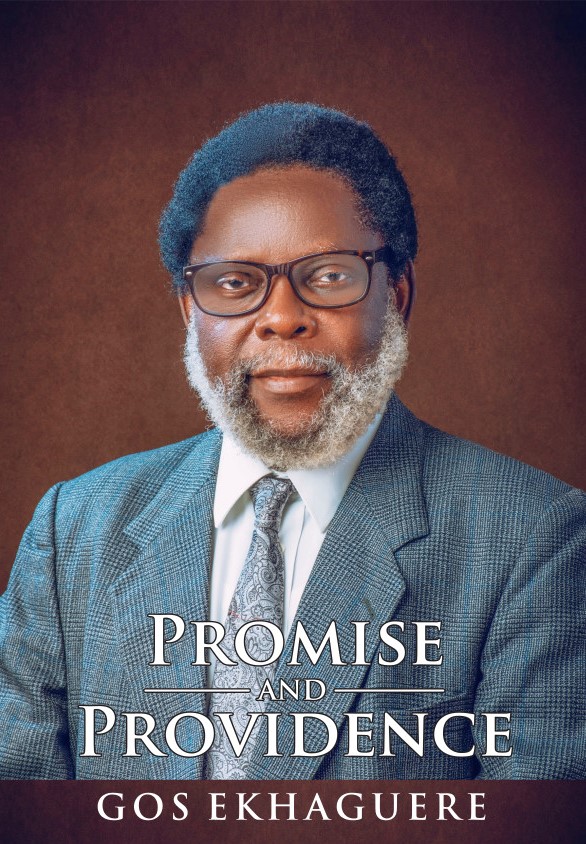
Any review of the autobiography Promise and Providence by Emeritus Professor of Mathematics Godwin Osakpemwoya Samuel Ekhaguere (otherwise, GOS Ekhaguere), NNOM, must be set against the background of the author’s renowned humility and established penchant for understatement. Enormous things happen in the 547 substantive pages and 26 chapters of this phenomenal piece of work, which appear cast on a Homeric order. From its very beginning it attests to the interplay of mortals and immortals, in the affairs of men and of one man in particular –GOS Ekhaguere. Nothing could be more dramatic than that, or more evocative of the sweep of interpretive history. Yet, it is written with such linguistic sparseness, in an economy of words, which must be deciphered to unpack the grand dimensions of things written about. Paradoxically, it is this frugality of language that invests Ekhaguere’s ideas and narration with such unspeakable atomic power and human appeal.
The aim of the book is stated at the outset. It is spelt out in a rather matter-of-factly tone of voice which shows that the author was not going to indulge the reader’s hope for literary embellishments. In his first words, “This autobiography sketches some key aspects of my life journey.” Period. There is no adornment. No elaboration. But the words “sketches”, “some”, “key”, and “aspects” are unmitigated understatements, as this review would show. More than an autobiography, Promise and Providence is an engaged narrative of how history and critical reflection can shape the relationship between an individual and their society, and reconstruct their life aspirations. However, when that history is ineluctably guided by divine influence, then the vagaries of “a life journey” become the same things as the undulations of sea waves that bear a ship to a promised shore. I derive this seafaring metaphor from Ekhaguere himself, when he basically states the mathematical formulation that describes his life philosophy.
Each earthling has some innate potential or promise. But the invariably nonlinear route to realizing or claiming a potential or promise will, in general, be different for each person. In the rest of this autobiography, I highlight the taut nexus between promise and Providence in my life. To this end, I narrate how Providence mercifully turned around for me certain negatively disruptive and game-changing situations, by furnishing me with awesome solutions to multiple unforeseen and apparently intractable life problems…As it is said, no boat without a sail can take advantage of any wind, no matter how strong. In navigating the numerous treacherous seas that I had to traverse in my journey through life so far, promise was my boat and Providence was my sail.
This statement could possibly pass as Ekhaguere’s Principle. The ethnographic, oceanographic, philosophical, theological and mathematical significance and implications of this Principle are at the core of this review, and I shall return to them shortly.
In the meantime, as far as the stylistic choices of the book go, they exemplify what William B. Strunk (1869-1946) had promoted as the proper means of writing in his Elements of Style (1919). At p. 19 of Elements, Strunk notes that “brevity promotes vigour” and, years ago, I added to my own copy my persuasion that it was also “a sign of mastery over the subject matter.” Ekhaguere writes quite committedly with distinction and in the parsimonious tradition. But it is not likely that his parsimony was acquired through the parsimonious movement, which was a phase in social science writing during which the emphasis on brevity was paramount; Ekhaguere is not a social scientist per se. So, why does he writein this manner?
I must believe this style comes to him from Mathematics—a discipline whose lexical registers do not tolerate the superfluous. Unlike Literature, Mathematics has no room for drama, no space for suspense. However consequential its findings, they are rendered in cold cryptic calculi that brook no tension, intention or emotional flourish.
Nonetheless, the novelist’s conversational mien is unmistakable in Promise and Providence. There is an Achebe there. Ekhaguere adopts this tone to make his dense material accessible to his audience, otherwise it would have remained a convoluted schema conveyed within a convergence of “taut nexi”. That would not have helped matters at all. The conversational tone is trustworthy. It delivers the core message with ease, under a historical leitmotif that arranges the material in a digestible logical flow and chronological sequence. In essence, Promise and Providence is what happened when a Mathematical rabbi borrowed tools from a literary writer to speak about his personal history and its underlying elements.
Following a neurologically sound strategy, Ekhaguere found it expedient to present his conclusion first, noting that his “ongoing earthly pilgrimage is amply symbolized by the following simple equation:
“My Life = Promise + Providence”.
Quite ostensibly, he retreated into the disciplinary territory in which he is a celebrated guru, namely Mathematics, to come up with a summary of his life philosophy by way of this “equation”. For him, “The providential interventions transformed multiple fate-determining ordeals in my life into a series of modest achievements.” At that point, he invites a philosophical scrutiny of his intentions. It is abundantly clear that this “equation” is couched in terms of Hegel’s dialectical idealism, although the language used and the introduction of the question of ordeal makes his message distinctly Augustinian. But why does Ekhaguere run counter to the epistemology of John Locke (1634-1704) and his critique of any theory of innate ideas by submitting that “Each earthling has some innate potential or promise.”
This idea of “innate potential” is inherently Platonic. In his Theory of Recollection, Plato had averred that human beings retained a remembrance of things they knew innately in their souls. Locke confronted this theory of innate ideas by noting that ideas that were often cited as innate were so complex that they could not be apprehended without learning. He (Locke) therefore wondered what the utility of innate ideas were, if we were not aware of these innate ideas. For him, whatever we thought of as innate had been deciphered through schooling and, in this way, was not innate at all.
Similarly, Locke would not have been satisfied with the prominence granted Providence in this work since, for him, God is not a universally accepted idea and can therefore not be held to constitute some part of innate knowledge. The Augustinian argument that every human being had a God-shaped void, which only God could fill, would have been an apt rejoinder but this autobiography establishes its philosophical foundations upon a contested pedal without moving swiftly to defend it.
At this point, the dramatic quality of the autobiography takes off. There is a continuous tension between explosive “fate-determining” histories and the moderation of a mathematician who must describe and, ultimately, own them. Ekhaguere comes across as a modest mathematical charioteer charged with the responsibility of guiding an experiential herd of horses from treacherous terrain belonging to arch-epistemologists like Locke to the greener pastures “innately promised” by God. He has done this charioting masterfully, albeit with such detachment as warrants a commentary on its own. The interesting fact, further to this, is that Ekhaguere is a master mathematician, an Emeritus Professor whose forte is in the field of epistemology for, as I noted years ago in a book of tributes written in his honour, according to Leibniz, Mathematics is the highest form of logic (Obono, 2017).
So, why does Ekhaguere not dwell at length on the thrills and frills of his emotional experience? Is it solely because he believes that his life is a product of the alignments of promise and Providence? Is that an adequate explanation? As I write this, I recall the times I served on policy formulation committees at the University of Ibadan, which Ekhaguere led. These were many years ago, but I distinctly recall thinking how this man had so much knowledge that his default attitude in his interactions with the world was by means of what I conceptualized as “engaged detachment”. It was in reference to Ekhaguere that I first coined this phrase as I sought for ways of understanding how and why he could have so much commitment and passion about an enterprise and yet retain this ethereal air of equanimity about his person.
I suspect that it is a degree of that same engaged detachment that we find in the autobiography, which is also what makes the account so trustworthy and reliable. There is no push to persuade. But there does seem to be some ambivalence in the organisation of this crowning achievement. Reading through a second time, I still came away with the impression that, left to his own devices, Professor Ekhaguere would ordinarily not have gotten round to writing this autobiography. As he explains in the book, the COVID-19 lockdown of 2020 forced him to write this weighty tome. He says: “I wrote much of this book from March to December 2020, in the throes of an existential struggle to be unharmed by a novel, virulent and excruciating coronavirus pandemic, as one way of keeping myself busy and safe.”
Yet, I am not too certain that I completely agree with this. I do not think that GOS Ekhaguere produced what could easily amount to his crowning achievement within nine months, or that the reason he had for doing so was to keep himself busy and safe. If it were that, then he could conveniently have taken up bee-keeping or snail production to stay busy, and Jiu-jitsu to stay safe. In my mind, the depth and breadth of his submissions in Promise and Providence show quite clearly that he had been ruminating over this autobiography subconsciously in his head for a long time. No specific timeframe can be placed on this, but it certainly extends beyond nine months. What I think Ekhaguere did within the nine months was to set down in visible written form the ideas he had been invisibly writing for many years before now, bringing order to the chaos. To use an analogy drawn from obstetrics, I would say that the gestation period of this work was far longer than the nine months it took for the birth delivery, and other elements of “autochthonous phytomedicine”, to occur.
As I mentioned, I worked with Ekhaguere on several committees, which he led, and had the additional privilege of co-publishing with him on the impacts of underdevelopment on the quality of research. He has a highly developed sensitivity to matters of a moral kind. He might classify his achievements as being “modest” all he wants. That would not necessarily make them so. His achievements are extraordinary. Someone has actually said that “the Ekhaguere kind” does not pass through the same planetary system except at long intervals (Obono, 2017). He knows this, but his humility prevents him from openly acknowledging it. And, yet, he also knows that: “For everyone to whom much is given, from him much will be required; and to whom much has been committed, of him they will ask the more” (Luke 12: 48, NKJV). I believe that it is from this deep well of moral intelligence that Professor Ekhaguere stoked this intellectual fire and sustained it until it brought us this life-affirming ambrosia.
Speaking on his childhood, he shares difficult experiences of growing up in a working class family. His mother, uneducated and illiterate, gained some financial stability by performing child deliveries and other minor medical procedures using phytomedical approaches. His mother had a policy of treating her patients first and requesting payments only after the patient had recovered. Predictably, some patients did not return with payment, but this did not dissuade his mother from doing the same thing over and over again. Her humanitarian approach to interpersonal relationships exemplifies the difference between economic and virtuous wealth. Her economic situation did not deter her from being a virtuous human. This policy on payment has stuck with Ekhaguere as most important and foundational to his work ethic. It has left him with lasting lessons in personal ethical management.
Ekhaguere faced more than just economic instability during his childhood. In secondary school, he was forced to abandon his education due to a coup d’état in 1966. A national event instantly rendered him even more vulnerable. This demonstrates how economics and politics could intersect to create unstable grounds for childhood development. Earlier, he withdrew from school because his mother could no longer afford the fees. While these incidents showcase the suboptimal educational conditions for a child of low socioeconomic background, Ekhaguere was quick to recognize, and seize, the opportunity presented by the Universal Primary Education Programme instituted by Chief Obafemi Awolowo that allowed his return to school. His story is one of unending perseverance, courage, and good fortune. His rise to prominence in the Mathematics Department at the University of Ibadan demonstrates the heart that he showed and will to lift himself out of a working class background.
Having said that, the pertinence with which he recalls details from this background is not only incredible but also instructive. It is as though he sought to pay homage to every crop farmed by his single mother “such as cassava, maize, cocoyam, okro and our indigenous melon” as instruments of divine provenance in his life. These were the crops that sustained him – he who hawked kerosene for his mother “throughout the Nigerian Quarters at WAIFOR after school as from 4pm…[until] 7 and 8 pm.” For five straight years, commencing at age 7, Professor Ekhaguere was his mother’s sales boy, until he turned 12. He hawked kerosene. This led to missed opportunities. He missed the co-curricular activities organised by teachers in the evenings after 4. He could not join the Boy Scouts or the Boys’ Brigade, which in his childhood eyes were the epitome of the sort of training needed by every progressive boy. It was too early for him to see the links between these organizations and a colonial mandate, and how those links cast doubt on their ethical neutrality on questions of race relations, even when he saw visual evidence of segregation and inequality in the divisions between the European Quarters and Nigerian Quarters at the West African Institute for Forestry Research (WAIFOR).
He regretted these things but remained committed to pulling his weight and making his contributions to domestic wellbeing. The experience of spending the first thirteen years of his life at the WAIFOR – which he calls “a veritable ecosystem of diverse nationalities, ethnicities, cultures, professions, and excellent resources” –situated him at the crossroads of opportunity and its denial. All around him, everything at WAIFOR seemed to reflect a European world at peace with itself, but his own internal “ecosystem” was in disarray. His apprenticeship in a vocational trade after he dropped out of school was the result of parental marital instability. His mother bore only him. His father was “indifferent to his education”. He was a serial monogamist who would in due course send the young Godwin’s mother away and take on another wife. His mother bore the costs of his education alone. For one gifted with such powers of perception, the trauma of this early period apparently never left him. But it did generate in him empathy towards others. The experience made him better, not bitter.
On this note of maternal intervention, who knows which new Benin hawker, aged 8 or so, would pick up this book in 2022, and find fresh reaffirmation in its pages? Should this account drift into the hands of a boy in a Soho slum, would it make a difference? The kind of mother that Ekhaguere had was a major factor in the ethical lifestyle he has chosen to lead. She appears numerous times in history, stabilizing a destabilized child, nurturing him to confidence. This maternal presence is a recurrent theme in the lives of many great people in the world today, such as an Obama, or a Carson. Alexander of Macedon. It should speak loudly to our society at a time of blurry role distinctions and the kind of familial disorganization that is behind my publication of “The End of Families” (Obono, 2019).
If there are any other young “Ekhagueres” out there, hawking not kerosene but oranges even at UI gates, or groundnuts from faculty to faculty, do they not deserve a stable family to enable them tide through this most destabilizing of experiences? If the parents abandoned ship, what would become of their biological passengers? We need to direct them to Providence and direct Providence to them.
As I wrote this section, my eldest son walked into my study, unannounced. He had just travelled in from his school, where he boards, to be with the family through the two-day holidays. His arrival reminded me of how about 18 years ago, when he was about 4 or 5, I had driven with him around the campus at about 10 PM. It was a familiar pastime of ours, only this time, I drove outside the school gates but really went nowhere. I swirled round at the intersection and headed back into campus, slowing down and stopping just before the gates.
As I expected, a young boy about my son’s age emerged from the darkness beyond my son’s window, hawking oranges. I left it to my son to decide how many oranges we should buy. He stated a figure. I surprised him by buying up every orange that the lad had. I tipped him, prayed for him, and asked him to go home, get some sleep, and be ready for school the next morning. He thanked me and ran off into the darkness. My son sat motionless as I quietly drove back to our home on campus. I gave him only a short talk about that anonymous boy who sold oranges in the darkness. I do not remember everything I told him but I do not think he ever forgot. Back home, I observed he could not bring himself to sucking the oranges. For all we know, that lad has a boat called promise and the wind behind his sails is Providence. He could be another Ekhaguere.
This, for me, is the purport of this autobiography. We mortals should be extensions of Providence on earth, much like Fr. Flanagan (Principal of Immaculate Conception College), or Professor Olumuyiwa Awe. We can make other people’s dreams come true.
It is simply amazing that a child born and bred under the circumstances documented in Promise and Providence would find his way to Imperial College, London. This is nothing short of providential. How that event became a catalyst for his subsequent assent to the greatness he had evinced all along is a lesson in faith and fate but also on the value of a sterling work ethic and the need for endurance of all adversity with grace and equanimity.
Reading through sections of Promise and Providence as they concern the early life of Emeritus Professor GOS Ekhaguere, therefore, I am reminded of the reflections of British naval historian Cyril Northcote Parkinson (1909 –1993), who once said that:
Nothing could more eloquently describe the triumph over this “early measure of adversity” than the life and times of Professor GOS Ekhaguere. Depending on one’s disposition, memories presented in this stark manner, without any attempt at, or interest in, whipping up sentiments, serve then to intensify pathos. Alternatively, and this is where it counts, they point to the significance of the message they convey—that throughout these events, the author was upheld by the hands of Providence. How else would you explain his not being qualified for primary school because he failed the arm-across-head test but was pushed forward to taking the aptitude test, which he passed; or the fact that the period he needed a father figure most was the time of his domestic disruption, which saw him living and working with a single mother?
This is indeed an extraordinary book. It possesses the biblical quality of the Book of Esther, in which Providence plays a decisive role in thwarting the machinations of Haman and other enemies of God’s people, upon whom He had placed a promise, to deliver them from harm and bring them to an expected end. I believe the persuasion to write these two books came from similar sources. If Esther were to be renamed, a suitable title for it would have been Promise and Providence! Same difference!
Right from the title of this long-awaited autobiography to its Dedication—and the homage it pays to the named constellation of significant others in his life—the author, Professor Emeritus GOS Ekhaguere (NNOM) shows consistently that the cornucopia of realized promise that is the message of his life has been due less to human strategizing than the force of a Providential engagement. How a leading global mathematician would run all his calculations and arrive at God as his final answer to all the questions dialectically embedded in, and generated by, all possible answers is a mystery left unsolved by the author. I believe that, in a sequel to this autobiography, he must tell us how to make the engagement of Providence in our lives sure and secure.
In this sense, Ekhaguere’s mathematical theology presents object lessons to an agnostic professoriate which has for long held the belief that the recognition of providential powers was incompatible with pure scientific analysis. My Christological reading of Ekhaguere’s autobiography was preceded by a copy of The Science of God: The Convergence of Scientific and Biblical Wisdom, a book which, interestingly enough, I bought in a city called Providence while I had been a post-doctoral fellow at Brown University. That book dresses up Thomism in rich empirical accoutrements, and essentially disputes the idea that science was contrary to religion.
There are important similarities and differences in the approach adopted by physicist Gerald Schroeder in The Science of God to this unique aspect of cosmology, and Ekhaguere’s approach to it in Promise and Providence. The former’s empirical approach is immediately obvious. Schroeder deliberately uses a definitively discursive interdisciplinary methodology, drawing from the latest scientific evidence in biochemistry, astrophysics, and quantum physics, to show that science and religion were not just compatible but interdependent. He subscribes to a certain amoral binarism in which the products and the producer are at opposite ends of an equation, with the equality sign being the medium or bridge by which causality is established.
Ekhaguere, on the other hand, is instinctively transdisciplinary in his approach. He fuses all the evidence available in his illustrious life into a metaphorical bath of sulfuric acid (more or less supplied by Schroeder!) and points to the redundancy of dealing with contingent effects at the expense of a full focus on an Immutable Cause. His account dissolves the distinctions dependent on Providence by restricting the title of his book to the Primal Cause and the prophetic emanations of that Cause as they affected him. In the process, he (Ekhaguere) unified the universe. He tells the story of a single individual from an elevated ethnographic vantage point. Consequently, I would conclude that while Schroeder provided empirical demonstrations of the interdependence of science and religion, Ekhaguere took that discourse to an ontological plane by resituating it within what, for now, I will grant was an autobiography. Momentarily, however, I shall contend that Professor Ekhaguere has produced something much more than this. He has delivered to us an autoethnography.
His insistence on the primacy of God is not in any question. He clearly places God at the centre of his accomplishments when he wrote that:
After my retirement, I was appointed, through God’s amazing grace [emphases mine], to the life-long post of Professor Emeritus of Mathematics by the Governing Council of the University of Ibadan, following a recommendation by the institution’s Senate. I also had the good fortune [emphases mine] of winning the Nigerian National Order of Merit (NNOM) award, the nation’s highest intellectual and academic laurel.
The interaction between the dependent human being and the contingent circumstances that then produced autobiographical outcomes are, in his view (and I am taking large liberties with an explanation of a theory or philosophy that even Ekhaguere might not be aware he had enunciated) become readily obvious to one. As I approach a conclusion of this review, it does indeed keep occurring to me that what Prof. Ekhaguere intended to produce was a thoroughgoing autobiography. But I cannot pull away from the fact that what he has achieved is not an ordinary autobiography. It is what anthropologists would call an autoethnography. Once Ekhaguere had committed himself to referring to his early childhood in the environment of a research institute as “a veritable ecosystem”, the Freudian slip was out. The “biographical” content of the “autobiography” had become subsumed within a much larger ethnographic enterprise.
This explains why he seamlessly transits from WAIFOR to ICC, the premier university, and Imperial College, to his engagements in several professional bodies and formations of mathematical bodies, and the treatment of national politics as though these were the usual antecedents of an academic biographer. They are not. Ekhaguere’s intuitive immersion in subliminal history is palpable as he narrates the subtle environmental influences that shaped his life as a person and scholar. It is at these points that the narrative begins to resonate with the multiple spiritualities of his diverse readership, who themselves are part products of the histories described. The continuous contention with that ecological perspective is what translates this work from being a mere autobiography into a constitutive autoethnography. Nowhere is he more autoethnographical than when he writes that:
I have also sketched my own perspective of some of the elements of the history of some of the educational institutions with which I was involved either as a student, teacher, researcher, visiting scholar or higher education administrator. In doing so, I have tried to furnish as many facts as possible, always with much sensitivity to avoiding an unwieldy presentation. It is my thinking that through progressive accretion of facts from similar sketches, by other alumni and alumnae as well as workplace colleagues, to complement the ones that I present in this book, the history of each of the institutions might be incrementally reconstructed.
Once the focus shifts, and is deflected away from the individual biographer to an account of external systems or institutions as the main subject, then the book has moved past the zones of autobiography and morphed into something much larger. The author’s personal antecedents and a huge number of intellectual factors perhaps make it impossible for him to focus exclusively upon himself alone in this book, even when he is the worthiest candidate for that attention. He is a quintessential autoethnographer. His transdisciplinary mindset makes it easy for him to achieve this feat, within this eclectic realm of discourse. I extend my congratulations to him on this.
It is my submission that this book would probably go down as Ekhaguere’s magnum opus. It is a far-ranging self-conscious and critically-aware chronicle of a swathe of history and how that shaped a distinguished human life. Thus, again, while the Science of God is interdisciplinary, Promise and Providence is the transdisciplinary compendium of a rich repertoire of experience that signals the dawn of a new ethos in the production of autobiographies. One would always expect that the summary of GOS Ekhaguere’s life philosophy would be expressed in one form or the other of a mathematical dualism. In this sense, it is the equation of a pervasive moral force, which he charges with beneficence and, for convenience, calls “Providence”.
As far as mathematical mantras go, this is a thick kind of equation. Two independent variables exist and both are located on the right hand side of the equation. The one (promise) is, however, a product of the other (Providence). Both are treated as though they were coequal. Whether this dialectical contradiction is deliberate on Ekhaguere’s part, or it is something serendipitous that inevitably emerged from his genius, even when it was not actively engaged to produce the kind of statement that this autobiography leads to, one cannot say. What one can say is that, in a nutshell, this is a stupendously engaging intellectual tour de force. The entire account suggests that the only knowable things are the permanent things, not transient ones. Thus, by identifying the “innate potential” that he always understood was placed upon his life by grace, Ekhaguere has produced a veritable autoethnography that invites us to acknowledge the Providence that had placed it there.
References
Obono, Oka. 2019. The End of Families. In Eze Nwokocha and Funke Fayehun (eds.). Concise Demography of Nigeria. Ibadan: BumbleBee Publishing. Pp. 99-123.
Obono, Oka. 2017. A Quiet Introduction to Ekhaguere. GOS Ekhaguere: A Multi-Perspective Glimpse into the Life of a Mathematician at 70. Ibadan: NP: International Centre for Mathematics and Computer Sciences. Pp. 36-41.
Schroeder, Gerald. 1997. The Science of God: The Convergence of Biblical and Scientific Wisdom. Simon and Schuster.
Oka Obono is a Professor of Sociology and Ethnodemography,Obol Kògbóónghà K’Ékpòn of Yakurr, and President, Yakurr Academic Society. He is also the Chair, Case Studies Consulting Ltd.









Leave a comment