

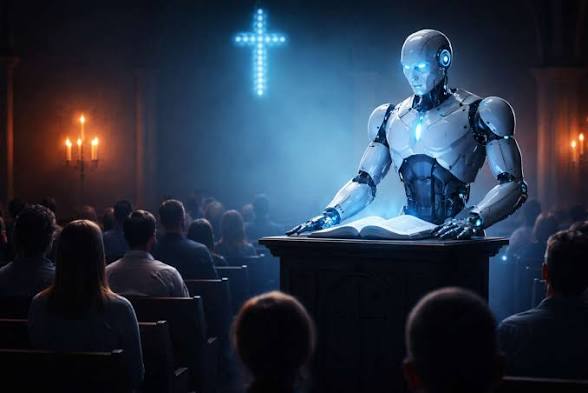
In June, the Christian Council of Nigeria and Jama’atu Nasril Islam met in Abuja and made a joint appeal: religious leaders should be part of drafting Nigeria’s national AI policy, with ethical safeguards built in.
It is a reasonable demand. Nigerians whether Christian, Muslim or even the traditional faiths place a high premium on faith as a measure of identity. Faith shapes how most Nigerians understand dignity, truth and authority, and a framework written without putting that into consideration would be incomplete.
But the demand raises a question. What do our churches require of their own pastors? I searched for a published AI-use policy from any Nigerian denomination or umbrella body, something that tells a pastor what he or she may and may not do with AI use. I found statements, warnings and encouragement. What I did not find, however was a policy. (If there is any, I would very much love to see it).

The Catholic Bishops’ Conference of Nigeria has urged caution and ethical principles, including for education. After its 2025 communicators’ conference, the Church of Nigeria (Anglican Communion) urged its media officers to embrace AI and promote digital literacy, and said AI belongs in theological training. A Foursquare Gospel Church overseer has publicly called on Christian institutions to develop responsible guidelines.
These are useful signals, but none of it is an AI policy. A communiqué cannot tell a youth pastor at 11 p.m. on a Saturday whether it is acceptable to paste his notes into a chatbot and ask for a sermon.
Meanwhile, the tools are arriving. Deeper Christian Life Ministry launched Ask Kumuyi in 2025, an AI chatbot that answers questions about and from its General Superintendent, W. F. Kumuyi’s sermons.
All over the country, Nigerian developers are building Bible and church-presentation assistants.How many Nigerian pastors already use AI themselves? While there is little data on AI use among Pastors in Nigeria, A Barna survey reported this month found that 24 percent of pastors use AI to write or edit sermons, and 94 percent believe a church should have guidelines for responsible use. Only 21 percent said their church has any, and just 4 percent said the guidance is formal.

It is a different country, but nothing suggests Nigerian pastors are shielded from the tool. The pull may be stronger in large congregations with heavy preaching schedules.What the vacuum costs
Four risks stand out. The first is accuracy. AI can produce confident, wrong theology, and a scholarly paper on AI in Nigerian church teaching flags doctrinal accuracy and spiritual authority as open questions.
The second is privacy. Pastors hold counselling disclosures, prayer requests and family crises, and pasting these into a commercial tool to “personalise” a message sends them outside the congregation.
The third is honesty. Christianity is particularly heavy on the “inspired by the Holy Spirit” part of teaching and as such a congregation is expected to believe that a sermon came from a pastor’s own time with the spirit as opposed to an LLM prompt.
The fourth is language. Machine translation of scripture and doctrine into Yoruba, Hausa, Igbo or Pidgin needs a fluent human reviewer before it travels through WhatsApp groups.
The models exist
Other traditions have started. In 2023, the Southern Baptist Convention adopted what its leaders described as the first resolution on AI by a major denomination, and in 2026 Lifeway convened Baptist leaders to produce a ministry statement for local churches. The Vatican’s Antiqua et Nova, issued in January 2025, offers ethical reflection meant partly for pastors and bishops. The Missouri Baptist Convention goes further, publishing a transparency statement that its representatives will not use AI to write sermons or Bible lessons, alongside a sample policy for churches. One congregation’s published policy requires disclosure when AI plays a significant role in a sermon.
What Nigerian guidelines should contain
Nigerian Christian fellowships don’t need to copy all of these policies for the sake of it, but Nigeria needs its own, written for its languages, congregation sizes and denominations. A workable one-page model would cover five things:
1. Tiers of use: routine tasks such as transcription, proofreading and research into commentaries; uses needing approval, such as drafting sermon manuscripts; and uses that are off limits.
2. Disclosure when AI shaped a sermon or teaching in a significant way.
3. A data rule: no names, confessions or counselling details in public tools.
4. Review by someone with theological training before AI-assisted material is published, with a fluent speaker checking local-language output.
5. A named owner and a scheduled review, because the tools change faster than synods meet.
Who should lead this AI Policy Creation?

The umbrella bodies already exist and already convene, and the Ibadan-based Institute of Church and Society has shown it can bring Christian and Muslim leaders to one table on AI. A model policy that dioceses and districts can adapt would be a start.There is also a matter of credibility.
Religious leaders cannot convincingly ask government to adhere to an AI policy in the public square while leaving the pulpit unregulated. The strongest case for a seat at the national table is a house already in order. And a pastor’s authority rests on trust, which is far easier to protect with rules written in calm than to rebuild after a scandal, whether a sermon built on fabricated claims or a counselling record leaked through a chatbot. The time to write them is now.








Leave a comment