

No single policy has defined Nigeria’s economic trajectory since 2023 more than the removal of the petrol subsidy. It is the decision on which President Bola Tinubu stakes his legacy, the issue on which the opposition is most divided, and the reality that shapes every household budget in the country. As the 2027 election approaches, the subsidy debate has become a proxy for a deeper argument about the nature of Nigeria’s economy and who it is designed to serve.

Tinubu’s Position: No Regrets, No Return
The President has been unambiguous. In a nationwide broadcast, he declared that his administration would not return to what he called “Egypt,” a metaphor for the subsidy regime he describes as a sinkhole of corruption and inefficiency . His argument is straightforward: the subsidy was unsustainable, it benefited a cartel of importers rather than ordinary Nigerians, and removing it was the only way to prevent the country from bankruptcy.
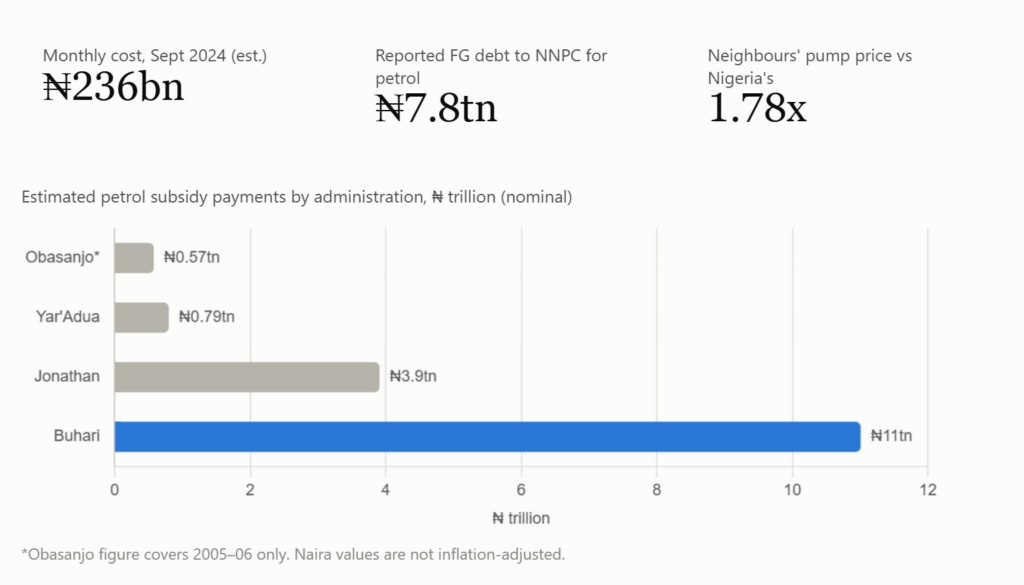
The government’s defenders point to the fiscal reality. Under President Goodluck Jonathan, the subsidy regime was riddled with fraud on an industrial scale. A parliamentary investigation in 2012 found that importers were being paid for 59 million litres of fuel per day while the country consumed only 35 million, with mismanagement and theft costing $6.8 billion over three years . The number of fuel importers rose from six in 2006 to 140 in 2011, many of them existing only on paper, collecting subsidies for fuel that never existed .
Under President Muhammadu Buhari, the problem mutated rather than disappeared. The administration failed to make provision for subsidies in its final budget, and the Central Bank of Nigeria printed money through the Ways and Means mechanism to bridge the gap. A probe panel accused the CBN under Godwin Emefiele of printing N22.7 trillion, while the federal government borrowed to pay salaries and pensions . The Senate later set up an ad hoc committee to investigate N30 trillion in Ways and Means expenditure approved for the Buhari administration .
This is the context in which Tinubu’s decision must be understood. The subsidy was not a benign intervention; it was a system of transfer from the public treasury to a network of politically connected importers. Removing it was fiscally necessary. But necessity is not the same as sufficiency, and the government’s failure to cushion the shock has become the central economic grievance of the election.

The Opposition: United Against Tinubu, Divided on Subsidy
The opposition’s unity against the subsidy removal collapses upon closer inspection. The positions range from full restoration to targeted intervention to maintaining the status quo, and the distinctions matter.
Peter Obi of the NDC has opposed a return to the old subsidy regime, arguing instead that the savings from its removal should be properly deployed. Gbenga Olawepo-Hashim, the Accord Party chieftain, placed Obi in what he called the “extreme conservative political wing” alongside Atiku, while aligning himself with Sowore and Adewole Adebayo on the left-centre .
Atiku Abubakar of the ADC has proposed what his campaign calls the Atiku Fuel Affordability Plan. His spokesman, Kenneth Okonkwo, insists this is not a return to the old regime: the plan envisages supplying crude oil to domestic refineries at a fair price, reducing production costs and making petrol affordable . The distinction is important. Atiku is not proposing to resurrect the import-based subsidy that Jonathan presided over. He is proposing to intervene in the domestic refining chain.
Omoyele Sowore of the AAC has taken the most direct position. In a post on X, he declared: “Under our government, Nigerian workers will earn a minimum wage of at least N500,000 monthly. We will also restore the petrol subsidy” . Sowore’s position is unapologetically welfarist, and it places him at odds with Obi and the more centrist opposition figures.
Seyi Makinde of the APM has said he would not return to the old subsidy regime, proposing instead cheaper domestic crude pricing for Nigerian refineries .
And then there is Peter Agada of the Young Progressives Party. Agada has taken the most surprising position of all: he would retain Tinubu’s policy. “I will stick to the gun with the present administration. We will remove subsidy the way they have done,” he said on Channels Television . Agada’s argument is not that the removal was well executed. He has criticised the timing and the absence of cushioning measures. But he maintains that the principle is sound, and that the real problem lies in how Nigeria manages its oil revenues and the waste embedded in the Engineering, Procurement and Construction system .
Agada’s position is a reminder that the opposition is not a monolithic bloc. It is a collection of politicians with different diagnoses, different constituencies and different calculations. On the subsidy question, the only thing they agree on is that Tinubu’s government has handled the aftermath poorly.
The Minister’s Challenge
The Minister of State for Finance, Taiwo Oyedele, has become the government’s most articulate defender of the subsidy removal. In a live broadcast, he laid out the arithmetic: after royalties, production costs and other deductions, the federal government retains only a fraction of the oil it produces. The figures Agada cited in his interview, though inconsistent, point to the same conclusion: the government does not have the resources to sustain a subsidy regime that consumes more than it delivers .
Oyedele’s challenge to the opposition has been direct: present fact-based alternatives with solutions, not slogans. It is a fair challenge. Atiku’s plan, whatever its merits, has not been costed in public. Obi’s argument that the savings should be “properly deployed” is a statement of intent, not a policy. Sowore’s restoration promise lacks a funding mechanism. Only Agada, among the opposition candidates, has accepted the government’s core premise while criticising its execution.

The Cushion That Never Came
The tragedy of the subsidy removal is not that it was wrong in principle. It is that the cushioning measures that were supposed to accompany it never materialised.
The prices of food, drugs and transportation have risen beyond the reach of ordinary Nigerians. The minimum wage of N70,000, signed into law in July 2024, has been eroded by inflation. The NLC has described it as a “poverty wage” and demanded a review, but the government insists the law provides for a three-year cycle . For a worker in Lagos or Kano, the debate over legal timelines is meaningless. What matters is that the salary does not cover the month.
The President’s interventions, including the Presidential Compressed Natural Gas Initiative and the Nigerian Education Loan Fund, have not reached the scale required to offset the shock. The National Social Register, which was supposed to deliver direct support to the poorest households, has been criticised for inefficiency and political capture. The bridge to prosperity that Tinubu promised has not been built.
Beyond Purchasing Power: The Structural Problem
The subsidy debate, for all its intensity, obscures a deeper truth. Nigeria’s economic problem is not merely that the naira has lost value or that fuel costs more. It is that the economy is structured to serve a narrow political and commercial elite, while the majority of Nigerians remain excluded from productive participation.
There are too many educated, skilled and unemployed Nigerians. The formal sector cannot absorb them, and the informal sector offers survival rather than advancement. Small enterprises, which should be the engine of job creation, are strangled by lack of access to credit, unreliable electricity and a regulatory environment that favours the connected over the competent.
The government has invested in small and medium scale enterprises, but not enough. The enabling environment that would allow a young entrepreneur in Aba or Ibadan to build a business has not been created. The economy remains centred on politics and the distribution of oil rents, not on production and enterprise.
If Nigeria is to become an economic giant, it must reverse its standpoint. It must move from a political economy, where resources flow to politicians and their partners, to a real economy, where Nigerians have the wherewithal through their small enterprises to determine their fates. The subsidy debate is a symptom of this larger failure, not its cause.
The Election Ahead
The 2027 election will be fought over many things: insecurity, corruption, the state of the naira, the competence of the candidates. But the subsidy question will be present in every conversation, because it is the question that touches every household.
Tinubu will argue that he took the difficult decision that his predecessors avoided, and that the pain is temporary. Atiku will argue that a targeted intervention can restore affordability without resurrecting the corruption of the past. Obi will argue that the savings have been mismanaged. Sowore will argue for full restoration. Agada will argue for continuity with reform.
None of them will say what needs to be said: that no subsidy regime, however well designed, can substitute for an economy that works. Until Nigeria builds an economy that empowers its citizens to produce, to trade and to thrive, every policy intervention will be a temporary patch on a structural wound. The subsidy is not the disease. It is a symptom. And the election, for all its sound and fury, has not yet produced a candidate willing to treat the disease.




Leave a comment