


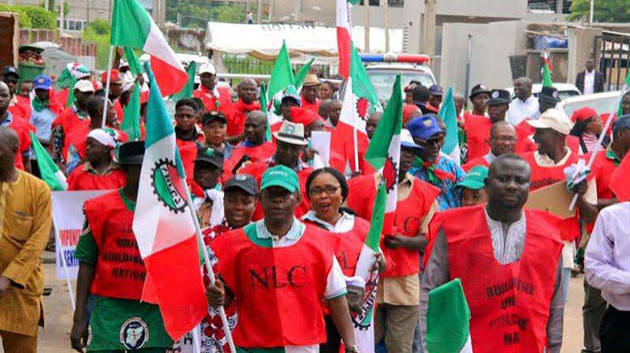
Nigeria’s labour movement has issued its most direct challenge to the Tinubu administration since the fuel subsidy was removed in 2023. The Nigeria Labour Congress has given the federal government a two-week ultimatum, demanding a reduction in petrol prices to 2024 levels and the immediate commencement of negotiations for a new national minimum wage . The government’s response has been polite, legalistic and immovable: the ₦70,000 wage, signed into law in July 2024, will not be reviewed until June 2027 . The standoff is unfolding less than three months before a presidential election, and it exposes a question that neither the ruling party nor the opposition has been willing to confront directly. What is a wage worth when the currency that carries it is collapsing?
The Legal Fiction of ₦70,000
The arithmetic of the current minimum wage is not complicated. When President Tinubu signed the ₦70,000 wage into law on 29 July 2024, petrol was selling at approximately ₦580 per litre at NNPC retail stations, with the national average at ₦770.54 . By October 2026, the NLC argues, the purchasing power of that wage has been destroyed by the relentless depreciation of the naira and the cascading cost of transportation, food and housing .
The Minister of Labour and Employment, Muhammad Dingyadi, does not dispute that workers are suffering. His letter of 12 October 2026 acknowledges the economic pressures and cites the Presidential Compressed Natural Gas Initiative and food security programmes as evidence of the government’s concern . But his legal position is rigid: the National Minimum Wage Act, as amended in 2024, provides for a review every three years. The current wage becomes due for review on 1 June 2027. Commencing a fresh review barely two years into implementation would be, in his words, “premature, inconsistent with the law, and disruptive to the orderly industrial relations system envisaged by the Act” .
The NLC’s response, drafted by President Joe Ajaero, is forensic. The union does not dispute the three-year cycle. It argues that the cycle began with the original Act of 2019, which was signed on 18 April 2019 and envisaged a review by April 2024. The 2024 amendment, the NLC contends, did not erase that timeline. Negotiations, the union insists, must begin at least six months before the existing arrangement expires. On that basis, the process should have commenced by 17 October 2026 .
Ajaero’s letter contains the sharpest line of the exchange: “The Federal Government should understand that a wage increase that is immediately swallowed by hyperinflation is not a wage increase; it is a statistical illusion” . It is a phrase that will resonate with every Nigerian worker who has watched their salary disappear before the month ends.
The APC’s Labour Directorate: Familiar Faces, Unfamiliar Task
The All Progressives Congress has not ignored labour. Its 223-member Presidential Campaign Council includes a Directorate of Labour and Union Relations, led by Governor Nasir Idris of Kebbi State, a former National President of the Nigerian Union of Teachers and Deputy President of the NLC . His deputy is Comrade Issa Aremu, a veteran labour leader and Director-General of the Michael Imoudu National Institute for Labour Studies .
The inclusion is significant on paper. Idris and Aremu are not outsiders to the labour movement. They speak its language and know its internal politics. Aremu has described the inclusion of labour in the campaign council as “a validation of progressive politics” and a commitment to the ILO’s decent work agenda . He has argued that labour issues, including living wages and pension payments, will shape the 2027 elections.
But the task facing this directorate is not persuasion in the abstract. It is the management of a movement that has spent the past two years confronting the government in the streets, in the courts and before international bodies. The NLC has petitioned the International Labour Organisation over alleged anti-union violations, including the violent attack on Ajaero in Imo State in November 2023 and the occupation of the NLC secretariat in Edo State . The National Industrial Court has restrained the NLC and TUC from protests in the Federal Capital Territory on more than one occasion, including an interim order obtained by FCT Minister Nyesom Wike in February 2026 .
The deeper problem for the APC’s labour directorate is credibility. A government that has been accused of union repression before the ILO cannot easily present itself as labour’s friend in a campaign. The presence of Idris and Aremu on the campaign council may open channels of communication, but it does not erase the legal battles, the court injunctions or the petitions. The labour movement’s intellectual and organisational weight has tilted against the administration’s policies, and a directorate, however well-staffed, cannot reverse that tilt by proximity alone.

What the Candidates Are Saying
The three leading presidential candidates have staked out distinct positions on the wage question, though none has made it the centrepiece of their campaign.
Atiku Abubakar of the ADC has proposed a “capped, budgeted production subsidy” for locally refined fuel, arguing that a N70,000 minimum wage now buys only 50 litres of petrol compared to 118 litres for N30,000 in April 2023. His campaign frames the wage crisis as a direct consequence of the subsidy removal and promises to restore affordability through a production-linked intervention.
Peter Obi of the NDC has promised to reinstate fuel subsidy after tackling corruption, arguing that “by removing the corruption, I assure you that we will bring back subsidy.” He has identified education, security and national unity as his priorities, and his campaign has focused on the cost of living as a symptom of mismanagement rather than an inevitable consequence of reform.
President Tinubu’s position is the government’s position: the wage is law, the review will come in June 2027, and the interventions already in place are sufficient. His campaign has not made labour relations a central theme, preferring to emphasise economic growth figures and infrastructure delivery. The Labour Directorate in his campaign council is a gesture of engagement, not a concession on policy.
The NLC’s Diminished Leverage
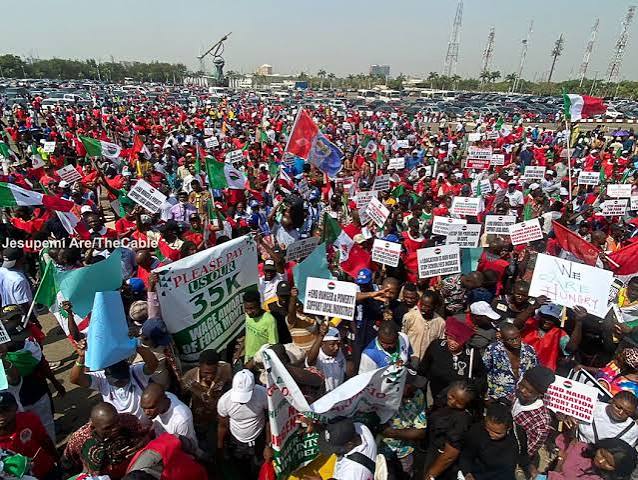
There is a harder truth that the NLC’s ultimatums cannot mask. The labour movement is not as strong as it once was. The era of nationwide general strikes that paralysed the economy and forced governments to retreat is not the present reality. The NLC’s threats of “remedial steps” are carefully worded, but the capacity to execute them is constrained by court injunctions, internal divisions and a public that has grown weary of disruptions.
The February 2026 FCT protest was halted by a court order obtained by Wike . The NLC’s petition to the ILO is a moral victory at best, with no binding enforcement mechanism. The government has learned that it can absorb labour’s pressure by acknowledging hardship, offering dialogue and waiting out the ultimatums. Dingyadi’s letter is a model of this strategy: it thanks the NLC for its “continued engagement,” recognises its right to advocate, and then refuses every substantive demand .
The appointment of NLC leaders to APC campaign councils, including the Niger State chairman in October 2026, has also raised questions about the movement’s political neutrality . When labour leaders accept partisan roles, the distinction between representing workers and serving a political party becomes blurred. The government’s allies can point to these appointments as evidence that labour is not monolithically opposed to the administration.
The Election Nobody Wants to Discuss
The wage crisis is the central economic fact of the 2027 election, and yet it is being discussed only at the margins. The APC defends its record. The ADC and NDC attack the subsidy removal without explaining how they would fund a restoration. The NLC issues ultimatums that the government absorbs and outlasts.
The question that neither the parties nor the candidates have answered directly is this: if the naira continues to depreciate, what wage can possibly keep pace? A review in June 2027 will produce a new figure, but that figure will be measured against a currency and a price level that no one can predict. The NLC’s demand for a “living wage” is morally unimpeachable and practically undefined.
Until Nigeria confronts the structural drivers of inflation and currency instability, every minimum wage will become a statistical illusion within months. The government knows this. The opposition knows this. The labour movement knows this. The silence on the underlying causes is the most telling feature of the entire debate.
The fire this time is real, but it is burning in a room that the political class has agreed not to enter.






Leave a comment