

Nigeria’s 2027 presidential race has begun to reveal its organisational architecture, and the picture is starkly different across the three major parties. One has assembled a “rainbow” coalition that absorbs its rivals. Another has stitched together a lean structure after internal wrangling. The third has only just unveiled its campaign council, weeks before the election. The composition of a campaign council should be a demonstration of organisational capacity. In Nigeria’s current political context, it is closer to a mirror, reflecting each party’s real power configuration and strategic anxieties.
The APC: A Rainbow That Dissolves the Opposition
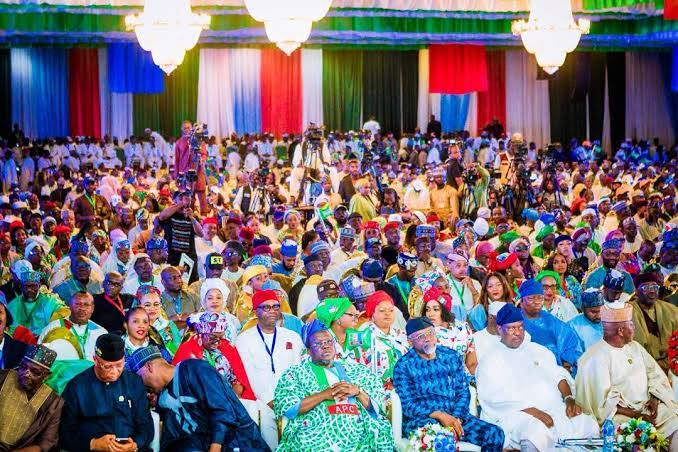
President Bola Tinubu’s All Progressives Congress campaign council was inaugurated in mid-October at the State House banquet hall. Its most striking feature is not its size but its composition. Federal Capital Territory Minister Nyesom Wike, a Peoples Democratic Party member, was named coordinator for Rivers State and the FCT. Anambra Governor Charles Soludo of APGA was handed Anambra. Osun Governor Ademola Adeleke of the Accord Party was given Osun.
The arrangement has been described by TheCable as the formalisation of a rainbow coalition. The newspaper argued that Tinubu has spent decades perfecting this craft: drawing key figures across party lines, weakening opponents from within, and converting ideological difference into negotiable political interest. It noted that Wike serving as a minister in an APC government while retaining his PDP membership and campaigning for Tinubu would once have attracted expulsion. Today it is praised as strengthening national unity. The question that follows is uncomfortable: if senior opposition figures are working for the ruling party’s re-election, in what sense do their parties remain opposition?
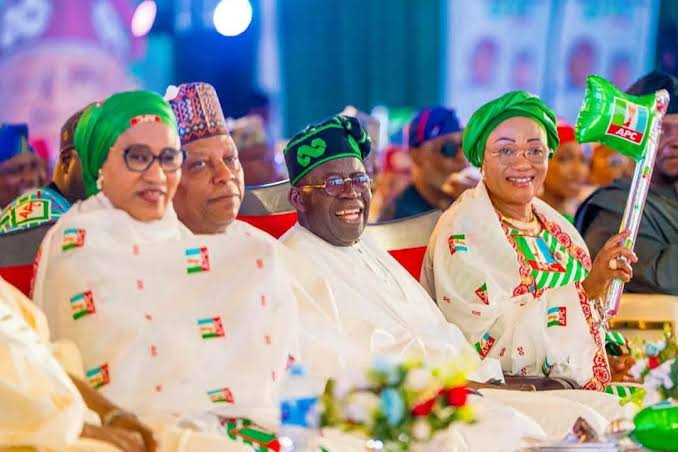
The APC structure is undeniably vast. In Niger State alone, the campaign council comprises three committees and seventeen specialised directorates covering finance, media, security, youth and women mobilisation, legal affairs and religious matters. At the national level, there are sectoral campaign structures including agro-allied and labour relations. Yet scale is not the same as effectiveness. The labour relations directorate is led by familiar names, but the Nigeria Labour Congress and the Trade Union Congress have confronted the federal government repeatedly over the past two years, from the minimum wage dispute to the consequences of fuel subsidy removal. Whether these familiar faces can persuade organised labour to accept a government it has opposed on the streets is a separate question entirely.
More significant is Tinubu’s own campaign method. He has made clear he will not tour all 36 states. At the campaign council inauguration, he said: “Nigeria needs focus now more than ever. The responsibility of this office does not pause… So you will forgive me if I don’t go everywhere with you; we have bills to pay. American creditors cannot wait.” Campaign council member Obafemi George elaborated that the President had examined the electoral map and concluded that “sustaining the gains made for Nigerians is more important than embarking on a nationwide campaign tour.” This is a strategy built on a governance record, and it is also a gamble: a bet that voters will reward delivery rather than presence. In a country experiencing a severe cost-of-living crisis, the risk of that bet should not be underestimated.
The ADC: Atiku’s Lean Structure and the Return of El-Rufai
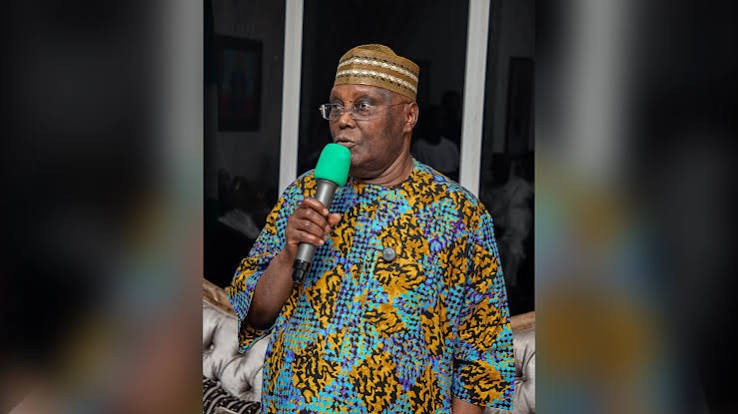
The African Democratic Congress campaign council was the first of the three to take shape, and it carries the most technocratic character. Kashim Ibrahim-Imam serves as chairman, former Kaduna Governor Nasir El-Rufai as deputy chairman, and Senator Austin Akobundu as director-general. The media and communications directorate is led by veteran journalist Dele Momodu, liaison and mobilisation by former Senator Dino Melaye, and the policy team by economist Mohammed Hayatu-Deen, with Kingsley Moghalu among its members.
Atiku’s team describes the structure as lean and people-focused, arguing that with Nigerians bearing the burden of food prices, transport costs and shrinking incomes, a campaign asking for trust must demonstrate discipline in its operations. The argument has merit, but it is also a pragmatic response to resource constraints. Compared with the APC’s sprawling architecture, the ADC committee resembles a conventional party campaign machine: a clear director-general, a policy team and a media chief, without attempting to absorb every political ally into the list.
El-Rufai’s return deserves attention. The former Kaduna governor was among the founders of the APC before drifting away from the Tinubu government. His placement as deputy chairman is both a hand extended to northern political elites and a signal that the ADC is gathering figures who have either lost influence within the APC or chosen to distance themselves. Whether El-Rufai can deliver a meaningful increment in votes, particularly in the North-West, remains doubtful. His record in Kaduna is mixed, and his public disagreements with the current government do not automatically translate into support for Atiku.
Atiku’s campaign strategy also contains an explicit commitment: he will visit all 36 states. This stands in direct contrast to Tinubu’s decision not to tour. For a challenger, it is a necessary gesture. For a candidate approaching eighty, it is also a test of physical endurance. Whether the ADC campaign council can sustain that pace depends on the actual density of its state-level structures, not on the names assembled in Abuja.
The NDC: An Argument First, a Campaign Council Second
The Nigeria Democratic Congress campaign council was the last of the three to emerge, and its path was the most troubled. In September, a support group known as the OK Movement published its own fifty-nine-member campaign committee, claiming it would operate independently of the NDC’s official structure. The NDC leadership immediately disowned it, warning that the action could destabilise the party. The OK Movement subsequently reversed its position, with its spokesman acknowledging that the list had been produced “without due process” and accusing the APC of amplifying the NDC’s internal friction to create an impression of division.
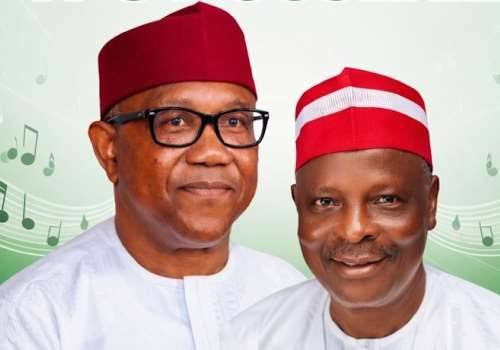
The episode exposed a structural weakness in the NDC. As a recently registered party, it lacks mature internal governance mechanisms to define the boundary between party institutions and support groups. Peter Obi and Rabiu Kwankwaso, as presidential and vice-presidential candidates, command enormous personal appeal, but the party machine is still being assembled. The eventual solution was to cede the power to nominate key personnel to Obi and Kwankwaso, including the director-general, the northern deputy director-general, the finance director and the media director. National Chairman Moses Cleopas explained the delay as “careful vetting,” saying: “This is a sensitive election and we must check character.”
The NDC campaign council will eventually be inaugurated on 20 October, less than three months before the election. For a new party that must build national recognition from a standing start, the timetable is tight. When Obi ran on the Labour Party platform in 2023, his campaign structure was relatively flat, relying heavily on volunteer networks and social media mobilisation. The NDC’s challenge is to preserve that movement energy while building a formal architecture capable of covering 36 states, coordinating agent training and managing polling-day operations. Concentrating nomination power in the candidates may speed decision-making, but it may also deepen reliance on individuals rather than institutions.
What the Composition Tells Us
The differences among the three campaign councils reflect three distinct political situations. The APC’s rainbow structure is an incumbent’s display of strength: it can absorb the elite of its opponents because power itself is attractive. The cost of that strategy is clear. When key figures from the PDP, APGA and Accord work within the APC campaign framework, the credibility of those parties as alternatives is systematically eroded. Democracy requires opposition, and Tinubu’s political engineering is rendering the opposition functionally indistinct.
The ADC’s lean structure reflects a challenger’s resource constraints and strategic choices. Atiku lacks the ruling party’s capacity to absorb rivals, so he has opted for a more conventional campaign architecture, with policy and media operations at its core. El-Rufai’s inclusion provides northern symbolic capital, but whether the ADC can build effective mobilisation networks at state level remains unproven.
The NDC’s disorder is the growing pain of a new party. The Obi-Kwankwaso pairing has cross-regional and cross-religious appeal on paper, but a party’s organisational capacity cannot be substituted by candidate charisma. The OK Movement episode showed that when formal structures are absent, supporters’ enthusiasm can become a threat to campaign discipline. Concentrating personnel decisions in the candidates is a pragmatic solution, but it also means the NDC campaign remains, to a considerable degree, “Obi’s project” rather than the collective action of an institutionalised party.
Conclusion: Who Is Really Campaigning?
A campaign council’s list can display the breadth of a coalition, but it cannot prove the depth of mobilisation. The APC has the largest structure, yet its candidate has chosen not to tour, delegating the campaign to a committee that includes several non-APC members. The ADC has the clearest policy orientation, but its candidate must bear the physical burden of 36 states alone. The NDC has the most compelling candidate pairing, but its machine is still being assembled.
The 2027 election will test a simple question: in Nigeria, are political parties vehicles for ideas and organisation, or temporary scaffolding erected around key individuals? The three campaign councils offer three different answers. The voters will deliver the final verdict at the ballot box.




Leave a comment