

By Chibuzor Alli
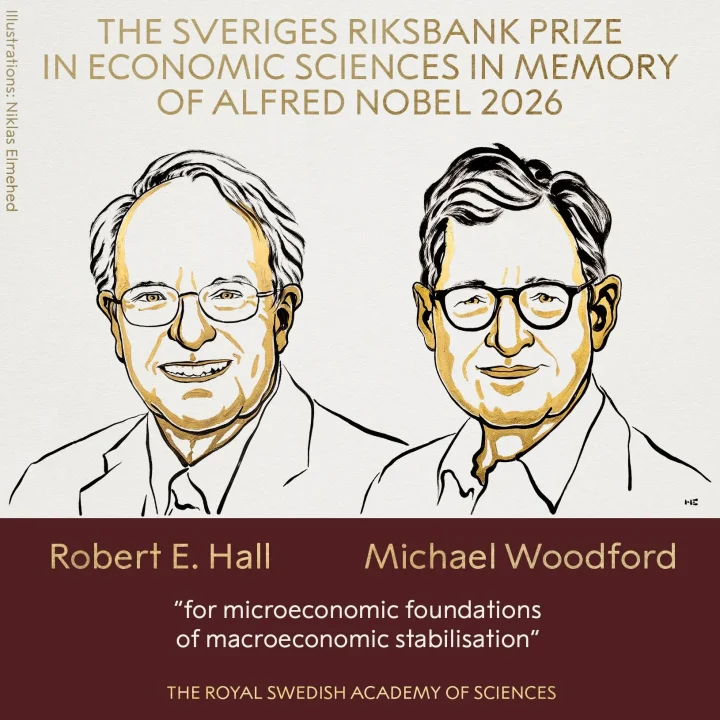
Two American economists have won the 2026 Nobel Prize in Economic Sciences for developing models that help governments and central banks manage inflation, recessions and other economic shocks.
Robert E. Hall of Stanford University and Michael Woodford of Columbia University were announced as this year’s laureates on Monday, October 12, for their work on the microeconomic foundations of macroeconomic stabilisation.
The Royal Swedish Academy of Sciences said their research had strengthened policymakers’ ability to use monetary and fiscal measures to reduce sharp swings in economic activity. The models examine how decisions made by households and businesses influence the wider economy. <Cite refs={[“turn152087search1″,”turn152087search2”]}/>
“The laureates have helped us smooth out the economy’s peaks and troughs,” the academy said in its announcement.
How their research helps policymakers
The economists’ work focuses on how people and businesses respond to changing economic conditions, including expectations about future income, prices and government policies.
During a recession, central banks may lower interest rates while governments increase spending or run larger budget deficits to support demand. When economic activity grows too quickly and inflationary pressures build, policymakers may take steps to cool demand.
The models developed by Hall and Woodford help explain how the timing and design of these interventions can influence economic outcomes.
A key principle is that households and businesses make decisions based not only on current conditions but also on what they expect to happen in the future. Government announcements and central bank communication can therefore influence spending, saving, investment and pricing decisions.
Lessons from the inflation crises of the 1970s
The research addresses weaknesses exposed during the economic crises of the 1970s, when several Western economies experienced high inflation alongside weak growth and high unemployment.
Traditional Keynesian models used to guide stabilisation policies struggled to explain and resolve these simultaneous problems. Hall and Woodford helped rebuild economic models around the decisions of individual households and businesses, rather than relying primarily on statistical relationships between broad economic indicators.
Their approach connected individual economic behaviour with wider movements in inflation, production and consumption, providing a stronger theoretical basis for assessing the effects of policy decisions. <Cite refs={[“turn152087search1″,”turn152087search4”]}/>
John Hassler, chair of the Committee for the Prize in Economic Sciences, said the research had established a foundation for economic models used by policymakers internationally.
“The laureates’ work has provided us with a stable theoretical foundation for the models that are now used by central banks and governments around the world. With them, we are better equipped to deal with shocks in the economy, such as energy crises or sudden changes in how much households consume,” Hassler said.
The academy added that the models had helped governments and central banks respond to economic downturns and evaluate the likely effects of their decisions.
Who are the Nobel-winning economists?
Hall was born in 1943 in Palo Alto, California. He received his PhD from the Massachusetts Institute of Technology in 1967 and is a professor at Stanford University.
Woodford was born in 1955 in Chicopee, Massachusetts. He earned his PhD from the Massachusetts Institute of Technology in 1983 and is a professor at Columbia University in New York.
The award is formally known as the Sveriges Riksbank Prize in Economic Sciences in Memory of Alfred Nobel. Established by Sweden’s central bank, the prize was first awarded in 1969 and is separate from the five original Nobel Prizes established under Alfred Nobel’s will. <Cite refs={[“turn152087search1″,”turn152087search6”]}/>












Leave a comment