

By Chibuzor Alli
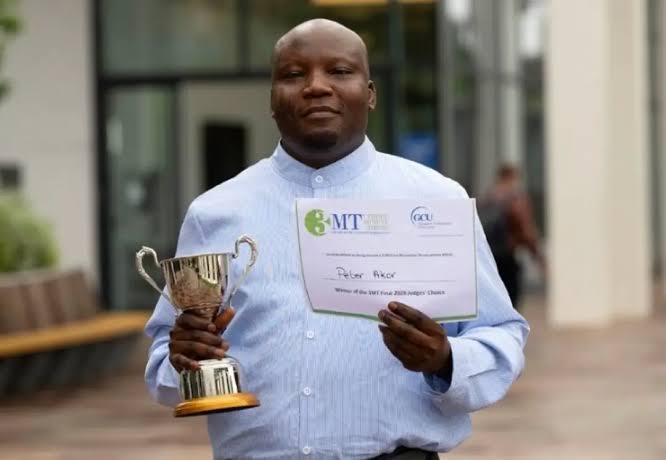
His three-minute pitch on using artificial intelligence to anticipate epileptic seizures earned him both the judges’ verdict and the public’s vote, putting a Benue-born academic at the centre of a growing conversation about technology, healthcare and African scientific talent.
In just three minutes, Peter Akor made a case for a future in which a person living with epilepsy might receive a warning before a seizure strikes.
The Nigerian researcher did more than capture an audience’s attention. At the 2026 Vitae Three Minute Thesis (3MT) national final in the United Kingdom, he walked away with both the Judges’ Choice Award and the People’s Choice Award, emerging ahead of five other doctoral researchers representing universities including Oxford, King’s College London, Surrey, Reading and Westminster.
For Akor, a doctoral researcher at Glasgow Caledonian University (GCU), the double victory was a personal milestone. For his university, it was a first national 3MT triumph. And for Nigeria’s research community, it offered a compelling reminder that scientific ideas developed by Nigerian scholars can command attention on an international stage.
The national final was broadcast on October 1, with the results announced on October 5, 2026. Akor became only the second researcher in the competition’s history to win both major awards in the same final, according to reports of the achievement.
But beneath the headlines about prestigious universities and an unexpected winner lies a more consequential story: a researcher seeking to change the way people think about epilepsy, moving care beyond responding to seizures towards anticipating them.
Three minutes, one slide and a potentially life-changing idea
Akor’s presentation carried a title that captured both the urgency of his subject and the promise of his research: “The Minutes That Matter: Transforming Epileptic Seizure Care from Reaction to Prediction.”
The idea is straightforward, even if the science behind it is not.
Epileptic seizures can occur unpredictably, disrupting daily activities and exposing people to injury. For those affected, uncertainty can be as difficult to manage as the condition itself. A reliable warning system that identifies an impending seizure could offer valuable time to take precautions, alert a caregiver or move away from a potentially dangerous situation.
Akor’s research explores how data, artificial intelligence and technology can help make that possibility a reality.
His wider research profile provides further insight into the work. In a professional post about a 2026 research conference, Akor described a wearable warning system built around two specialised models: one designed to predict early seizure risk and another to detect seizures as they occur. The models work together through a temporal state machine, with the aim of improving warning time while controlling false alarms.
The distinction is important. Predicting a seizure means estimating that one may occur before it begins; detecting a seizure means recognising an event that is already happening. Combining the two functions could potentially make a warning system more useful, provided it performs reliably.
Akor has also co-authored research published in the journal Sensors in November 2025 on deep-learning methods for real-time seizure classification on edge devices. Such devices can process data locally rather than relying entirely on remote computing systems, an approach that may be relevant to wearable healthcare technology.
These strands of work point towards an ambitious goal: developing intelligent systems that can interpret physiological signals and provide timely information to support people living with epilepsy.
However, the distinction between promise and proven clinical benefit remains crucial. The competition victory does not establish that Akor’s system is clinically approved or that it can reliably predict seizures in everyday use. Its real-world value will depend on further testing, including how early it can provide warnings, how often it produces false alarms and how well it performs across different patients.
The Nigerian academic behind the breakthrough
Akor’s story did not begin in a Scottish laboratory or on a British university stage. His academic journey began in Nigeria.
Originally from Owukpa in Benue State, he studied Electrical/Electronics Engineering at Joseph Sarwuan Tarka University in Makurdi, formerly known as the University of Agriculture, Makurdi. He graduated with First Class Honours in 2012 and was named Best Graduating Student in the university’s College of Engineering.
He subsequently joined the institution as a Graduate Assistant and progressed to the rank of Lecturer, spending about nine years in academia before moving to the United Kingdom to pursue doctoral research at Glasgow Caledonian University.
That journey adds an important dimension to his latest achievement. Akor was not simply a student discovering research for the first time. He had already spent years teaching and working within Nigeria’s academic system before taking his work into an international research environment.
His success also challenges the tendency to reduce stories of African achievement abroad to a simple contest between famous Western institutions and an unfamiliar Nigerian name. The more revealing question is how researchers develop their ideas, communicate their significance and turn scientific knowledge into solutions that people can use.
Akor’s trajectory—from engineering graduate to university lecturer and then doctoral researcher—offers one answer: sustained academic work, technical specialisation and the ability to explain complex ideas beyond the laboratory.
Winning the judges and the public
The Vitae 3MT competition is designed to test a skill that researchers increasingly need: the ability to communicate complex work clearly to people who are not specialists in the field.
Participants must explain the significance of their doctoral research in three minutes, using a single presentation slide. They cannot rely on a lengthy lecture, multiple slides or dense technical explanations to make their case.
Akor first demonstrated his ability to do this at Glasgow Caledonian University’s internal competition on June 3, 2026, where he won the Judges’ Choice Award and secured his place in the national final.
At the national event, he won over both the judging panel and the public.
The Judges’ Choice Award recognised the panel’s assessment of his presentation, while the People’s Choice Award was determined by public voting. Winning both meant that his research communication resonated across two different audiences.
His prizes include a £1,000 grant, mentorship from The Brilliant Club and a trophy for the judges’ award, alongside a further £250 grant, mentorship and another trophy for the public-voted award. The funding is intended for public engagement or professional development.
Rachel Bernasconi of the University of Surrey received the Editor’s Choice Award, selected by The Conversation UK.
The results place Akor in a rare category in the competition’s history. More significantly for Glasgow Caledonian University, his victory represents its first national 3MT win.
What could seizure prediction mean for patients?
The potential impact extends beyond academic recognition.
A dependable seizure-warning system could help people make safer decisions in the moments before an event. Someone might sit down, alert a family member, avoid operating machinery or take other precautions appropriate to their circumstances.
Caregivers could also benefit from earlier information, while clinicians might eventually be able to use reliable monitoring data to support more individualised care.
Yet epilepsy is complex, and not every seizure is preceded by a detectable warning pattern. Systems must also avoid overwhelming users with false alarms or creating a misleading sense of security when a seizure cannot be predicted.
For that reason, the next test of Akor’s work will not be how compellingly it can be explained in three minutes, but how well it performs under scientific scrutiny and real-world conditions.
Can it give meaningful warning time? Can it distinguish an impending seizure from normal physiological variation? Can it work consistently across different individuals? And can it do so in a form that patients and healthcare providers can access and trust?
Those are the questions that will determine whether the research ultimately translates into practical benefits.
Bringing the conversation back to Nigeria
Akor has indicated that he hopes to use his prize funding, subject to approval, to organise two public-engagement events—one in Nigeria and another in the United Kingdom.
The proposed gatherings would bring together researchers, medical professionals, artificial-intelligence specialists, people living with neurological disorders and caregivers to discuss how research and technology could improve healthcare.
For Nigeria, the initiative could create an opportunity to connect scientific advances with public understanding and local healthcare needs. It could also encourage stronger conversations among universities, clinicians, technology specialists and communities affected by neurological conditions.
But the broader significance goes beyond one proposed programme.
Nigeria has a considerable stake in how its researchers are supported, how scientific discoveries are communicated and whether promising ideas can move from academic papers into practical applications. International recognition can open doors, but sustained investment, research partnerships and clinical validation are needed to turn recognition into lasting impact.
Akor’s achievement therefore invites two complementary responses: celebrate the milestone, and pay attention to the work that follows it.
Beyond the headline
It is tempting to frame Akor’s victory as a story of a Nigerian defeating Oxford and other celebrated British institutions. The comparison is an effective headline, but it does not fully explain what happened.
The competition was not a ranking of universities or a contest to determine whose research was scientifically superior. It was a test of how effectively six doctoral researchers could communicate the value of their work within a strict three-minute format.
Akor excelled in that challenge.
His achievement demonstrates the power of clear research communication and highlights a subject with potentially significant consequences for people living with epilepsy. It also offers a glimpse of how engineering, artificial intelligence and healthcare research can intersect around a problem that affects everyday life.
For the researcher from Owukpa, the two trophies mark an extraordinary moment. For patients and families hoping for better ways to manage epilepsy, the more important story is still unfolding.
The ambition captured in his presentation is simple but profound: give people more information, more time to prepare and, where science permits, greater control over what happens next.
Three minutes were enough to win two national awards. Turning that promise into a dependable healthcare tool will take considerably longer—but that is where the real measure of this achievement will lie.












Leave a comment