

A Review of Molara Wood’s Indigo
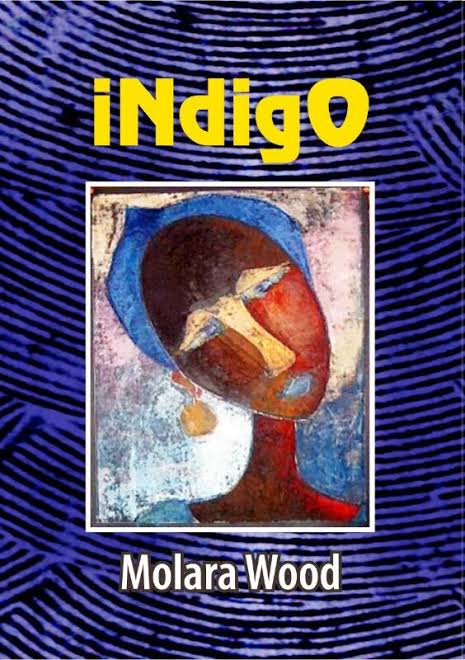
Indigo is the first collection of short stories offered by Molara Wood. It is a departure from her terrain of journalism and editorial practice in the culture space. This book of stories represents a myriad of ideas which include feminism, tradition and modernity, urban and rural interactions, diasporic realities, amongst others. It is a rare collection because the stories are deliberately orchestrated to connect to the reader in an intimate conversation that leads to a reflection on the characters, the motifs and the subtle themes.
The collection also has a distinctive poetic fervour that stems from the author’s unbundling of the Yoruba language, either as a proverb or as a transliteration. The poetry in the collection also attends to a certain internal musicality that runs in almost all of the collection. This internal musicality pulsates on the page while you participate in the happiness, sadness, confusion, conspiracy, angst, pity and joy of the characters. When reading Indigo you should also be fully aware of the metaphoric codes of place, time, names, and expressions and how they serve as metaphors or allusions to folklore, history or religion.
Molara Wood is interested in the engagements between social classes especially in domestic terrains and how government and governance improve or disrupt progress and freedom. Therefore, many of her stories are situated to reflect both socio-political and socio-cultural climates.

There is also no doubt that this collection contributes to the adaptive encumbrances and struggles inherent in migration and return. For many of the migrants in her stories, there are tensions that evoke the kinds of displacement that one would find in Segun Adeniyi’s A Life Elsewhere or Chimamanda’s Americanah. This is because many of the African migrants in her work are not only looking for greener pastures, they are also in constant discourse with the shocks of privilege, the hybridity of cultures which reflect bold elitism, and the comradeship of being away from home. In all of these, they are uncertain that they will fulfil global expectations from home.
In many stories, Molara engages patriarchy as a vehicle that forestalls the ambitions of women by men, women and culture. This exposure of the balance of participants who preserve and embolden patriarchy also speaks to the bold but subtle nature of Molara’s position on feminism. Her stories do not always give victory to the women but there is always the devil in the details fiddling with the choices that culminate into disasters or triumphs.
The author thrives in shorter stories than in the longer tales in Indigo. This is because the short story sub-genre gives ample room for the impatience of cosmopolitan life. Therefore, several attempts at creating complex or layered plots are an anathema to the reader of short stories.
These are some of my analysis of selected stories in Molara Wood’s Indigo, thus:
A Nigerian couple is comfortable with their western lifestyle while in London in ‘Indigo’. They stave off childbearing to relish their companionship and avoid the chaos that comes with childbearing. When they return home, they are shocked to realise that procreation is an essential marker for marriage. In fact, in the market of an African life, children are expected resonances of the years of companionship, without which there is no continuity and acceptance. The stigmatisation makes Idera, a ‘compromised’ Londoner, to seek African Traditional Religious help despite her extensive wealth of western knowledge. It took the fear of loneliness and ostracism to jolt the couple, Jaiye and Idera, out of their self-denial and silences emboldened by their western ways. This speaks to the powerful influence that communalism engages despite the fact of Afropolitanism.
Gani meets his match when he impregnates and marries Clara, a younger, educated woman in ‘Gani’s Fall’. His enduring first wife collaborates with Clara to disempower his ego. Sariatu, the first wife, also informs us about Hafsanat, a cousin of her husband, who despite her past disappointment with the patriarch, joined ranks with them to mete out the same bitter pill to her fellow women. This showcase of characters helps the reader to discover the imbalance of opportunities inherent in society for both genders. The story hints that it would take a lot of ‘rebellion’ or a non-conformist stance from women for them to pursue their dreams. The different backstories that led Sariatu and Clara to marry Gani also embolden or disempower the negotiation powers of both wives.
‘Night Market’ is nuanced with the folkloric superstition about make-shift markets at night. It also explores the high rate of unemployment caused by rural-urban migration. For Adigun, a former Sango priest, his sojourn to the city became necessary when his heritage, religion and craft were burnt down by intolerant Christian Pentecostals. Adigun acknowledges the great contributions of Christianity in the same space, but laments the new wave of Pentecostalism which has caused an anathema to the balance of both worlds. Despite the extensive jeopardy of infrastructural underdevelopment and lack of ample opportunities in the city, Adigun was able to reach within his ancestral depths to help an African-American woman from post-partum trauma enhanced by the ‘Night Market’ superstition. By reconnecting to the limitless vortex of his heritage, he also helped her find the home within her being by resolving the ‘middle-passage’ crisis that often burdens many African-Americans.
While ‘Kelemo’s Woman’ speaks to the subject of choice, it also reflects on the grim realities of military interregnums, and how Iriola used her body to subvert tyranny and survive. Iriola was quick to realise that her life was at stake. She was not prepared to stretch her loyalties to Kelemo, her activist fiancé, towards destruction. The story also informs us of the terrible and brutish state of our democracy which eroded legitimacy and gave room for military coups. The activist in this story was also hounded by the manipulative legal powers of civilian government to stifle the human rights of the voices of the people. There is no doubt that this story stretches its meanings beyond the year of publishing, as similar realities still happen in our socio-political clime.
‘In the Name of Job’ is one long story where Molara Wood succeeds in bringing the nuances and the layers together. The beautiful story explores trauma, escapism, convenient marriage for citizenship, loneliness, and the haunting childhood experiences that cause divisions, distances and gulfs that memory relentlessly reminds us of. In summary, the story tells us of the toxic husband and lovers of Emily Tarquin. These toxic men contributed to disrupting the family, creating hatred, and heartbreaks, so much that when Job Tarquin marries her, her heart and mind are already damaged by the trauma that packs into London from Nigeria.
The crux of ‘Smoking Bamboo’ is that men and women are meant to shape society for the better. The absence of one, in this instance, the men in largely equitable numbers to the women will likely lead to depression, frustration and disgrace. While continuity is a major issue in the story, happiness and love take centre stage. In this story filled with symbolism and metaphors, we are brought in contact with the people who live on the lower, dark and wet rung of society and how it reduces them to weakness and escapism. We also encounter the bright, energetic presence of Angelica, and how the prized city jewel calmed the nerves of ‘Bros’ and lighted up the village of depression. Unfortunately, she was reclaimed by her former lover and this led to the return of sorrow in the village. As much as this story can be engaged from several prisms, what is clear is that amidst the tough conflict of stereotypes, the positive forces of men and women are meant to make the earth a better place for all.
‘Leaving Oxford Street’ and ‘The Last Bus Stop’ are migration stories that reveal the privileges of being born on British, American, or Russian soil. However, these do not extricate you from the racism or the discrimination that is meted out to owners of Nigerian (African) passports. As much as being abroad eliminates the social privileges and largely eliminates the tribal tensions, the elitism of many diasporans reflects in their perception of themselves as the crème of African society. The cosmopolitan centres like London, Paris, and Lagos, and the experiences of these spaces are told as if the distance between them is shrunk by modernity. Nevertheless, while the modernity in London thrives on the promise of potential growth, the cosmopolitanism of Lagos and Abuja speaks of struggles of parents (who continue to support them until they become economically stable) and dependants who await remittances from struggling diasporans. In the West, all dreams are valid—for Maryam and many others, but racial prejudice and the legality of one’s stay may stand in the way of one’s dreams. While we all lay claims to successful Nigerians as an escape from our personal and collective failures, the tragedy of the migrant is even more profound, as they fear that they may not become successful and regarded as those who have subverted the systems at home to become celebrated and rich people.
‘Free Rice’ is a prelude to ‘The Scarcity of Common Goods’. These stories explore poverty of social and economic dimensions—including the scarcity of husbands. It also compares the way of life of the rich and the poor especially as it relates to funerals and trauma. The story perhaps envisages that scarcity of companionship, amongst other things, will lead many to begin to live in shared enclaves in peace and harmony with one another. There is also an interesting reflection on the use of someone’s family secret to defend oneself when there is need to emotionally blackmail someone for economic gain.
Molara Wood’s Indigo is a splendid collection of stories. As much as it is a first collection, it is a prolific reference to excellent creative writing. It takes a lot of concentrated creative energy to produce a work that reopens the familiar tropes in dimensions that refreshes one. Molara’s unique voice is a rich tapestry of culture, folklore, history, and a grasp of the currency of discourse without losing touch with the story. None of her stories reek of the language of journalism; instead they speak to the poetic excellence of a storyteller who has quietly practiced her craft by listening to tales, observing from a vantage point and rewriting the story from time to time.













Leave a comment