


From hawking on Lagos railway lines to building a Dubai-based media platform, Jeremiah’s Musa journey symbolises sacrifice, perseverance, pursuit of purpose and reinvention. He tells Chidera Okoro about how his persistence drive to defeat poverty shaped his rise from street survival to global recognition and impact-driven media entrepreneurship. I hawked on Lagos Streers, before success, he said.
Tell us about yourself.
I grew up in a family of seven siblings, and with my parents, we are nine. I was born in Lagos, although we had a short stay in Ogun State, but obviously, we moved back to Lagos. My dad was a police officer. I’m a media entrepreneur, a co-founder of the Bit Gazette. I’m currently a PR expert in Dubai and the Middle East.
You came from a family of seven children. What position are you in among the children?
I’m the third of seven children, and also the first male child.
Can you take us back to your childhood days in Lagos?
It was tough growing up in a family of a civil servant. The father was basically the only one working and making money. It was tough, having to take care of seven children, including my cousin, who was also staying with us. So, we all relied on his meager salary. Unlike now, when the police’s salaries are getting better a bit, back then, it was really tough because the salaries were awful. We enrolled in public schools back then. It was a public school, and it was like a privilege to be honest because we used to go to school barefoot, and there was no backpack to carry our books. We use polythene bags to keep our books and pens.
However, the dreams stayed real. Going and coming back from school without shoes was a tough thing to do at the time. Going through such conditions, school didn’t really interest us because we had to walk all the way to and from school, and that was not the only discouragement to education that I had. I see young kids saying school is a scam and that it is not the way out.
I always feel like if you had the conditions I had, you wouldn’t even want to go to school. You would have all your kids in the world not to go to school because we had no shoes, no proper meal, we had to walk a very long distance to get to school, and the school itself was terrible. I mean, the rain would fall on us, no seats or chairs. I don’t want to call the name of the school now, but it was the biggest public school somewhere in Agbado, Ogun State. The roof was leaky, and there was no seat for us. If I was lucky, I would find a window space to sit.
So, I was probably always targeting to sit by the window to at least eavesdrop or hear something that the teacher was saying, and school was not interesting to me. It was always a challenge every morning knowing that we had to face the same problems. It was a bit stressful sometimes, and then getting to school and not finding a seat. The teacher would teach and not even care about those who could hear them or not.
Obviously, it was a public school, so what did we expect? It was really crazy most times because back in the day, there was nothing like pity. You got flogged for every mistake you made. When you came late to school or made a mistake in class, you would get whipped. It was just demoralising going to school, and there was absolutely nothing interesting about school, so I had all the reasons and excuses to not want to pursue education or just come home and join the guys on the street doing all sorts of things, but none of that happened.
Apart from the school experience, we had to go home and hawk again after school. I used to hawk at Agbado Crossing. Before the new train system came, it was the locomotive trains back in the day, so the rail station was where I hawked pure water because my mum had a milling machine where you could grind tomatoes and other stuff, and it was running right there.
Of course, I would always support her by hawking pure water on the railway line. Sometimes, it was so crazy that even when there was a clear sight of the train approaching, I’d quickly have to get my money off someone who had just bought something. I risked my life within seconds just to run off the rail. Sometimes when the train stopped, one had to move to the next place. But, because the distance between you and the next turn is so far, you have to crawl under the train, risking your life, to reach out to your next customer. These were the challenges one had to go through.
Somehow, we managed to keep the hope alive, and today, we can look back and say, the journey has been worth it. Of course, by giving back to society, by supporting young chaps, young talents, and also trying to ensure that no one drops out of school. I will always look at what I can do about it, or maybe if I can’t take charge of the entire thing, I can reach out to one or two people who can support. I’m doing that because of what I’d also been through. Sometimes your vision or career is just overwhelming. It’s a pipeline to get what you’re calling. Your calling is not one little thing. It is shaped by some of your experiences and all the difficulties you’ve faced in life. That’s where the calling really comes from.
Did you ever believe that the situation was going to change?
No. Back then, it was almost impossible to believe. But there was something really important to note because I was born in a Christian family. So, there was this pastor of mine who was our resident pastor back in the day at the Assemblies of God Church, Agbado. He was a very fine blend of a motivational speaker and a clergyman. He understood life and had written books. He knew the principles, the ways, and all the things that one could apply in terms of principles and success. He was always teaching us at Bible study.
I mean, he wasn’t the typical pastor who would preach salvation all the time. He was also very big on principles of success, ways to succeed, how poverty eats up the family, and how to avoid it. I would pay attention every time I had Bible study in church services. Those rules he shared with us during Bible study were the starting points, and it was a beautiful approach as a child growing up.
What turning point made you believe that your life had taken a completely different direction from what you experienced in childhood?
It was actually when I got admission into the Nigerian Institute of Journalism in Ogba, Lagos State. After I wrote WASSCE, I did the Unified Matriculation Examination, now Unified Tertiary Matriculation Examination (UTME), five times. I left secondary school in 2006 and got admission into NIJ in 2011. That was going to be the last UME I was going to take because I had decided that if I didn’t make it that year, I was probably going to give up on education. I was actually giving up already, to be honest. I wasn’t giving up. There was one boy named Taofeek in my neighbourhood then. He was a friend of mine, and we were just having this usual conversation one evening. So, we were sitting with this guy, and he wasn’t even educated. He was a bricklayer, I remember, and he said to me, “Why are you giving up? You know that if your dad dies today, it’s all over for you. If you lose your parents, or if your dad dies, or your grandmother dies now, you can’t succeed. You have no chance to go to school anymore. So, now he is still alive, don’t give up. Keep trying.” That was it, and I was like, “That’s true. So, if dad passes away now, I have no chance at education anymore.” How about I just try one more time, and give it one more shot to see what would come out of it. That was when I applied for the fifth UME, which got me admission into the NIJ. That was where it started when I got that UME. I was already giving up because I had gone for different post-UME in Akungba, Oyo, Ibadan, and other cities. Maybe if they had known that I was this talented and would also go this far, perhaps they would have had me. But no one did. No one got me admission. So, I was also good enough that after the fifth UME, another friend came through. It’s been like a journey because friends have been helping me, and that’s why I always tell young people to play to make the right friendships and connections. Your friends have a very strong bearing on how you go through life. So, another friend came through for me, but it was a female friend. I was sitting there, frustrated as usual. She just walked in and said, “What’s wrong?” I said I did not know, and she asked if I took the last UME, and I said, “Yes.” She then said why didn’t I get a form for NIJ and I said, ” What’s NIJ?” She explained to me and told me the amount for the form. After that, I went to my dad and got the form. I realised I had to meet up with my UME score. We did all of that, and after the interview, the post-UMEs, and all the admission routine, she was denied admission, but I was admitted. So, it occurred to me that she probably didn’t go into the NIJ because she had a role to play in my life. It wasn’t for her. She did go to the NIJ and bought the form and ruled that she didn’t get admission, and after that, she didn’t try anymore. She explored other avenues, but I went through and was admitted.
You have a pattern of having breakthroughs, especially after being frustrated. How do you feel about that?
I just felt like that was how life was. I felt like when you’re giving up, you just need to keep fighting until you scale up. Right now, it has also taught me something in this life: nothing falls in your lap. From day one of my life, I fought for everything I got. Nothing has ever been given to me. No one has ever said he got promoted because I gave him the privilege or I helped him. Coming from where I came from, no one got a chance on the streets or in the ghetto.
Among all my friends back in my neighbourhood today, apparently, I’m the only one who has been able to fight this long and has been able to do something with my life. I’m even very scared to go back to where we used to hang out. So, I don’t know if the guys would still like to see me again because it’s been a huge lacuna in space in terms of how far one has gone. Nothing has been given to me. I’ve had to fight through hunger and sacrifice.
There was a time when I went to the NIJ, and I was planning for my Higher National Diploma, so I had to do a year’s internship at African Independent Television. Of course, it was no fun because there was no money. I’d ride a bicycle from Adiyan to AIT RayPower FM, where I worked for free every day because I didn’t have transport fare, so that bicycle was my only way of commuting. I know a lot of people who got internship placements but didn’t go for it.
Perhaps their cases weren’t as bad as mine. Some of them would say they couldn’t work for free, but I worked for free under terrible circumstances. I worked for Daar Communications PLC for free for so many years because I enjoyed serving. I enjoyed having a platform that could hone my skills. I enjoyed expressing myself. When you have a passion for something, whether or not you’re paid for it, you’ll enjoy doing it because the passion just looks for a way to express itself. You can’t have passion for something, and you want someone to tell you to do it before you do it. The passion itself makes you unsettled because you want the passion to express itself. You don’t feel that peace.
So, even if there were no bicycles, I would have walked all the way from Adiyan to RayPower FM every day to discharge my duties and serve them free of charge. After my final year, I was employed directly by Daar Communications PLC, even without certificates. The sacrifices of years paid off at the last minute because at that point, someone resigned from their role, and there was an opening.
So, before they would put vacancies out, they would look inwards. So, they saw who had been serving them for many years without being on the payroll. They decided to try me out, and I did better than the previous person who resigned. That was the only way I was able to pay back the debt I owed to the NIJ when I was studying there.
So, those sacrifices paid off. If I hadn’t done the internship, struggled under the rain, sunshine, riding a bicycle, walking to the AIT, just sacrificed and showed up on a daily basis, that was my springboard that fast-paced my Journalism career. However, nowadays, it’s quite different. I’m not sure young people still want to sacrifice anything, take the pain of working for free, because many things have changed.
How did those childhood experiences shape your mindset today?
Today, I’m a soldier. My Executive Assistant can testify. I just want the job done. It’s going to cost me my sleep and comfort; I don’t care. Those moments have shaped me into a soldier.
They’re like the on-the-field training I needed to weather the storms of life. I’m no longer wearing soft skin, although I may have a soft face and outlook. No challenges can change my resolve. When I’ve resolved to do something, I won’t rest until it’s done. And when I have challenges, I just laugh because I’ve faced worse. There were times when I didn’t have a chance. I was a write-off. There was nothing that was expected to come out of my life, but I have come this far, so no challenges can change me.
How were you able to transition from content writer to an owner of a cryptocurrency-focused news platform?
When I moved to Dubai, my priority was survival, so I started out as a content writer with different companies. At the time, I didn’t fully see beyond that role until a marketing director challenged us during a meeting. He pointed out that while content writers and copywriters often share similar skills, the difference in their earnings is significant. That moment made me realise I needed to aim higher and not settle.
I decided to transition beyond content writing into Public Relations, which I see as applied journalism using storytelling to shape and manage reputations. I took courses in PR, even though I had doubts about getting a job without experience.
Eventually, I secured an interview at a PR agency in Dubai. During the process, I relied heavily on my journalism background, especially when asked to write a press release. I was fortunate to be hired, even earning more than the PR manager at the time due to my perceived potential.
Despite the opportunity, I approached the role with humility, knowing I still had much to learn. I treated it like an internship, going the extra mile daily to understand the industry and build my skills. That dedication paid off, and I later moved to a better-paying role.
My transition into cryptocurrency and Web3 came while working as a crypto news writer. I handled multiple responsibilities, including managing the website and coordinating content. At some point, I realised I was doing much of the strategic work behind the platform. That sparked the idea to build something of my own.
Using the skills I had acquired, I created The Bit Gazette as a side project. I consistently published content, even funding writers from my own salary to keep the platform active. Over time, it grew from a one-man effort into a small team, and the visibility increased as search engines began to recognise the platform.
Eventually, my employer discovered my side project and let me go, but I wasn’t discouraged. By then, I had built something sustainable and was ready to focus on it fully. It wasn’t the easiest or most conventional path, but given my background, I had to take bold steps. I simply leveraged my skills, stayed consistent, and created an opportunity for myself.
Did your early struggles in life in any way influence the kind of opportunity you currently provide for people?
Absolutely, I felt like I was going to hire Nigerians and give back to society. That’s why The Bit Gazette hires Nigerians. Although we had some Pakistanis, Indians, and some other nationalities, primarily, it’s all been Nigerian. The editors, writers, and authors are Nigerian. And most of them had never worked for an international platform.
In fact, most of them never even worked for a proper news platform. So, what I do is to train, mentor, equip, and then send them off to work in the end. Something has shifted my perspective growing up. There was a time I was really struggling back then.
There was a point when I had nothing and no money to eat. So, there was this man who used to work somewhere. I reached out to him to help me with N5000. The normal thing people do when they’re broke. He was like, “Okay, Jerry, I’m going to give you N10, 000 now. But I have a little job opportunity for you. You’ll manage my social media for me, and I’m going to pay you N10, 000 in advance. The salary will be N10, 000 every month, so I’ll pay you after three months N30, 000. I’d give you the N10,000 initial payment now because you need money.”
That boiled down to nothing is given you still have to work, but these days, someone comes to me and asks for a favour, and I’m like, can I place you on an assignment, and I’ll just give you an advance now. But they will say no.” They want freebies; free money. So, I worked for the man for like a year. Of course, he gave me N10, 000 in advance salary because I needed the money. Somebody is giving you a job, and you’re saying no. Do you really need money, or you’re just being lazy?
So, because of that thing, it taught me to also try to not just give money to those people, but use it to inspire them to work. I just train and put them on because it’s best to just empower them rather than give them handouts. That’s my way of supporting those on the street. So, as long as you can write, you can excel in writing, and the rest is easy. I may not give N1million monthly, but I train and support them to get something more.
I have many writers who have left me today to work in bigger places, yet I didn’t remove their names from their bylines. Their bylines are their bylines still today because I can’t expect them to still work forever. It is not possible. But if there’s any support I need to give them right now, I make sure I do it because I know what it feels like not to have a dime you’re receiving in Nigeria.
Was there a moment in school that you would never forget?
At the NIJ, my father could only pay for two semesters, and from the third, I struggled with school fees. After his retirement, there was no money, and I had to borrow from many people, often taking from one to pay another. I ended up owing several students from my third semester to my final year.
On the day of my last exam, those I owed confronted me in the hall, insisting I repay them since it was my final paper. Some had even involved female lecturers. The people I owed came to the exam hall, and insisted that I must pay up their money because it was my last paper and they might not see me again in life.
They had gone to gang up with some female lecturers because they were mostly women. That’s why I used to say that without the women, I probably wouldn’t have come through. Whilst in school, women supported me a lot. Some supported by giving me money, some would borrow from me and ask me to pay them back later. But the ones I was unable to pay back were the ones who conspired with lecturers, and came to do ‘parapo’ on my head.
On my last paper day, two lecturers confronted me, saying, “We’ve heard about you. You are a serial debtor, and you must pay before you write this paper.” It felt like everything was closing in on me. Then a male lecturer, Mr. Boyeola, stepped in and asked what was going on. After listening, he said that as far as the school was concerned, I had paid my school fees and was eligible to write the exam. However, he added that I would not graduate or receive my certificate until I cleared all my debts. He instructed that I would sign an undertaking in his office to that effect. That moment stood out in my life because he stood up for me when it mattered most.
After the exam, I went to his office with the students I owed. I couldn’t say much because I was truly indebted to them. I listened as they expressed their frustrations. I had been borrowing money from my first day in school, so I had no defence. But the lecturer said something that stayed with me. He noted that students with such stories often turn out to be successful. At the time, I didn’t take it too seriously, even though I knew I had the determination to succeed, but lacked the privilege. That experience became a defining part of my story because someone believed in me when I had nothing.
Last year, I made a personal commitment that if things improved for me, I would return to my alma mater, NIJ, to support students struggling with school fees. When that breakthrough came, I fulfilled the promise by paying the fees of a student who was about to drop out. Working with the student affairs office, I ensured the support reached those truly in need students on the verge of deferring their education.
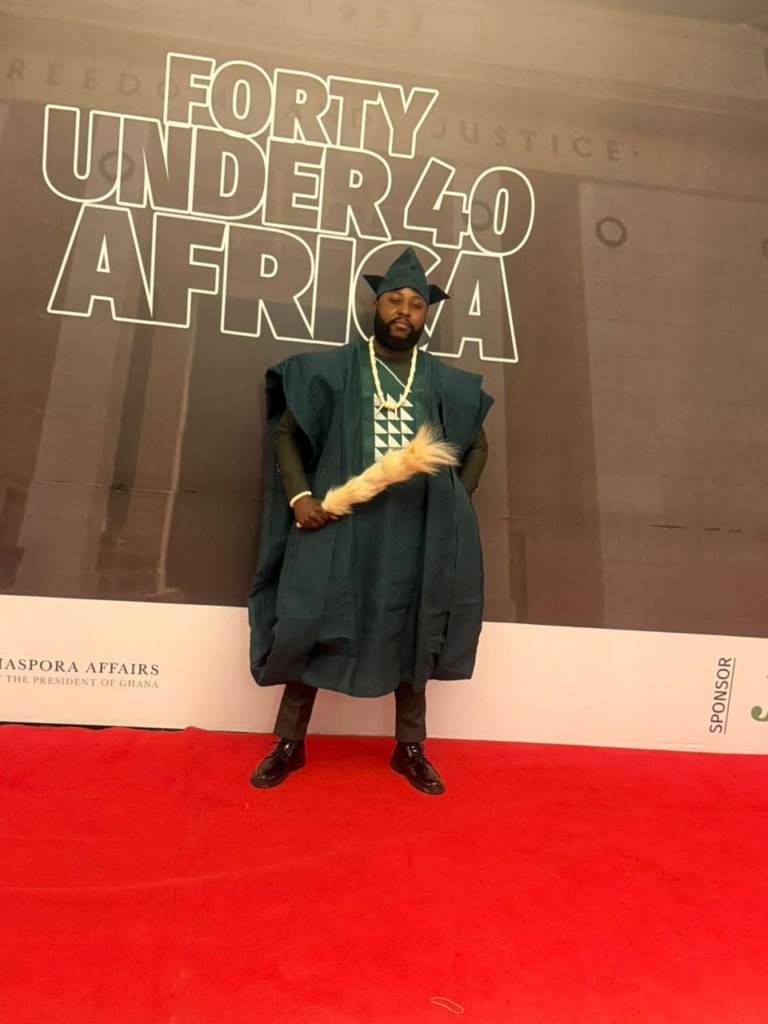
That moment brought me deep fulfillment. Hearing the gratitude from the student’s family moved me to tears because I had once been in that position. Since then, I have resolved to sponsor at least one student every year, as long as I am able. I have also extended this support beyond Nigeria, assisting students in Ghana during a visit for the Forty Under 40 Awards.
For me, giving back is personal. I want to be a source of hope and joy to others. Those who knew me during my struggles can relate to how far I’ve come. I strongly believe that if more people support students in their former schools, many young people would not have to abandon their education due to financial challenges.
You recently received the 40 Under 40 Africa Award. How was that moment like for you?
It meant that after all the struggles I have faced in life, there was a form of global or continental recognition. I knew I didn’t achieve it alone, as it is rare for someone with my background to receive such an honour.
I dedicate it to every Nigerian child struggling with school fees and the less privileged. It is the biggest award I’ve received. It feels fulfilling because it came not just from being a PR specialist or journalist, but from empowering others and giving back. At a place of service, there is always a reward. God, nature, and life have a way of giving back.
As someone who hustled from the streets to become something in life, what does success mean to you?
Success, I’ll say, is relative. For me, success means having the ability to ensure there are no kids in Nigeria who can’t go to school because of school fees. That’s my biggest goal right now. My mum is Igbo, who used to make a delicacy made with fried coconut with boiled corn, and sell them inside nylon. So, I was a serial hawker, and for anyone hawking now or going through some challenges or difficulties, it’s not the end. That’s not the destination. It’s probably just a phase you are passing through, so keep up the fight.











Leave a comment