

No Food, No Nation
The Federal Government has restated its commitment to transforming Nigeria’s agricultural sector from a subsistence model to a wealth-creating, industrialised economy. Speaking at the 48th Regular Meeting of the National Council on Agriculture and Food Security in Enugu, the Permanent Secretary of the Federal Ministry of Agriculture, Dr Marcus Ogunbiyi, emphasised that the focus must shift beyond merely increasing food production to building value chains that support industries and create jobs. The policy priorities include developing commodity value chains for rice, cassava, maize and livestock, strengthening market access, and leveraging the African Continental Free Trade Area.
This policy announcement comes amidst a severe cost-of-living crisis. While Nigeria’s headline inflation rate dropped to 14.63 per cent in September 2026, the lowest level since October 2020, food inflation remained stubbornly high at 19.59 per cent. This divergence between headline and food inflation is critical. It means that even as general price pressures ease, the cost of putting food on the table remains a daily struggle for millions of Nigerian households. Atiku Abubakar recently described the situation as crushing, noting that food and transport have become unaffordable for millions.
The government’s proposed shift toward agro-industrialisation is theoretically sound. Nigeria has long suffered from a paradox: it produces food but still suffers from high food prices due to post-harvest losses, poor storage infrastructure, and a lack of processing capacity that forces farmers to sell raw commodities at low prices while consumers pay premiums for processed goods. If implemented effectively, value chain development could stabilise food prices, reduce import dependence, and create employment for the youth. The focus on AfCFTA is particularly significant, as it opens regional markets for Nigerian processed agricultural goods, potentially transforming the sector from a domestic survival mechanism into an export-oriented economic driver.
How Insecurity Has Sabotaged the Food System
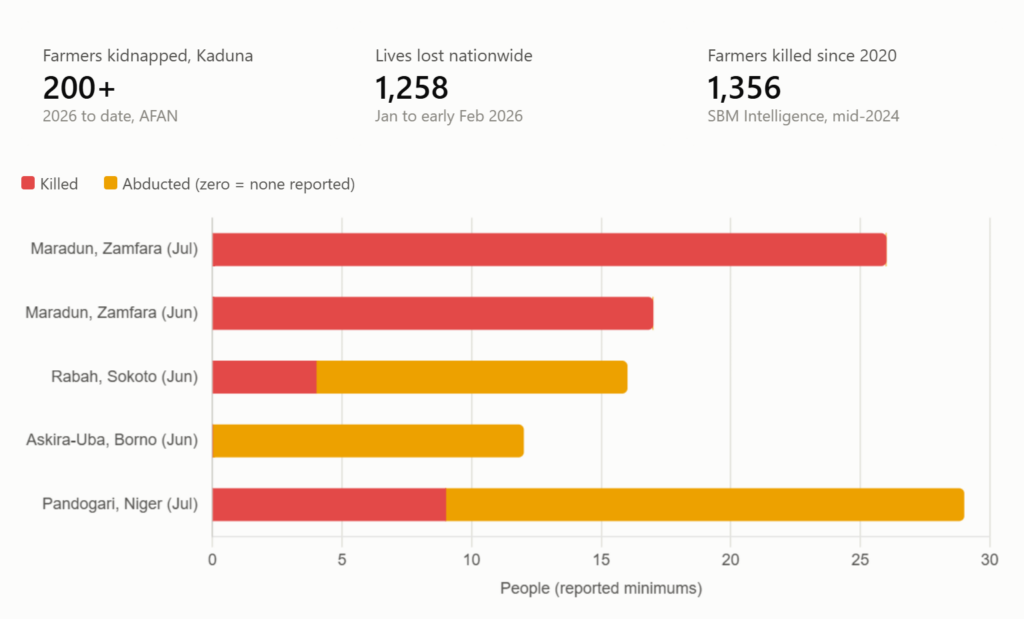
The policy’s success, however, is not merely a question of value chains and processing capacity. It is fundamentally a question of whether farmers can safely reach their fields. The evidence from 2026 demonstrates that insecurity has already inflicted structural damage on Nigeria’s food system, and no amount of agro-industrial policy can compensate for farmland that cannot be cultivated.
The geography of the crisis is precise. Conflict is severely disrupting agricultural activities in Benue, Borno, Kaduna, Katsina, Niger, Plateau, Sokoto and Zamfara states, where key cereal-producing areas are located . These are not marginal territories. Benue has long been regarded as the Food Basket of the Nation. Plateau and Kaduna supply maize, yam, rice, cassava and vegetables to markets across the country. Niger State’s grain corridors feed the Middle Belt and beyond.
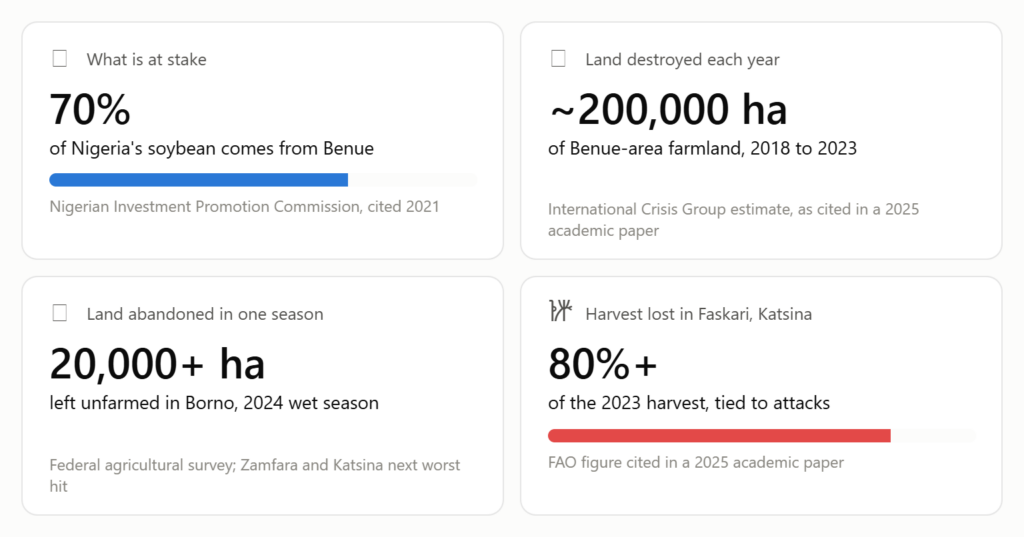
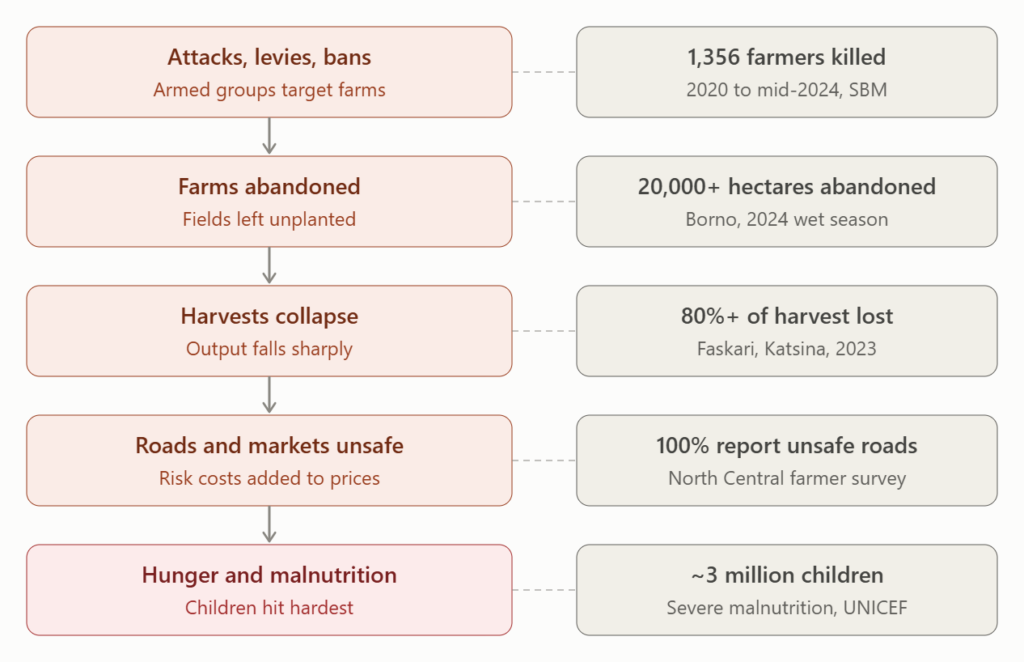
Attacks by non-state armed groups have constrained access to farmland, while their imposition of levies and cultivation bans has forced some farming households to reduce the area planted or suspend agricultural activities entirely. In the worst-affected local government areas of Borno, restricted movement prevents households from reaching farmland and markets, driving large food consumption gaps. Across much of northern Nigeria, Crisis outcomes are expected to continue through January 2027 as conflict disrupts livelihoods, market activity and main season cultivation.
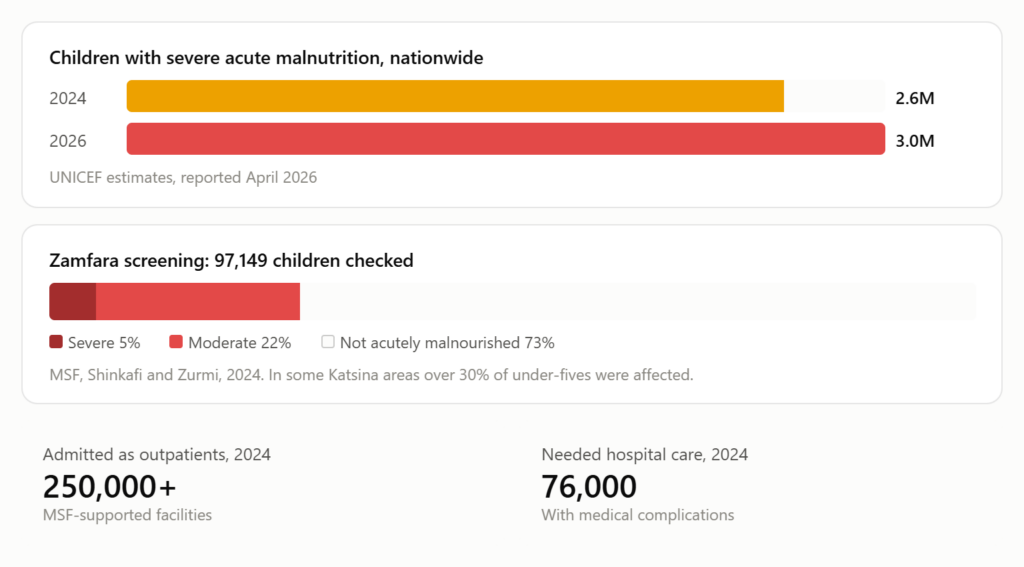
The figures quantify the damage. As of August 2026, nearly 36.3 million people were estimated to face severe acute food insecurity during the June to August lean season, including about 2.1 million in Emergency conditions and approximately 10,300 in Catastrophe. This represents a deterioration from 2025, when more than 30.6 million people faced similar conditions, mainly reflecting the effects of escalating conflict. Over 3.7 million people were internally displaced nationwide, with about two-thirds located in Borno State.
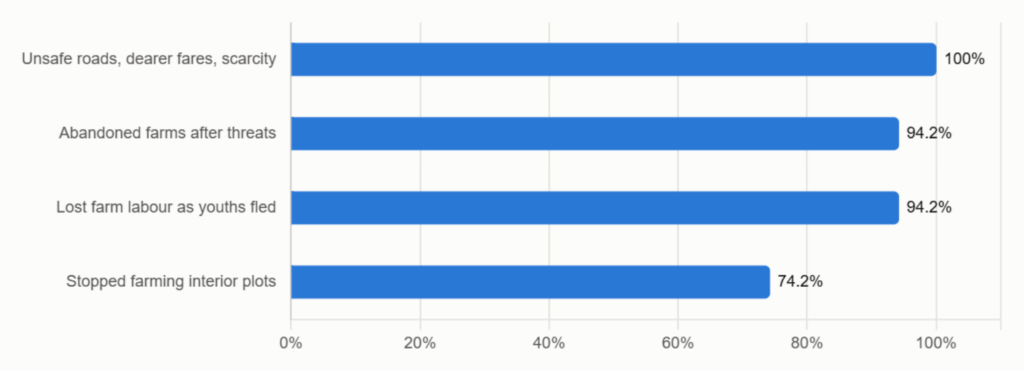
The transmission mechanism from insecurity to food prices is direct and observable. When farmers abandon fields in Benue, output falls. When bandits impose levies on rural communities in Zamfara and Katsina, the cost of production rises. When transporters avoid certain routes unless security escorts are provided, risk charges are added to the price of every bag of maize that reaches Lagos or Onitsha. Traders in northern and central markets have cited insecurity, transport risks and reduced harvests as major causes of surging prices for beans, rice, yams and maize.
The October 2026 market data confirms the result. In Lagos, a 50kg bag of maize climbed from N40,000 in September to N55,000 in October, a 37.5 per cent month-on-month increase. Yellow garri rose from N18,000 to N23,000, a 27.78 per cent increase. Brown beans rose from N105,000 to N110,000 . These increases occurred during the harvest season, a period when prices should be moderating. The fact that they rose instead is a measure of how severely supply has been disrupted by the abandonment of farms in the food basket states.
What This Means for Nigerians
For the average Nigerian household, the success of the value chain policy is a matter of survival, but the policy cannot succeed in a security vacuum. The government’s focus on processing and market access addresses the disconnect between production and consumption, but it assumes production is taking place. In Benue, Niger, Kaduna and Plateau, it is not.
For diaspora Nigerians, the policy signals a potential shift in investment opportunities, but the credibility gap is now compounded by the security reality. If the government successfully de-risks the agricultural sector through credit guarantees, market access and infrastructure investment, it could attract foreign direct investment from Nigerians abroad. But no diaspora investor will commit capital to processing facilities in regions where the supply chain depends on farmers who cannot reach their fields. The diaspora investor will watch for concrete security improvements in the food belt before committing capital, alongside the budget allocations and private sector partnerships that any serious agricultural policy requires.
The Solution
Any agricultural transformation agenda that does not address rural security will struggle to achieve its objectives. The government must sequence its policy correctly. Value chain development, processing capacity and AfCFTA export strategies are necessary but not sufficient. The first requirement is the restoration of safe access to farmland in Benue, Kaduna, Niger, Plateau and Zamfara. This means a security architecture designed specifically for agricultural corridors, not merely urban patrols, and it means doing so before the next planting season, not after.
The second requirement is transparency in implementation. Successive governments have announced ambitious agricultural policies only to abandon them mid-implementation. The diaspora investor and the Nigerian farmer alike will judge this policy by whether tractors return to fields in Benue and whether maize prices in Lagos fall during the next harvest, not by the eloquence of the Enugu communiqué.
Without these measures, the value chain policy will remain a sound framework for a food system that insecurity has already broken.













Leave a comment