

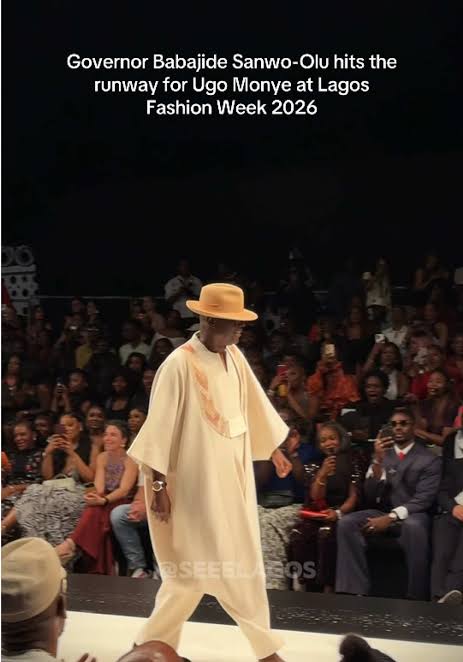
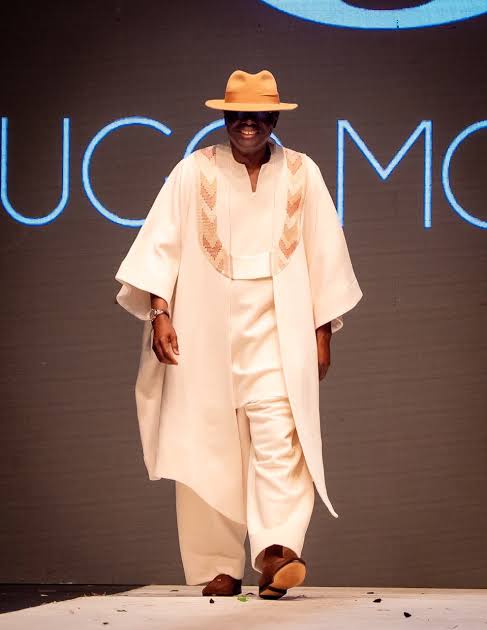
Lagos Governor Babajide Sanwo-Olu is not a model. But on Saturday night at the Federal Palace Hotel, he walked that runway like a man who understood the assignment.
Dressed in an off-white Ugo Monye ensemble—caftan meets kimono, finished with a beige fedora—the governor strutted alongside professional models at the 2026 Lagos Fashion Week, throwing peace signs and nodding at a crowd that erupted the moment they clocked him. It was his second time on the LagosFW catwalk, following a 2023 appearance for Emmy Kasbit.
“I stepped away from the usual business of governance,” he later posted on X, “to walk the runway for the incredibly talented Ugo Monye. Lagos continues to grow as a home for fashion, creativity and culture”.
And honestly? The man has a point. Lagos does move differently.
The Vibe: Lagos as Africa’s Culture Engine
Let’s give credit where it’s due. No other Nigerian state throws a cultural calendar quite like Lagos. Between Felabration at the New Afrika Shrine, the Eyo Festival’s white-robed spectacles, Lagos Fashion Week itself (now in its 15th year and pulling over 40,000 retailers, journalists and fashion lovers annually), and the DecemberDetty December madness that drags the diaspora home by the planeload, Lagos has built something real. It is the one Nigerian city that consistently feels like it’s competing on a continental stage.
The state has also tried to institutionalise the hustle. The Lagos State Employment Trust Fund runs the Eko Hub Model, including the 360 Creative Innovation Hub in Yaba—a fashion production facility with industrial sewing machines, pattern-making equipment, photography studios and co-working space, all available at subsidised rates for young designers who can’t afford their own setup. There’s also the Eko Fashion Hub in Sabo, Yaba, designed to bridge the gap between raw talent and the technology needed to scale.
In October, the Ministry of Tourism, Arts and Culture also put out a call for event organisers to submit proposals for seasonal activities—festivals, concerts, fashion fairs, art exhibitions—promising selected events inclusion on the official Lagos Tourism Calendar and promotional support. Commissioner Toke Benson-Awoyinka framed it as a way to “harmonise all seasonal activities” and give stakeholders “visibility, wider participation and economic benefits”.
The Reality Check: Where’s the Fabric?
Here’s where the runway glamour meets the grittier truth.
Nigeria’s textile industry is not just struggling. It is, for all practical purposes, dead. The Textile, Garment and Tailoring Senior Staff Association of Nigeria recently raised the alarm over the “uncontrolled influx of cheap foreign textile products,” warning that local manufacturing capacity has been decimated and thousands of direct and indirect jobs lost. China alone accounted for 41.02 per cent of Nigeria’s total imports in Q2 2026—N5.92 trillion worth of goods, much of it fabric that Nigerian designers buy because there is no viable local alternative.
So when a governor walks a runway in a stunning Ugo Monye piece, the question every sharp-minded fashion lover should ask is: what is this made of, and who made the fabric? Because if the answer is “imported from Guangzhou,” then the celebration is incomplete. Ugo Monye is a top dog, no doubt. But for every Monye, there are thousands of tailors in Aba, weavers in Akwete, and design school graduates in Surulere who cannot afford industrial machines, cannot access affordable credit, and cannot compete with the ₦3,000 Chinese fabric that undercuts everything they make.
The LSETF hubs are a genuine step forward. The ₦1.5 billion creative fund, while modest, exists. But the reach is nowhere near enough for an industry that employs millions informally. And the Ministry’s festival submission call, while well-intentioned, left creatives confused. What are the selection criteria? Is there funding attached, or just a spot on a calendar? For a sector tired of promises that evaporate after photo ops, the ambiguity matters.
Global Context: Do Other Leaders Do This?
Yes, but rarely. Former US President Donald Trump once walked a charity runway. European mayors have appeared at fashion weeks in Paris and Milan. But in Africa, a sitting governor strutting for a designer is still unusual enough to make headlines. Sanwo-Olu deserves credit for the visibility. The question is whether that visibility translates into policy that keeps the industry alive beyond the applause.
What Lagos Must Do Next
Three things, urgently.
First, treat textile production as infrastructure. Nigeria has the cotton. It has the history—Kano’s mills, Aba’s craftsmanship. What it lacks is power, affordable machinery, and protection from smuggling. Incentivising local fabric production through tax breaks, subsidised energy for manufacturers, and grants for small-scale weavers would create the foundation the entire fashion value chain is missing.
Second, scale the mentorship and funding. The Eko Hubs are great, but they’re concentrated in Yaba. What about Badagry? Ikorodu? Epe? A dedicated fashion incubation programme that provides seed grants, studio access and market linkages to at least 500 emerging designers annually—not just the ones who already have Instagram followings—would change lives.
Third, clarify the festival process. If Lagos wants a world-class cultural calendar that pulls diaspora tourists and their foreign exchange, the submission guidelines need transparency. Criteria, benefits, timelines. Cultural policy cannot be a guessing game.
Sanwo-Olu has now walked the runway twice. He clearly enjoys it. But the real flex would be walking into a textile mill in Kano or a weaving cooperative in Akwete and announcing a policy that makes their work viable again. The governor can wear the clothes. Now he needs to make sure the people who make them can afford to keep sewing.






Leave a comment