

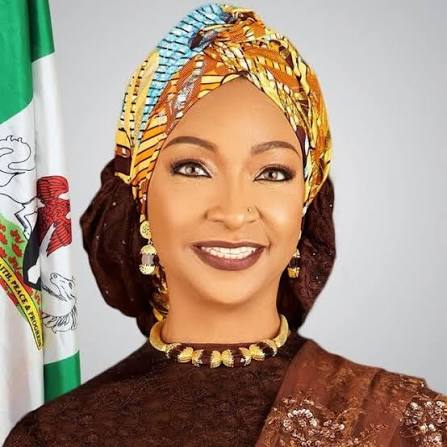
Hannatu Musawa, the Culture Minister
Hannatu Musawa is not a quiet minister. Since taking charge of the Federal Ministry of Art, Culture, Tourism and the Creative Economy, she has inaugurated four drafting committees, announced a Destination 2030 agenda, and repeatedly reminded Nigerians that the creative sector contributes roughly 2.3% of GDP against a target of N100 billion and two million jobs by the decade’s end . She has pushed the ministry into the Orange Economy conversation, partnered with NIPSS, and kept the creative sector on the front pages.
Credit where it is due. The woman is doing the work of visibility.
But visibility is not the same as architecture. And a close look at what Nigeria is building versus what its BRICS peers are constructing reveals a troubling imbalance. The ministry’s energy flows toward the flashy—fashion weeks, music summits, film industry partnerships. The intellectual backbone of culture—literature, history, theatre, archives—sits neglected, underfunded and largely absent from the policy conversation.
The BRICS Benchmark: What Others Are Building
At the XI BRICS Culture Ministers’ Meeting in Bhopal this August, member states adopted a declaration that should make Nigerian policymakers uncomfortable. The BRICS culture track committed to cooperation on cultural and creative industries, exchange of methodologies, support for creators, and expanded market access through digital tools. India announced a pilot Voluntary Artist Registry designed to facilitate cultural exchanges and strengthen professional networks across member states .
Brazil went further. In October, the Ministry of Culture instituted the Aldir Blanc Programme for Creative Territories, funding Creative Innovation and Support Centres with annual investments of between R$600,000 and R$2 million per facility. These centres offer collaborative workspaces, professional training, technical assistance for formalising creative businesses, and support for market access—all designed to be pluriannual, recognising that cultural development requires continuity beyond one budget cycle.
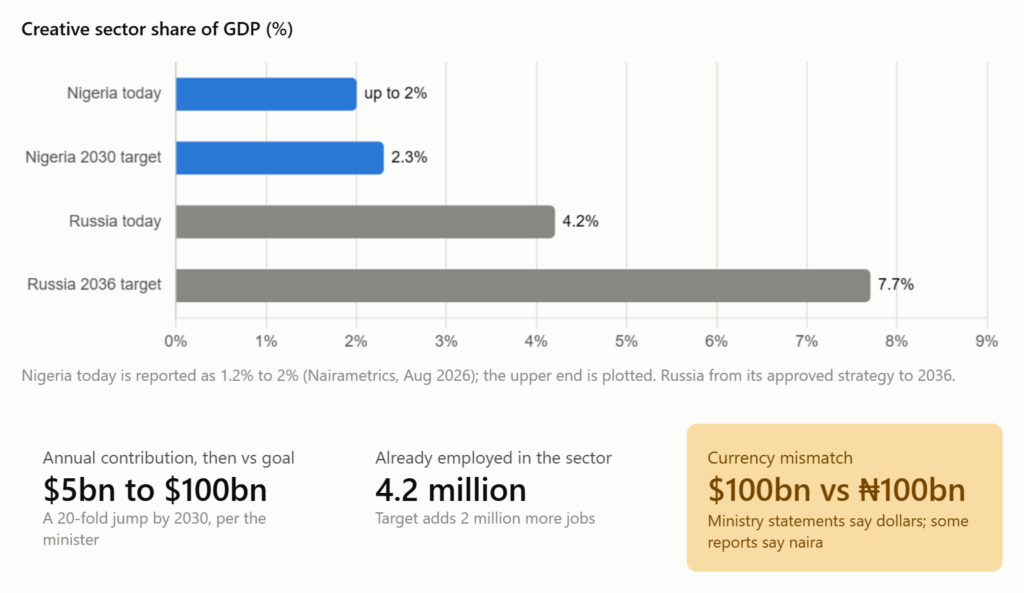
Russia’s government approved a Creative Economy Development Strategy through 2036, targeting an increase in the creative sector’s GDP share from 4.2% to 7.7%, with a corresponding expansion of creative education and regional creative clusters.
South Africa launched Cultural and Creative Industries Clusters across 17 creative disciplines, explicitly aimed at strengthening coordination, enhancing governance and professionalisation, and improving access to funding and markets.
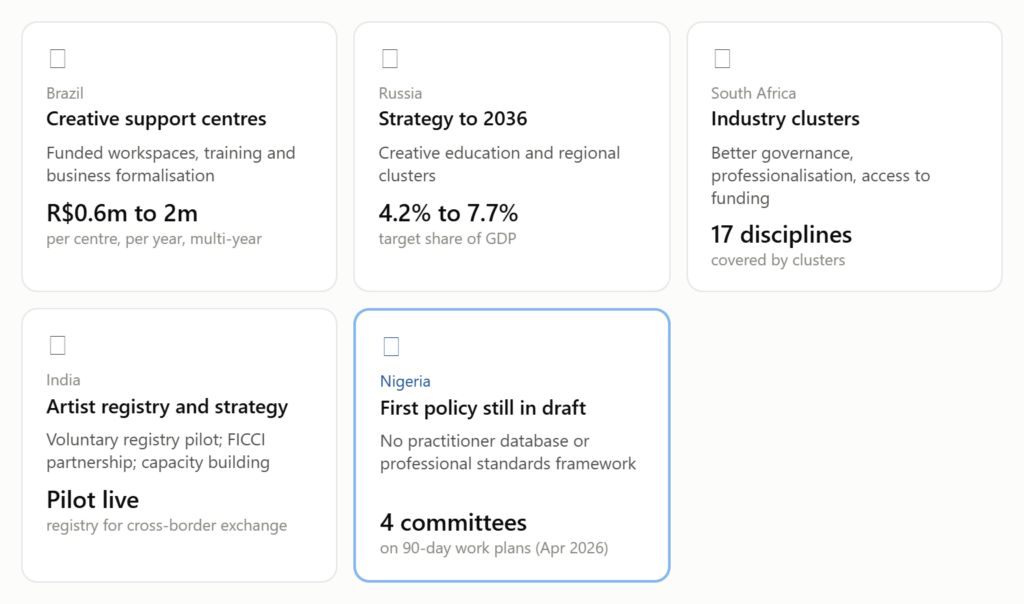
India’s Ministry of Culture signed an MoU with FICCI to develop a comprehensive strategy for the cultural and creative economy, and formulated “Rachnatmak Bharat,” an intervention covering capacity building, market access, innovation and institutional strengthening across visual arts, performing arts, museums, heritage and digital creative industries.
What do these countries share? A recognition that culture policy is not just about backing the industries that generate headlines. It is about building institutions, professionalising the sector, and creating durable infrastructure for creators at every level.
Where Nigeria Excels—and Where It Fails

To be fair to Musawa, the ministry has produced frameworks. The Creative Economy Development Fund was approved in October 2024. The Creative and Tourism Infrastructure Corporation followed in February 2025. A €100 million French Treasury financing line for creative infrastructure was secured in May 2025 . The four drafting committees inaugurated in April 2026 were given 90-day work plans and charged with producing Nigeria’s first comprehensive creative-economy policy .
But the gap between announcement and delivery is now a feature of Nigerian governance. A September 2026 review of the ministry’s performance noted that while frameworks were commendable, “concerns persist over implementation, funding, and whether its policies are delivering meaningful impact for practitioners in the sector” . The CEDF’s Phase 1 opened in 2025, but as of April 2026 there was no public evidence of disbursements, named beneficiaries, or final award decisions .
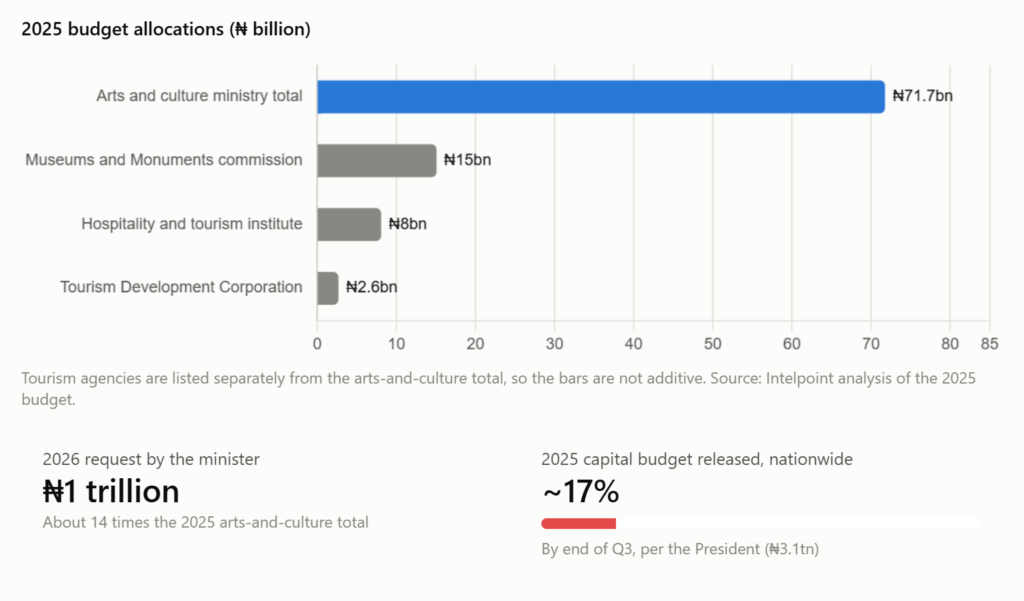
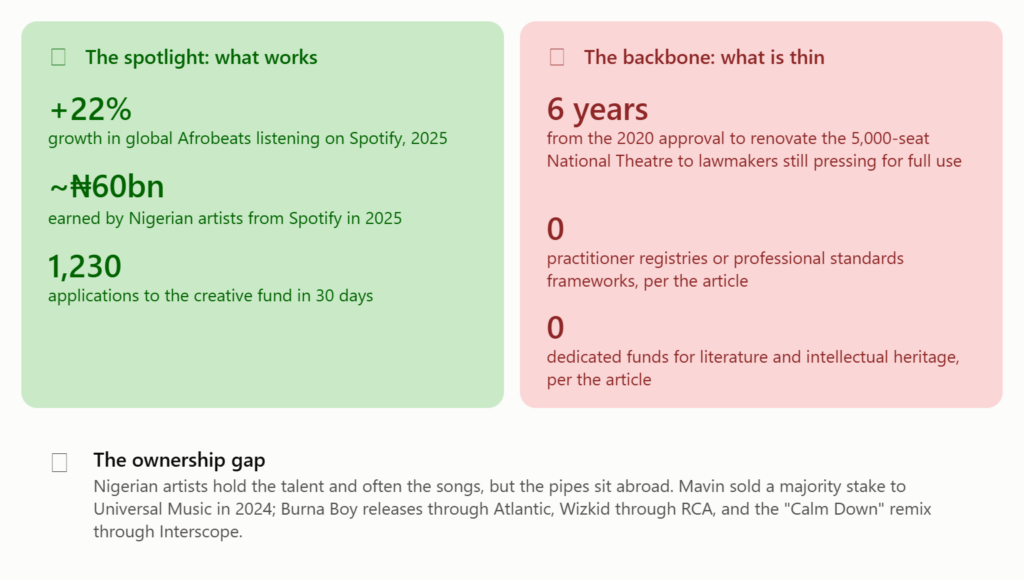
Meanwhile, the ministry’s spotlight falls disproportionately on fashion, music and film—the sectors that photograph well and attract diaspora attention. Literature, the foundational art form that gave Nigeria Chinua Achebe, Wole Soyinka, Chimamanda Ngozi Adichie and a generation of global voices, receives a fraction of the attention. History, the discipline that anchors cultural identity, is left to underfunded university departments and scattered heritage initiatives. Theatre, beyond the ongoing revamp of the National Theatre in Lagos, lacks a coherent national strategy for professionalisation, touring, or the development of new work.
The Tourism Bright Spot
One area where the ministry deserves genuine commendation is tourism. Ola Awakan, the Director of Tourism, has been quietly effective. Under his watch, the ministry has moved to conclude a National Tourism Policy that will “anchor this vision for years to come,” as Musawa noted in August. The tourism directorate has engaged with state governments, positioned Lagos’s festival calendar as a diaspora magnet, and worked to integrate tourism into the broader creative economy agenda rather than treating it as a distant cousin.
Awakan’s approach patient, institutional, less concerned with Instagram than with policy documents, offers a model for what the culture side of the ministry could become. Tourism understands that the product must exist before the marketing. Culture should learn the same lesson.
What Nigeria Must Do
First, the ministry must stop treating literature and history as afterthoughts. A dedicated Literature and Intellectual Heritage Fund, with transparent application processes and grants for publishers, literary festivals, translation projects, and historical research, would signal that the backbone matters as much as the runway.
Second, the BRICS model of artist registries and professionalisation clusters should be adapted. Nigeria has no comprehensive database of its creative practitioners. No system for connecting emerging talent with mentors. No professional standards framework for curators, cultural managers, or theatre practitioners. South Africa’s cluster model and India’s artist registry are not exotic—they are basic infrastructure .
Third, the Creative Economy Development Fund must actually disburse. A fund that exists on paper but reaches no one is not a policy. It is a press release. The ministry should publish disbursement data quarterly, naming beneficiaries and amounts, so that the public can judge whether the fund is reaching the tailors in Aba and the playwrights in Jos, not just the designers who already have Lagos Fashion Week invites.
Fourth, culture communities must own the policy, not merely consult on it. The drafting committees are a start, but if they produce a document that sits in a ministry drawer, nothing changes. The policy must be debated publicly, adopted by state governments, and written into budget lines. Cultural policy that does not survive the minister who commissioned it is not policy. It is a memo.
Musawa has shown she can convene, announce and inaugurate. What Nigeria needs now is for her to deliver—not just for the sectors that shine on camera, but for the ones that build the nation’s soul. The BRICS partners are already moving. Nigeria has the talent, the diaspora and the market. What it lacks is the discipline to build the backbone before the spotlight.






Leave a comment