

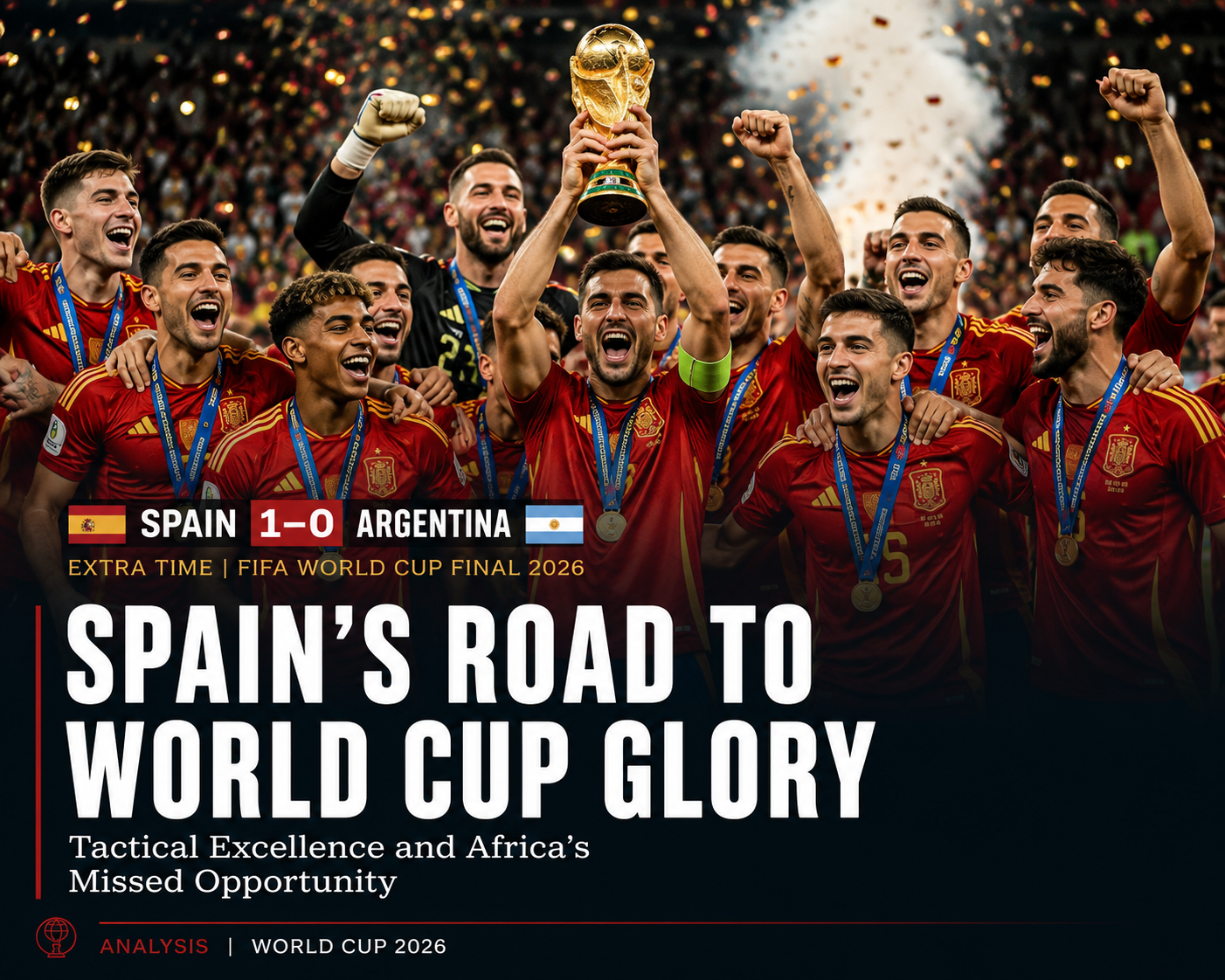
Spain’s 2026 World Cup triumph was the result of tactical discipline, collective quality and outstanding performances from a new generation of stars. Their 1-0 extra-time victory over defending champions Argentina completed a remarkable campaign in which Spain remained unbeaten and conceded just once across eight matches.
More importantly, the victory showed how a well-organised team can combine possession football with aggressive pressing, quick transitions and defensive discipline. While Spain celebrated a second World Cup title, Africa was left to reflect on another tournament without a semi-finalist.
A Champion Built on Control
Spain’s success was not based on individual brilliance alone. Instead, La Roja dominated through collective football and intelligent movement.
Their familiar possession-based approach returned with greater intensity. However, this time, the team added more vertical attacking play, faster transitions and greater defensive organisation.
Throughout the tournament, Spain defeated Portugal, Belgium, France and Argentina on their way to the trophy. Their midfield controlled the rhythm of matches, while a disciplined defence provided the platform for their attacking players to express themselves.
The final was a perfect example of that identity. Argentina struggled to break through Spain’s organised press and compact defensive structure. Eventually, Ferran Torres scored the decisive extra-time goal, securing Spain’s second World Cup title after their historic 2010 triumph.
Spain 2026 World Cup Triumph: The Players Who Made It Possible
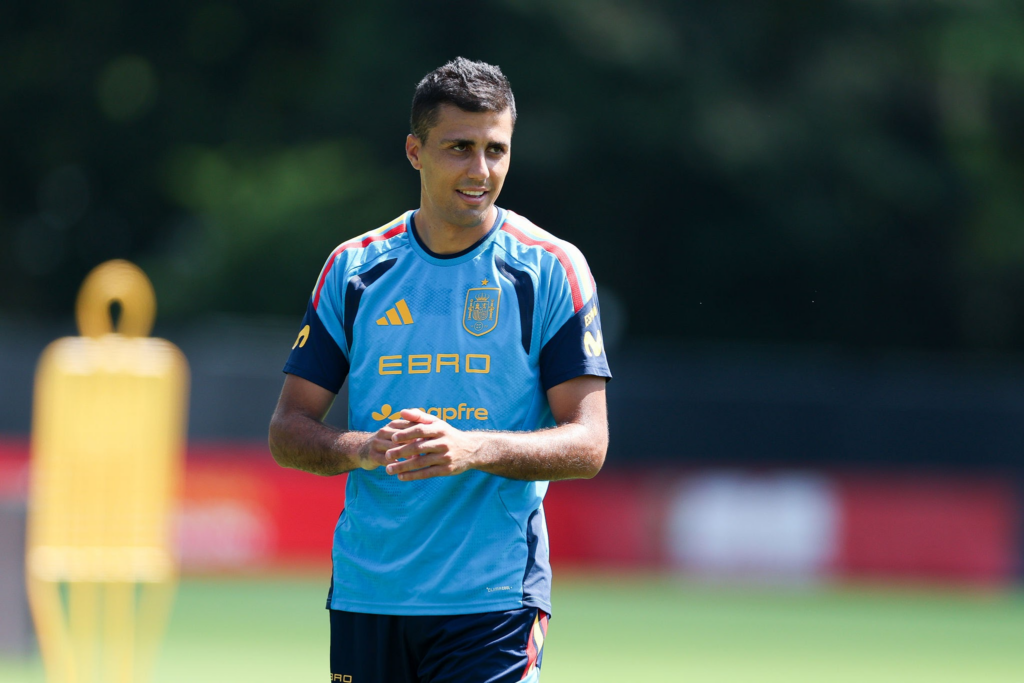
Rodri – The Midfield General
Rodri was the heartbeat of Spain’s midfield. Positioned in front of the defence, he controlled possession, interrupted opposition attacks, and provided composure under pressure.
His positional intelligence allowed Spain’s creative players to attack while maintaining defensive balance. As a result, he emerged as one of the tournament’s most influential performers.
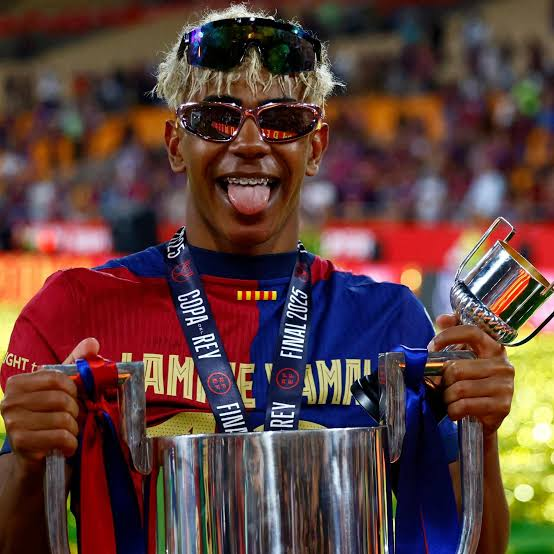
Lamine Yamal – The Teenage Superstar
At just 19, Lamine Yamal continued to establish himself as one of football’s brightest young talents.
His pace, creativity and confidence made him a constant threat. Furthermore, his ability to unlock compact defences gave Spain another dimension in the final third.
Despite his age, Yamal played with remarkable maturity and became one of the team’s most dangerous attacking outlets.
Ferran Torres – The Match Winner
Spain’s campaign was built around collective strength, but Ferran Torres provided the defining moment.
His extra-time goal against Argentina delivered the World Cup trophy and ensured his place in Spanish football history. His performance also highlighted why experienced attacking players remain valuable in high-pressure knockout matches.
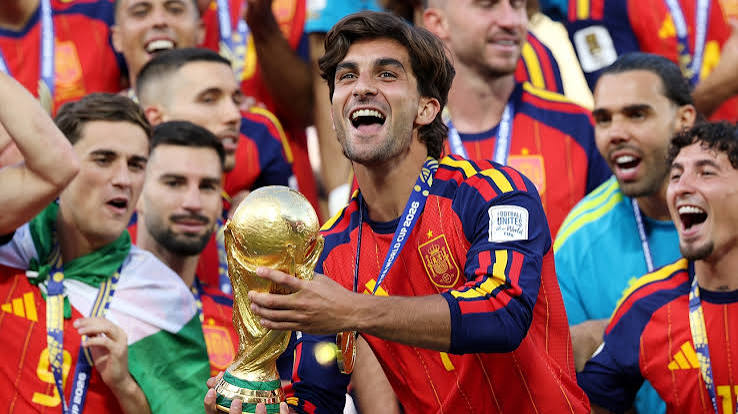
Pau Cubarsí
Pau Cubarsí was one of the tournament’s defensive revelations. Comfortable in possession and composed under pressure, the young defender contributed to Spain’s impressive defensive record.
His emergence also offered Spain a promising long-term option at the back.

Marc Cucurella and Unai Simón
Marc Cucurella provided energy and width from the left side while maintaining his defensive responsibilities. Meanwhile, goalkeeper Unai Simón delivered important saves during the knockout stages.
Together, they reinforced the balance that became a defining feature of Spain’s World Cup campaign.
Luis de la Fuente’s Tactical Masterclass
Manager Luis de la Fuente deserves significant credit for turning Spain into a team that could dominate possession without becoming predictable.
His tactical approach combined:
- Controlled possession.
- Aggressive pressing after losing the ball.
- Flexible attacking movement.
- Defensive compactness.
- Effective squad rotation.
Rather than building the team around one superstar, De la Fuente created a system in which every player understood their responsibilities.
Consequently, Spain were able to control games while remaining dangerous in attack. That balance ultimately separated them from their opponents.
Africa’s World Cup Challenge Ends Without a Semi-Finalist
While Spain celebrated, African football was left with mixed feelings.
The expanded World Cup provided the continent with unprecedented representation, with nine African nations competing for global glory. Morocco, Senegal, Egypt, Algeria, Ghana, Ivory Coast, South Africa, Cape Verde and DR Congo all entered the tournament with ambitions of making history.
Several African teams reached the knockout stages. However, none advanced beyond the quarter-finals.
Morocco
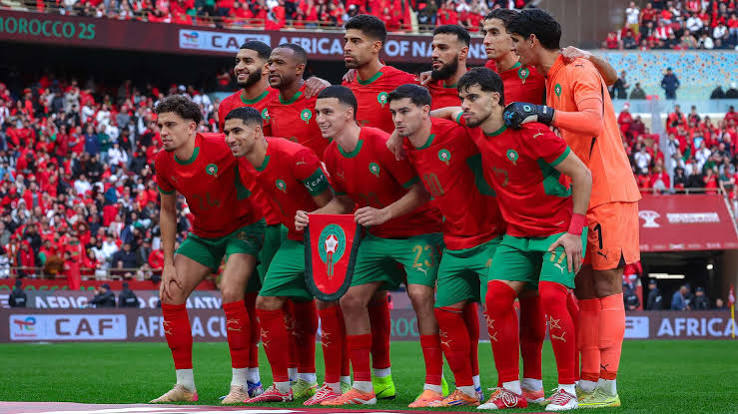
After reaching the semi-finals in 2022, Morocco once again impressed with disciplined defending and tactical organisation.
However, their campaign ended against eventual finalists France in the quarter-finals. Despite the defeat, Morocco remained Africa’s strongest performer and demonstrated that the continent can compete with the world’s best.
Senegal
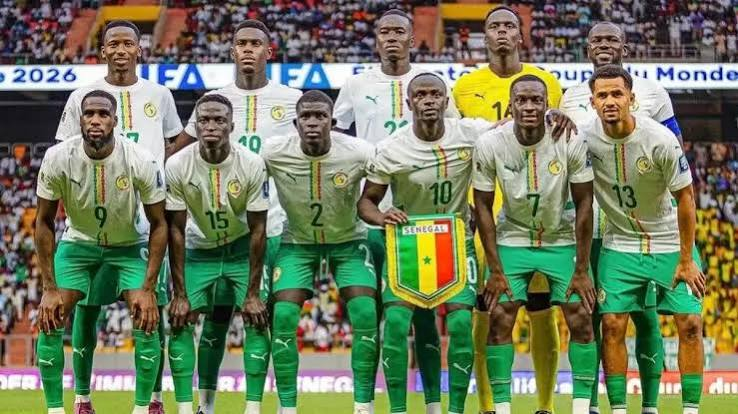
Senegal showed plenty of attacking quality, but defensive mistakes proved costly.
Their narrow defeat to Belgium in the Round of 32 demonstrated how small tactical errors can decide knockout matches at the highest level.
Egypt
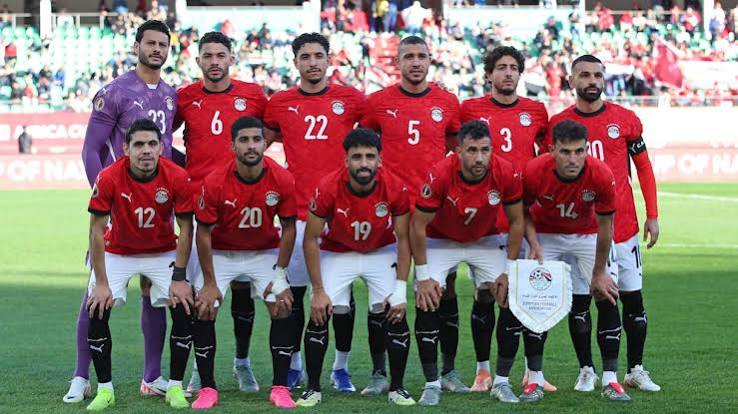
Egypt fought bravely but eventually lost a dramatic penalty shootout to Australia after a 1-1 draw.
Although they displayed resilience, the team struggled to create enough clear opportunities against a well-organised opponent.
Ghana
Ghana produced spirited performances but lacked the finishing quality needed to turn promising moments into goals.
Their campaign ended with a narrow defeat to Colombia in the Round of 32.
Ivory Coast
The Elephants showed flashes of quality but were punished by Norway’s efficient finishing.
Missed opportunities and defensive lapses ultimately ended their campaign earlier than expected.
South Africa, Algeria, Cape Verde and DR Congo
The remaining African representatives also produced encouraging moments.
Cape Verde, in particular, earned praise for their fearless approach despite their defeat to Argentina. Meanwhile, DR Congo pushed England hard before suffering a narrow loss.
Why African Teams Fell Short
Several factors contributed to Africa’s failure to produce a semi-finalist.
Inconsistency: Many African teams produced excellent spells but struggled to maintain their intensity for the full 90 or 120 minutes.
Finishing: Some sides created promising chances but failed to convert them against disciplined opposition.
Game management: Teams such as Spain, France and Argentina showed greater control when protecting leads and managing difficult moments.
Squad depth: While many African starting line-ups were competitive, European teams often had stronger options available from the bench.
Tactical discipline: Spain’s campaign demonstrated the importance of structure. Athleticism and individual talent remain valuable, but elite tournament football also demands tactical organisation and positional discipline.
What Spain’s Victory Means for the Future
Spain’s 2026 World Cup triumph could mark the beginning of another dominant era for La Roja.
With young stars such as Lamine Yamal and Pau Cubarsí developing alongside experienced leaders like Rodri, Spain has the foundations to remain a major force in international football.
For Africa, however, the tournament should not be viewed solely as a disappointment. The continent had more representatives than ever before, while several teams reached the knockout rounds and emerging nations such as Cape Verde showed that the competitive gap is narrowing.
The next step is to turn that progress into sustained success.
Stronger youth development, improved tactical education, better squad depth and greater investment in elite coaching could help African nations take the next step.
Key Highlights
- Spain won the 2026 FIFA World Cup after defeating Argentina 1-0 in extra time.
- The victory gave Spain their second World Cup title after their 2010 triumph.
- Spain’s success was built on possession, pressing, defensive organisation and midfield control.
- Lamine Yamal and Pau Cubarsí emerged as important members of a promising young generation.
- Africa produced several competitive performances but failed to reach the semi-finals.
Conclusion
Spain’s 2026 World Cup triumph demonstrated that international football success requires more than individual talent. Tactical sophistication, defensive organisation, squad depth and composure under pressure all played crucial roles in La Roja’s success.
For Africa, the tournament offered both disappointment and hope. The continent’s teams showed they can compete with elite opposition, but the next challenge is converting competitive performances into deeper runs.
Spain’s victory ultimately reinforced a simple lesson: at the highest level of football, talent can open the door, but tactical discipline and collective identity are often what carry a team all the way to the trophy.









Leave a comment