

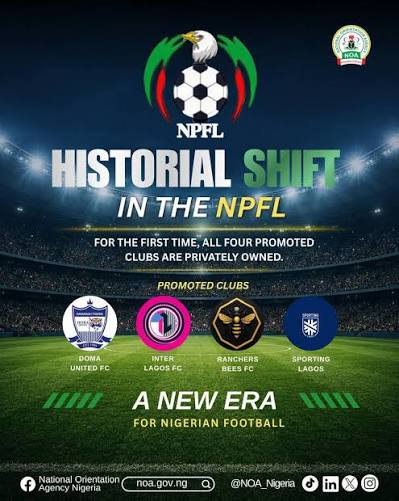
Nigerian football has reached an inflection point. Heading into the 2026/2027 season, four clubs are joining the Nigeria Premier Football League from the Nigeria National League and for the first time in the country’s footballing history, every single one of them is privately owned. Ranchers Bees, Sporting Lagos, Doma United, and Inter Lagos complete their ascent into the top flight, joining Kun Khalifat , Ikorodu City, and Barau FC to push the NPFL’s tally of privately driven clubs to seven (would have been eight had defending champions Remo Stars not got bizzarely relegated).In a league long synonymous with state subventions, civil-service bureaucracy, and government boardrooms, this is nothing short of a quiet revolution.
From Margins to Mainstream
For decades, private clubs were the exception in Nigerian football, often struggling against better-funded government sides for survival, let alone silverware. That changed dramatically when Remo Stars lifted the NPFL title in 2025, becoming the first privately owned club to win the championship in twenty-five years. Around the same period, Ikorodu City, founded only in 2022, emerged as genuine title contenders, going toe-to-toe with traditionally dominant, government-backed institutions.These results were not flukes. Investors who had watched from the sidelines, wary of a league where state subsidies often determined competitiveness, suddenly had a blueprint: structure, discipline, and smart recruitment could outperform bureaucracy and bottomless (if inconsistent) public funding.
The Class of 2026/2027
The four newly promoted clubs each bring a distinct story to this moment. Ranchers Bees, based in Kaduna and owned by Super Eagles and Valencia CF striker Sadiq Umar, represents the revival of a historic club that had fallen into decline. After early infrastructure setbacks forced a temporary relocation of operations to Minna, where significant investment went into upgrading facilities, the club topped its NNL conference and secured promotion in dramatic fashion on the final day of the season.Sporting Lagos returns to the top flight after building what has been described as a modern, privately structured outfit with a strong emphasis on fan engagement, a phrase rarely associated with Nigerian football clubs of the past. Inter Lagos and Doma United complete the quartet, rounding out a group that, as one analyst put it, brings fresh private capital into a league hungry for it.Notably, Lagos State alone will field three privately owned clubs next season, Sporting Lagos, Inter Lagos, and Ikorodu City, setting the stage for derby matches that promise to reignite old rivalries and inject new energy into a city that once buzzed with top-flight football in the 1970s and 80s with iconic clubs like Stationery Stores.
Why This Matters: Governance Over Government
The significance of this shift goes well beyond ownership structures on paper. It signals a fundamental change in how Nigerian football clubs are run.Government-owned clubs in Nigeria have historically been vulnerable to the rhythms of political cycles, funding tied to administrations, decisions made by civil servants rather than football people, and management reshuffles that often follow elections rather than results. Privately owned clubs, by contrast, are increasingly being built around boards of directors, defined mandates, and long-term planning that doesn’t evaporate with a change of government.Ikorodu City, for example, offers a useful template. Founded and run by a board of directors under Sanmi Doherty, the club was conceived as a community-focused project with a clear mission: identifying and developing local talent. That mission has since expanded well beyond its original scope, but the underlying philosophy, clarity of purpose, accountable leadership, and a development-first mindset, has become something other private clubs are emulating.
Talent Development as a Core Strategy
One of the clearest threads running through this new wave of clubs is an emphasis on talent identification and development, rather than simply assembling squads of established names. For owners operating without government subsidies, building and selling talent isn’t just good football philosophy, it’s a sustainable financial model. A club that can identify, nurture, and eventually transfer promising young players creates a revenue stream that government-funded clubs, focused primarily on domestic results, have rarely prioritized.This approach also strengthens the broader football ecosystem. Players who might previously have been overlooked now have pathways through community-rooted clubs into the NPFL and, potentially, beyond Nigeria’s borders entirely.
Fan Engagement: The Missing Piece Returns
Perhaps the most visible difference between the new private clubs and their traditional counterparts is the attention paid to supporters as stakeholders rather than afterthoughts. Sporting Lagos has built its identity around fan engagement from the ground up, and the anticipated Lagos derbies between Sporting Lagos, Inter Lagos, and Ikorodu City are expected to do more than fill stadiums, they’re expected to drive media coverage, commercial interest, and a renewed sense of identity for fans who have often felt disconnected from clubs run at arm’s length by government bodies.
The Road Ahead: Challenges Remain
None of this is to suggest the transition is complete or without friction. Infrastructure gaps remain a persistent challenge for clubs built from the ground up without state resources, Ranchers Bees’ relocation from Kaduna to Minna is a clear example of the practical hurdles private owners still face. Facility limitations across the lower leagues continue to constrain how quickly newly promoted clubs can scale operations to top-flight standards.There’s also the matter of sustainability under pressure. Remo Stars, the very club that broke the twenty-five-year title drought for private ownership, has found itself fighting relegation in the season that followed, a reminder that early success doesn’t guarantee a smooth trajectory, and that private ownership alone isn’t a magic formula.
A Bold New Chapter Still
The trajectory is unmistakable. From a league once almost entirely dominated by government-funded teams, the NPFL now heads into 2026/2027 with seven privately owned clubs, a number that could grow further depending on how the relegation picture resolves. What’s emerging is not just a change in who signs the cheques, but a broader cultural shift toward professional management, commercial thinking, and fan-centered football. For a domestic league that has long struggled to retain talent, fill stadiums, and compete for attention against European football on Nigerian television screens, this wave of privately driven ambition may be exactly the spark needed. The 2026/2027 season won’t just be about who wins the title, it will be a test of whether this new model of ownership can deliver the stability, professionalism, and sustainability that Nigerian football has been waiting for.








Leave a comment