

Two federal agencies set out to reach millions of Nigerians with biometric identity systems. One has largely succeeded. The other is still struggling with the final step of getting a card into a citizen’s hand. The comparison is not abstract. It is the difference between an identity system built for participation and one that functions, in practice, as a filter.
The NIN Success Story
As of September 2026, the National Identity Management Commission had issued National Identification Numbers to over 142 million Nigerians and legal residents, up from roughly 100 million before the current enrolment drive. The engine behind that growth was the Ward-to-Ward Enrolment Project, which deployed NIMC officials and National Youth Service Corps members to communities across the country, including areas without permanent registration centres. NIMC also introduced a self-service platform allowing Nigerians to update their records without visiting an office, a system that has processed approximately two million record updates.
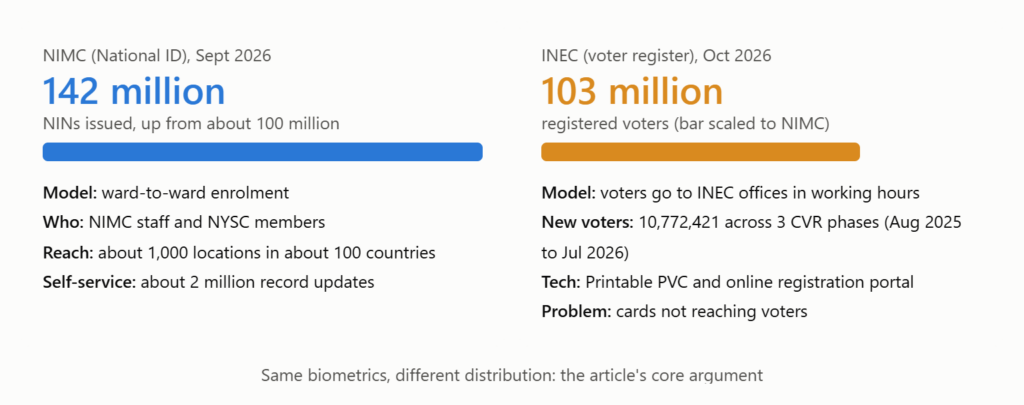
The scale is remarkable. NIMC reached nearly 1,000 locations across about 100 countries through partnerships with international organisations, extending the identity net to the diaspora . The federal government now speaks of a coverage target that would make Nigeria’s identity database among the most comprehensive in Africa
The PVC Bottleneck
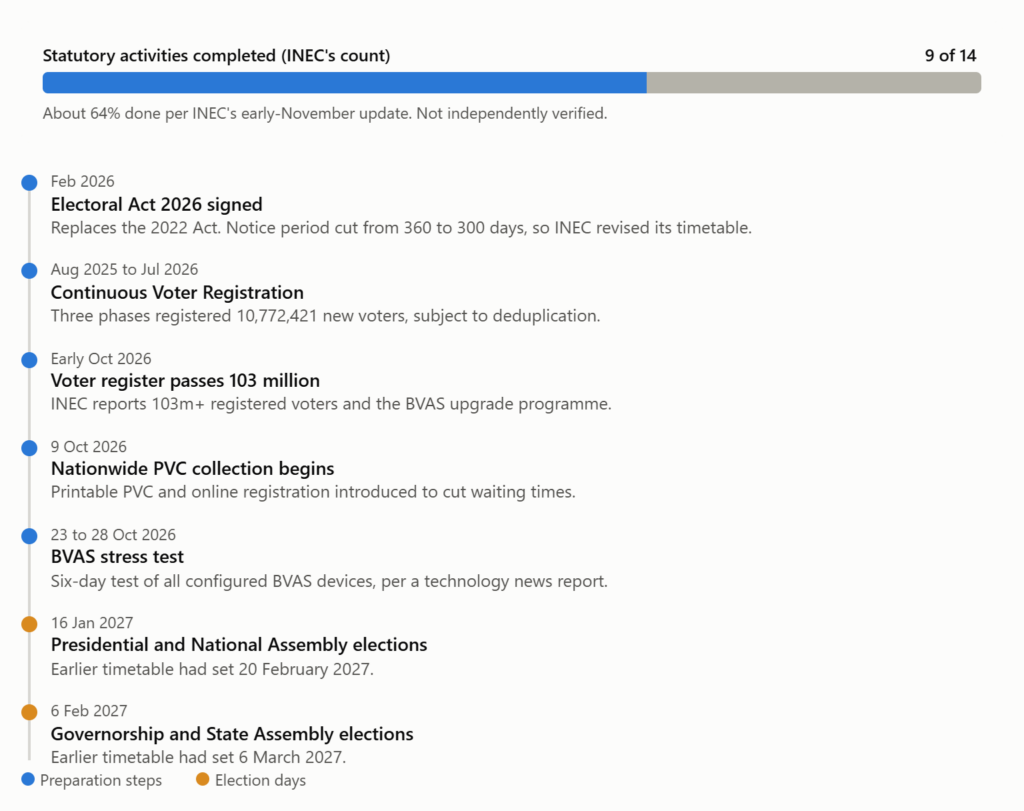
INEC’s parallel system tells a different story. The National Register of Voters stands at over 103 million registered citizens, and INEC conducted three phases of Continuous Voter Registration between August 2025 and July 2026, registering 10,772,421 new voters subject to deduplication. The commission has activated Printable PVC technology and an Online Registration Portal, innovations that its chairman, Professor Joash Amupitan, says should make “waiting for months to pick up a voter’s card” a relic of the past.
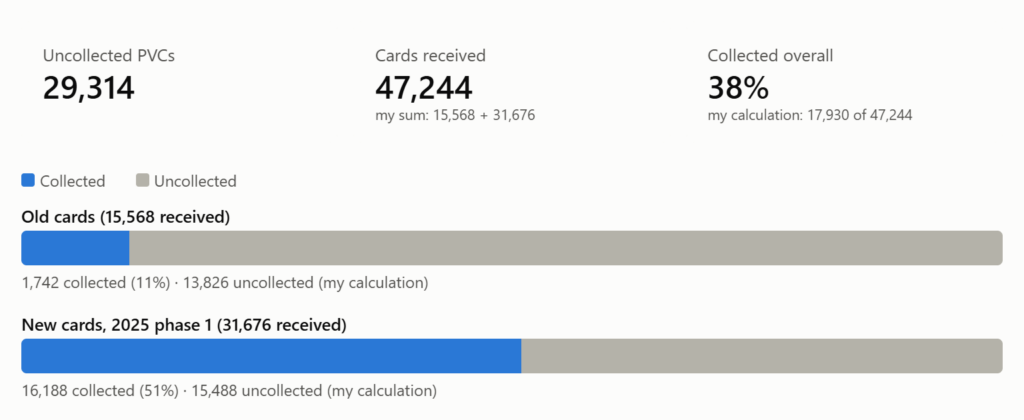
Yet the cards are not reaching voters. In Taraba State alone, 29,314 PVCs remained uncollected as of October 2026. Of the 15,568 old cards received by the commission, only 1,742, or 11 per cent, had been collected. Of the 31,676 new cards from the first phase of the 2025 registration, 16,188, or 51 per cent, had been collected. The pattern is national. The constraint is not technology. Both systems use biometrics. The difference is distribution strategy. NIMC took enrolment to the ward level. INEC requires voters to come to INEC offices during working hours, often at locations distant from where they live.
The 2023 Observer Verdict
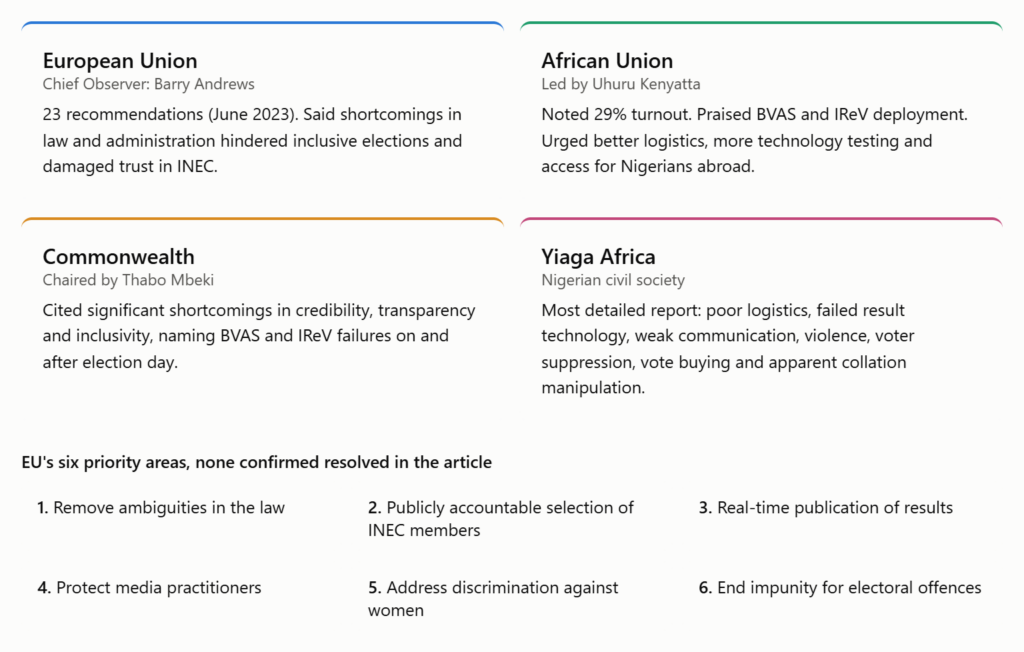
The evidence base for INEC’s operational failures is not anecdotal. It is documented by the European Union, the African Union, the Commonwealth, and Nigerian civil society, and the findings converge on the same points.
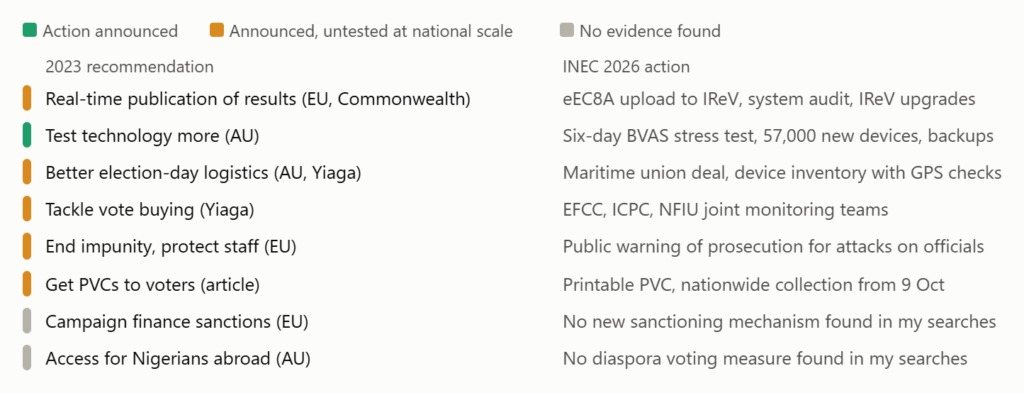
The European Union Election Observation Mission published 23 recommendations in June 2023, identifying six priority areas: removing ambiguities in the law, establishing a publicly accountable selection process for INEC members, ensuring real-time publication of results, protecting media practitioners, addressing discrimination against women, and ending impunity for electoral offences. The EU’s Chief Observer, Barry Andrews, stated plainly that “shortcomings in law and electoral administration hindered the conduct of well-run and inclusive elections and damaged trust in INEC”.
The African Union Election Observation Mission, led by former Kenyan President Uhuru Kenyatta, noted the low voter turnout of 29 per cent and praised the deployment of BVAS and the IReV portal while recommending better logistical strategies, more testing of new technologies and adjustments to voting times. The AU also flagged the need for improved access for Nigerians abroad to vote, a point directly relevant to the diaspora.
The Commonwealth Observer Group, chaired by former South African President Thabo Mbeki, cited “significant shortcomings” that detracted from credibility, transparency and inclusivity, specifically naming the failures of BVAS devices and the IReV portal on and after election day.
Yiaga Africa’s final report was the most detailed. It found that “poor logistics on election day, especially during the February 25 election; the failure of the technology designed to drive transparent result management; poor communication provided by INEC at critical points in the process; tactical use of violence to influence electoral outcomes; voter suppression; vote buying; non-compliance with electoral law and guidelines; and apparent manipulation of results during collation cast doubts on the credibility of the process”.
The turnout figures confirm the consequence. Nigeria’s 2023 presidential election recorded a turnout of approximately 25.7 to 27 per cent, the lowest in recent democratic history and a decline from 35 per cent in 2019. Roughly seven in ten registered voters did not cast a ballot. The causes were cumulative, and each is documented in the observer reports. None has been definitively resolved.
The Campaign Finance Vacuum
The Rufai Oseni intervention in October 2026 gave the campaign finance question a concrete focal point. The Arise News anchor questioned the APC’s distribution of seven brand-new 2026 Toyota Land Cruiser Prado SUVs to selected youth leaders for election mobilisation, a decision announced by National Youth Leader Dayo Israel before the post was deleted. At the listed Nigerian retail price of ₦160 million for the Adventure version, seven vehicles would cost approximately ₦1.12 billion, or about $842,415 at the September 2026 exchange rate. Oseni’s argument was not a formal allegation of statutory breach. It was a question of priorities: whether a party seeking re-election should be spending at this scale on luxury vehicles for mobilisation while Nigerians grapple with hardship, and whether buses that could later serve as ambulances would have been a more defensible choice.
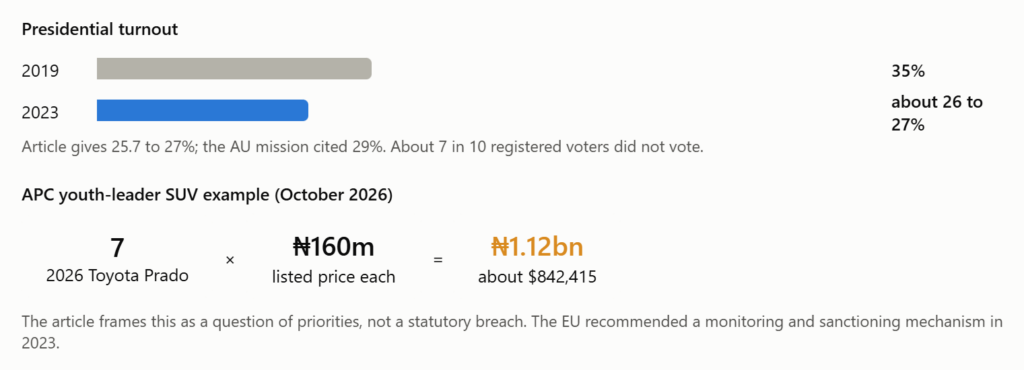
The broader point stands. Nigeria’s campaign finance regime exists on paper but lacks a credible monitoring and sanctioning mechanism. The EU observation mission recommended in 2023 that Nigeria “enforce INEC’s campaign regulations by establishing a robust and effective monitoring and sanctioning mechanism to curtail abuse of incumbency” . That recommendation, like the others, awaits implementation.
What This Means for Nigerians at Home and in the Diaspora
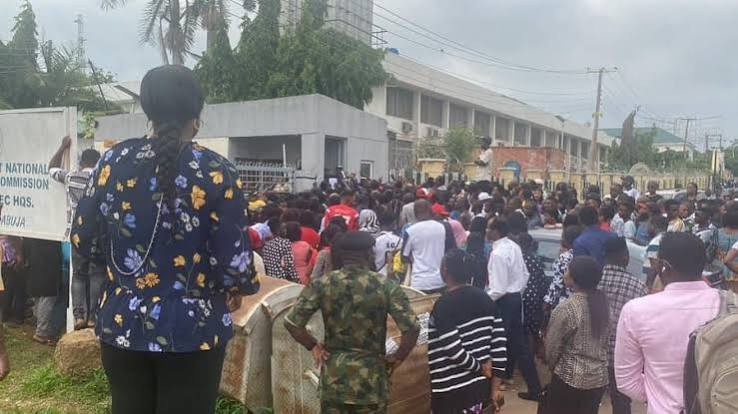
For the voter in Taraba who registered in 2025 and has not collected a card, the elaborate debates about alliances and policy platforms are abstract. Disenfranchisement is not a theoretical risk. It is the lived experience of millions who have been registered but not equipped to vote. INEC’s own chairman has said that “no eligible citizen who registered should be disenfranchised by administrative or logistical friction”. The data from Taraba and Plateau suggests that this principle is not yet operational.
For the diaspora, the implication is direct. The AU observation mission recommended that Nigeria improve access for Nigerians abroad to vote. That recommendation has not been implemented. Meanwhile, the family members they encourage to vote at home may find the process too costly to navigate. The NIN comparison matters here because it demonstrates that Nigeria can run a mass biometric programme efficiently when the political will exists to deploy ward-level infrastructure. INEC’s PVC collection crisis demonstrates what happens when that will is absent.
The 2027 election will be judged by the same standard as 2023: not by the sophistication of INEC’s press releases, but by whether a nurse in Jalingo or a trader in Onitsha can collect a card, vote without harassment, and see their vote counted transparently. The observer reports from 2023 provide the roadmap. The question is whether INEC will follow it or repeat the cycle.
The Solution
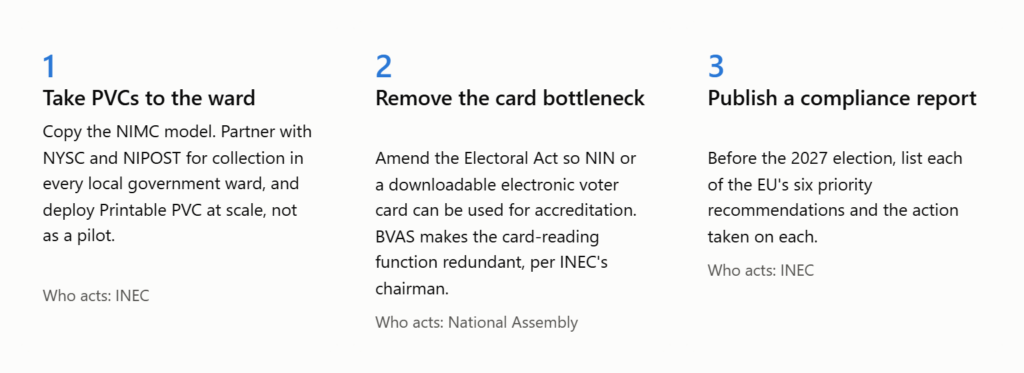
First, INEC should immediately adopt the NIMC ward-level model for PVC distribution, formalising partnerships with the NYSC and NIPOST to take card collection to every local government ward rather than requiring voters to travel to INEC offices. The Printable PVC technology that INEC has activated should be deployed at scale, not piloted.
Second, the National Assembly should amend the Electoral Act to permit the use of NIN or a downloadable electronic voter card for accreditation, eliminating the physical collection bottleneck. INEC’s own chairman has acknowledged that BVAS makes the PVC’s card-reading function redundant.
Third, INEC must publish a compliance report before the 2027 election listing each of the EU’s six priority recommendations and the specific action taken on each. The observer reports exist. The recommendations exist. What has been missing is accountability for implementing them. Without these measures, the 2027 election will produce another set of observer reports documenting the same failures, and another cohort of Nigerians will conclude that the system is not designed for them to participate.












Leave a comment