

The quarrel is almost banal. A mother, a son, a living room. JB has returned from Montreal with two philosophy degrees and a delusion he calls a career: esports athlete. He cites Sisyphus. She has run out of patience. This is the kind of argument that happens in Nigerian homes every week, the kind that ends with someone slamming a door and everyone pretending it never happened.
Tope-ẸniỌbáńkẹ́ Adegoke’s Two Interlocked Triangles is not interested in the quarrel. It is interested in the silence beneath it.
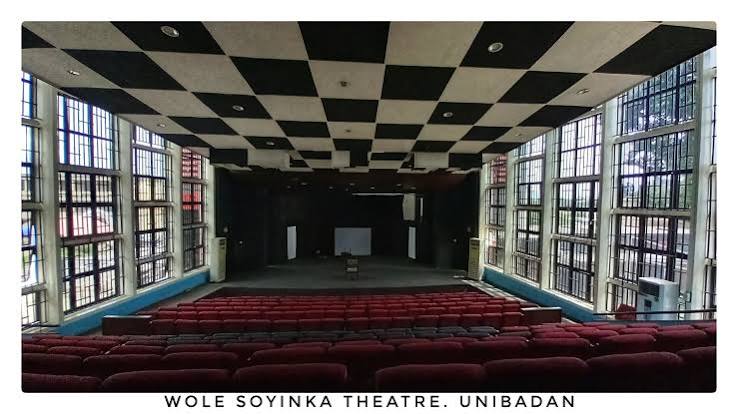
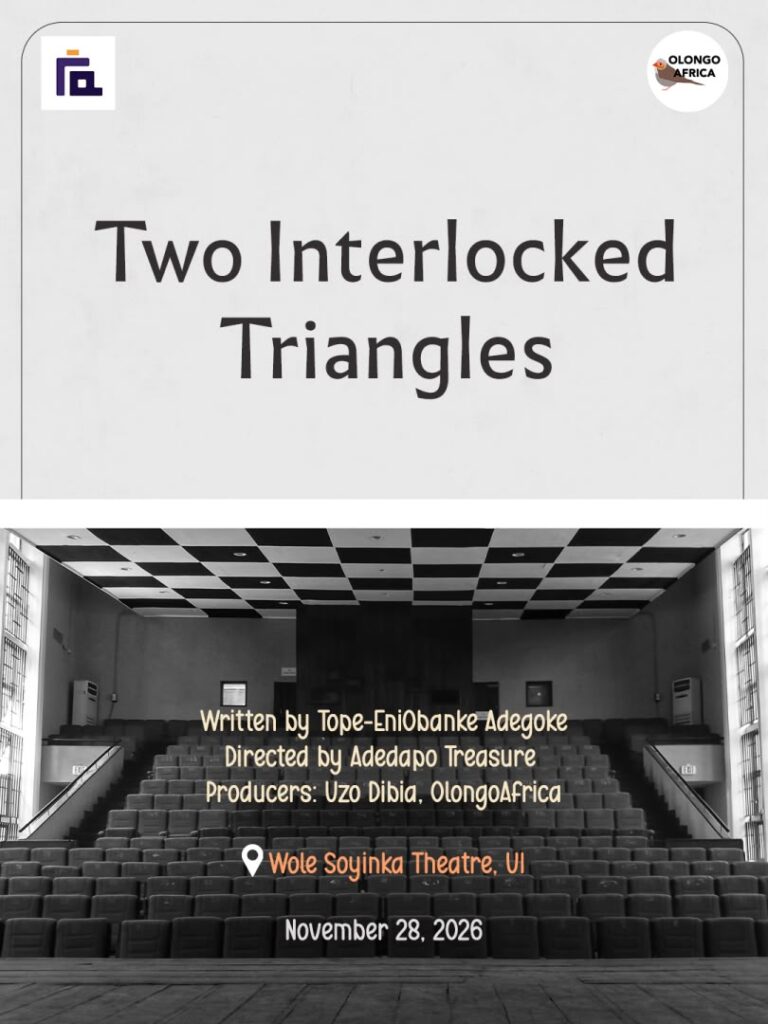
The play premieres at the Wole Soyinka Theatre, University of Ibadan, on November 28, as part of Fàdákà Fest 2026. Directed by Adedapo Treasure and produced by Uzo Dibia and OlongoAfrica, it features Michael Folagboye, Temitope Agoro, and Mabel Nwaoliwe. Tickets are ₦5,000.
The Sisyphus Problem
Adegoke has said the play began with a cartoon. During the COVID lockdown, he saw Adam Katzenstein’s New Yorker drawing captioned “Sisyphus works from home”. The image is funny because it is cruel: the mythological figure condemned to push a boulder uphill for eternity, now doing it in his pajamas, on Zoom, with nowhere to go.
But the myth does something else in Adegoke’s hands. Sisyphus is not just a metaphor for the absurdity of work. He is a figure for inheritance. The boulder is what you are given. The hill is where you are told to take it. And the question the play asks—through a mother, a son, and a buried memory that will not stay buried-is what happens when a family realizes the boulder was never theirs to push, but they cannot put it down.
This is where the play becomes something more than domestic drama. Adegoke connects the mother’s postpartum depression, unspoken and untreated, to the son’s paralysis. He connects both to the hangover of military dictatorship, the way a generation raised under authoritarianism learned to keep secrets as a survival strategy, and passed that silence to their children like an heirloom nobody wanted. The critic Ugochukwu Anadị called it “a therapy session and a history class,” which is accurate but perhaps too gentle. It is an autopsy.
The Playwright’s Formation
Adegoke is not an accidental writer. He studied English and Literature at the University of Benin, then worked in an Ibadan playhouse before coming under the mentorship of Rotimi Babatunde, the Nigerian playwright and Caine Prize winner whose influence is evident in Adegoke’s willingness to let language do uncomfortable work. He was selected for the Berliner Festspiele Theatertreffen 2025 International Forum, a competitive global programme that places him in conversation with theatre-makers from across the world. He has completed residencies at Theater Koblenz and with the Sylt Foundation, where he described the German theatre process as “a laboratory of ideas, a place where the mechanics of theatre were exposed, questioned, and reassembled”.
That phrase—exposed, questioned, reassembled—could describe what he is doing to the Nigerian family drama. The form is familiar: the living room, the argument, the secrets. But the reassembly is where Adegoke’s training shows. He is not interested in resolution. He is interested in the moment when a character realizes the story they have been telling themselves is a lie.
The Producer’s Bet
The play is produced in part by OlongoAfrica, the literary and cultural platform founded by Kọ́lá Túbọ̀sún. OlongoAfrica is not a theatre company. It publishes long-form journalism, travelogues, essays, and poetry. It produced the documentary Ebrohimie Road: A Museum of Memory, directed by Túbọ̀sún and shot by Tunde Kelani, which traces Wole Soyinka’s life through the University of Ibadan bungalow where he was arrested in 1967. The film won awards on the festival circuit and screened in Lagos, Ibadan, and the United States.
Why would a literary platform produce a play? Because Túbọ̀sún understands something about Nigerian cultural infrastructure: it is fragile, fragmented, and often indifferent to the work that matters. The institutions that should support new theatre, the national theatre, the state arts councils, the university drama departments-are underfunded, bureaucratically paralyzed, or both. The Makinde Adeniran, president of the National Association of Theatre Arts Practitioners, said recently that Nigeria’s creative industry lacks “deliberate government policies” and that without structures to contain investment, “you are throwing it into open air”.
OlongoAfrica is not waiting for policy. It is producing. That is not a solution to the sector’s problems. It is a workaround. But workarounds are how Nigerian culture has always survived.
What the Play Inherits
Fàdákà Fest’s 2026 theme is “RE:CLAIM”—what we take back and what we build next. The play fits because it is about a family reclaiming a story that was taken from them not by an enemy, but by silence. The mother’s depression was never named. The son’s paralysis was never understood. The military years were never fully reckoned with. And so the boulder keeps rolling.
Adegoke is not offering catharsis. He is offering recognition. For Nigerians at home who have sat in living rooms where the real conversation never happened, and for those in the diaspora who left partly to escape the weight of what was never said, the play is a mirror. It is also, perhaps, a warning. The silence that protects a family can also suffocate it.
The Details
Two Interlocked Triangles premieres Saturday, November 28, 2026, at 5 pm at the Wole Soyinka Theatre, University of Ibadan. Running time: 1 hour 30 minutes. Content notes: postpartum depression and trauma. Tickets: ₦5,000 via Paystack. Fàdákà Fest runs November 25–29. ₦5,000 and available via Paystack. Fàdákà Fest runs November 25–29. Full programme and festival passes at fadakafest.com.





Leave a comment