

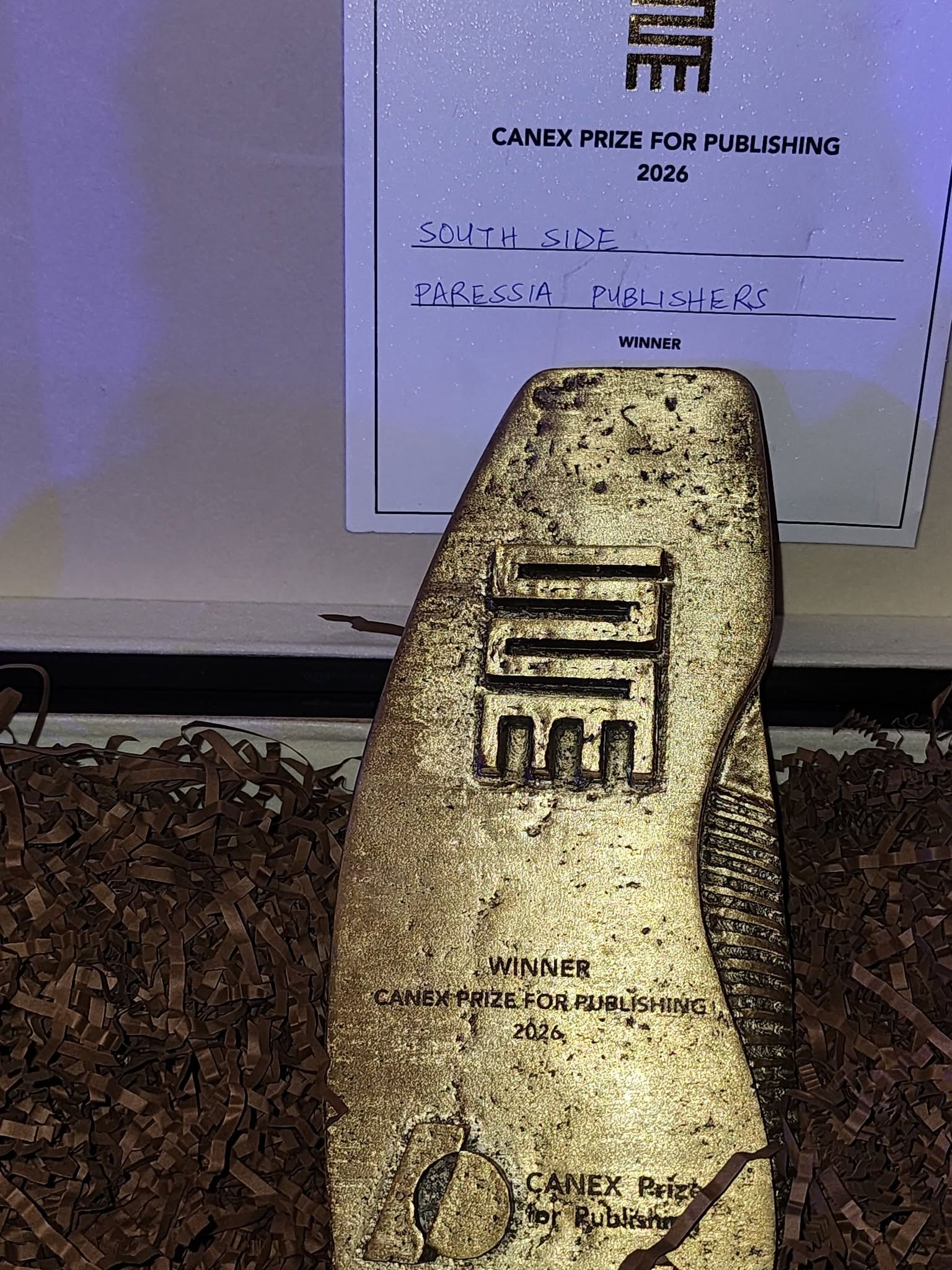
The money talk at CANEX WKND 2026 was loud. Afreximbank had $2 billion to deploy across Africa’s creative industries. Vice President Kashim Shettima wanted the applause of the world turned into contracts. Deal rooms buzzed with proposed transactions worth over $500 million. And then, on Friday evening, a small independent press from Lagos took the stage and quietly reminded everyone what the whole enterprise is actually about.
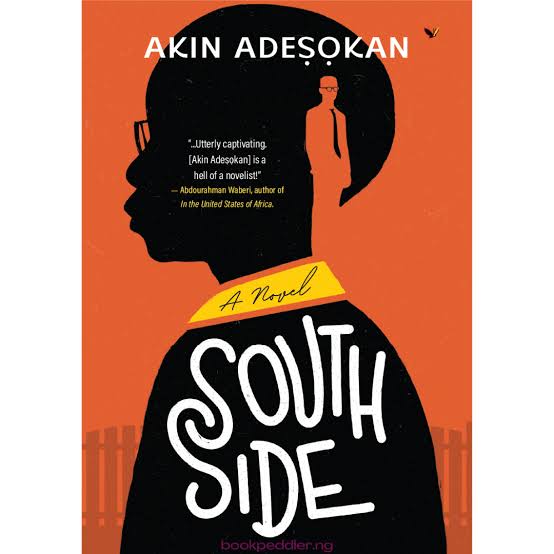
Parrésia Publishers won the $20,000 CANEX Prize for Publishing for South Side, a novel by Professor Akin Adesokan. The prize, now in its third edition, rewards the publisher’s whole crafteditorial quality, design, production, innovation, distribution, cultural impact, not just the manuscript. It is part of Afreximbank’s CANEX Book Factory, the infrastructure beneath the flash.
For Parrésia, founded in 2012 by Azafi Omoluabi and Richard Ali, this is a vindication of fourteen years of stubborn, unglamorous work. The press has always been more adventurous than commercial, publishing Abubakar Adam Ibrahim’s Season of Crimson Blossoms in 2015, a gamble that paid off when the novel won the Nigeria Prize for Literature in 2016. South Side itself is a long-delayed arrival, announced for May 2025, and the first fiction from Adesokan in 21 years. That patience—the willingness to wait for a book, to invest in a writer’s slow arc—is precisely what the prize is designed to honour.
The Context: Books Inside a Billion-Dollar Room
It would be easy to miss the publishing prize inside the larger CANEX machinery. The summit’s headline numbers are staggering: $118 million in new financing arrangements signed with Nigerian development banks, a commitment to African creative industries that has quadrupled from $500 million to $2 billion, and a deal room designed to facilitate commercial agreements between creatives and investors. The language is of ownership, intellectual property, and value capture. Dr George Elombi, Afreximbank’s president, put the problem bluntly: “Our talent is global; our share of the value, unfortunately, is only local”.
That framing applies to publishing as much as to music or film. A Nigerian novel that sells abroad generates royalties for the author and revenue for the foreign publisher. The editing, design, printing, and distribution-the work that Parrésia does, is where the economic value is built. By honouring the publisher rather than the writer alone, the CANEX Prize acknowledges that books are not just cultural artefacts. They are businesses, and the people who run them deserve recognition.
The prize itself has a short but telling history. The first winner, in 2024, was Nigeria’s Cassava Republic Press. In 2025, it went to Karavan Press in Cape Town. Now it has returned to Nigeria, closing a loop that mirrors the continental ambition Afreximbank keeps invoking. For 2026, the prize also widened its reach, dropping “in Africa” from its name and opening eligibility to publishers from Caribbean Community states. The jury was chaired by Professor Aderemi Raji-Oyelade, alongside Professor Polo Moji and Khainga O’Okwemba. The other four finalists—Masobe Books, Cassava Republic Press, and Editora Trinta Zero Nove, among them—each received $2,000.
The Wider CANEX Picture
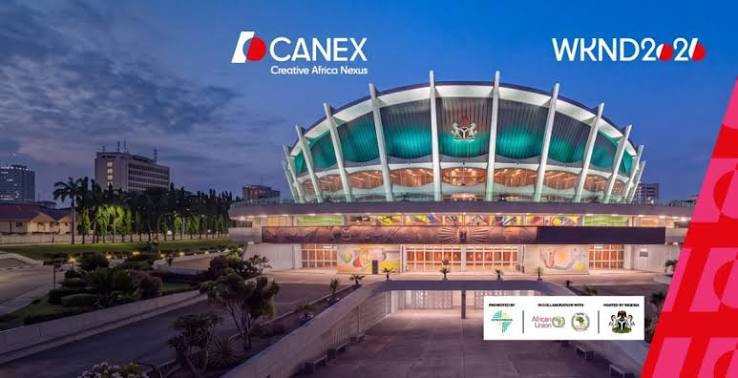
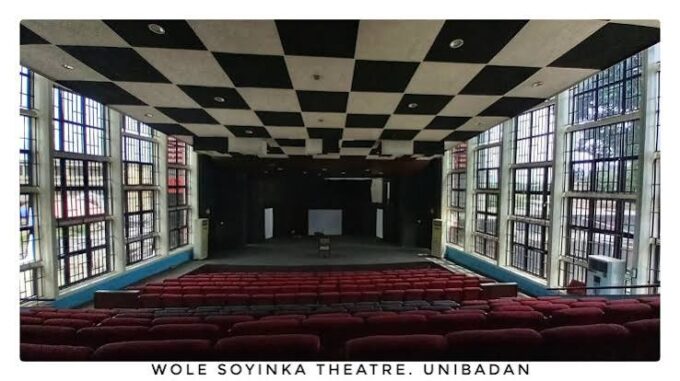
The summit itself was a statement of intent from Afreximbank and the Nigerian government. Held at the Wole Soyinka Centre for Culture and Creative Arts in Iganmu, the renovated National Theatre, a symbol of FESTAC ’77 reimagined for a commercial era, CANEX brought together creatives, investors, and policymakers from across Africa and the diaspora. The theme, “One People, United in Culture, Creating for the World,” made the lineage explicit.
Beyond the publishing prize, the summit featured a Creative Pitch Competition, training programmes for event technicians, fashion shows, film screenings, and music showcases. There were conversations about artificial intelligence and authorship, about distribution infrastructure, about how African creators can retain ownership of what they make. The ambition is to build an ecosystem, not just a trade fair.
But the ecosystem’s health depends on whether the money actually reaches the people doing the work. The $118 million in financing arrangements announced with DBN, NEXIM, and SMEDAN is welcome, but the terms of access will determine whether a small press like Parrésia, or a fashion designer in Bariga, can actually benefit. Elombi himself acknowledged the gap between production financing and value capture: “We can put these financing schemes into music and movie productions. Yet the value we derive will still be low. We must therefore focus on building the creative ecosystem”. That ecosystem includes publishers, distributors, booksellers, and the unglamorous infrastructure of literary culture.
What This Means for Nigerian Readers
For Nigerians at home and in the diaspora, Parrésia’s win is a reminder that the books they love do not appear by magic. They are edited, designed, printed, and distributed by people who have chosen to build institutions in a country where institutions are fragile. Omoluabi and Ali could have pursued more lucrative paths. They chose publishing. The $20,000 prize is not a fortune, but it is recognition, and in a sector where recognition is scarce, that matters.
It also matters that the prize was won in Lagos, at a summit hosted by the Nigerian government, for a novel by a Nigerian professor published by a Nigerian press. The symbolism is not incidental. For years, African publishing prizes have been awarded elsewhere, judged by panels convened in London or Cape Town. CANEX is an attempt to keep the conversation, and the money, on the continent. Whether it succeeds will depend on whether the next Parrésia, the press that has not yet been founded, the editor who has not yet been hired, can access the same opportunities.
The Details
The CANEX Prize for Publishing 2026 was announced at CANEX WKND, held November 5–8 at the Wole Soyinka Centre for Culture and Creative Arts, Iganmu, Lagos. The prize is $20,000 for the winner, with $2,000 for each of the four other finalists. Parrésia Publishers was founded in 2012 by Azafi Omoluabi and Richard Ali. South Side by Akin Adesokan is available from Parrésia.






Leave a comment