

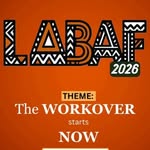
The Lagos Book and Art Festival (LABAF) returns for its 28th edition from November 16 to 22, 2026, at Freedom Park, Lagos Island, under the theme “Repair: The Workover Starts Now.” The programme, released this week, is unusually dense. It is a week of theatre, film, exhibitions, workshops, poetry competitions and panel discussions spread across multiple venues within the Freedom Park complex and the J. Randle Centre for Yoruba Culture and History in Onikan.
“Repair” is a loaded word in Nigeria. It can mean fixing what is broken, or it can mean pretending the damage was never as bad as it looked. LABAF’s programme leans toward the first meaning, with a series of conversations that refuse to let the past rest.
Cinema, Theatre and the AI Question
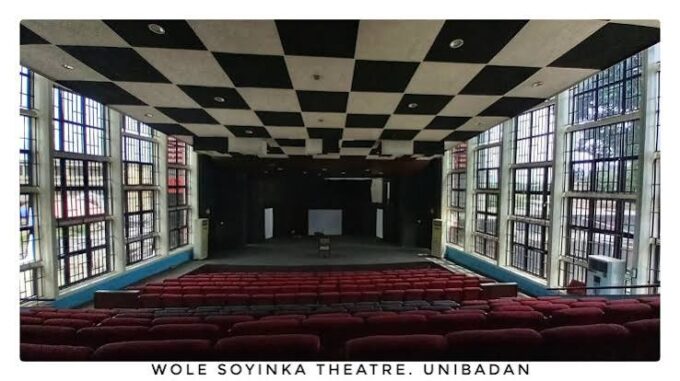
The under-30 crowd has the most to choose from. The festival’s theatrical centrepiece is No More the Wasted Breed, directed by Segun ‘Oriade’ Adefila and staged on November 21 at the Amphitheatre. The play is a revolutionary response to Wole Soyinka’s The Strong Breed, written by Femi Osofisan as an ideological critique. It rewards an audience willing to sit with uncomfortable questions about power, sacrifice and inheritance.
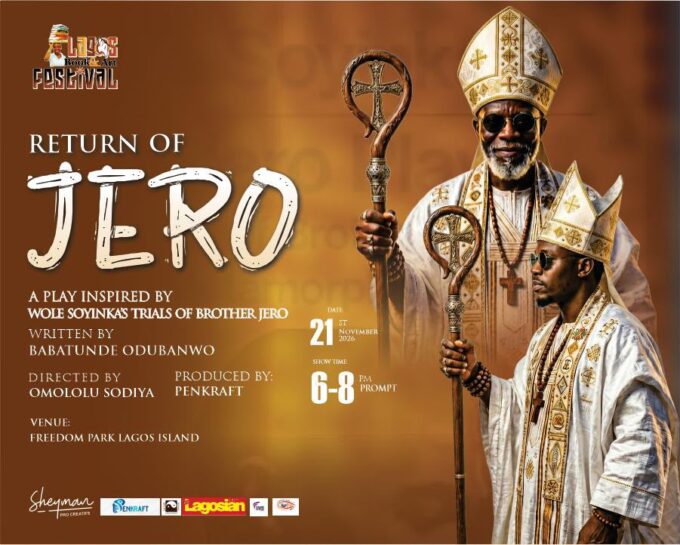
The Return of Brother Jero, Babatunde Odubanwo’s reimagining of Soyinka’s classic satire, stages on November 21 at 6 pm at the Amphitheatre. It reframes the prophet Jero for a generation that has grown up watching prosperity gospel and political theatre merge into a single spectacle.
Film offerings are strong. Tunde Kelani’s Maami screens on November 17 at 7pm at the Foodcourt, with Kelani present for a Q&A alongside Femi Osofisan. Cordelia, also directed by Kelani and adapted from Osofisan’s novel, screens November 18 at 8 pm. A documentary, The Marked, follows a woman’s journey from Taraba to Lagos through illness, poverty and abuse, screening November 19 at 10 am at Kongi’s Harvest.
For those interested in the creative economy, the AI Workshop on November 21 at 12 pm at Kongi’s Harvest, led by Pastor Dr. Adeoye Abodunrin, addresses how artificial intelligence is reshaping artistic expression. A conversation on “AI and Humanity” follows at 4 pm. The Publishers’ Forum on November 19 at 10 am at the J. Randle Centre tackles “AI & Literary consumption.”
The Open Mic on November 17 at 4 pm at the Basketball Court invites young creatives to reflect on Soyinka’s legacy. The Kayode Aderinokun Poetry Prize (KAPP) finale runs November 20 at 4pm, with cash prizes of ₦250,000, ₦150,000 and ₦100,000 for the top three. A live 3D Augmented Reality art experience on November 21 at 10:30 am at the CORA Library showcases Godwin Kalu’s work blending physical art with immersive digital technology, one of the first of its kind in Nigeria.
Osofisan at 80, Soyinka at 40 and the Archive
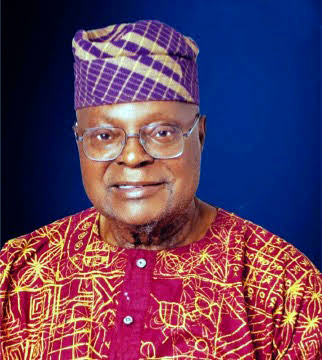
The festival’s intellectual spine is the daily #FemiOsofisan@80 series, running November 16–19 from 12 pm to 2 pm at Kongi’s Harvest. Each session examines a different set of Osofisan’s texts, with mentors including Professor Tunji Azeez, Sam Omatseye, Dr. Bunmi Adedina and Ropo Ewenla. The discussions are rigorous, and the texts, Literature and the Pressure of Freedom, Ireke, Morountodun, Best of Times, reward familiarity.
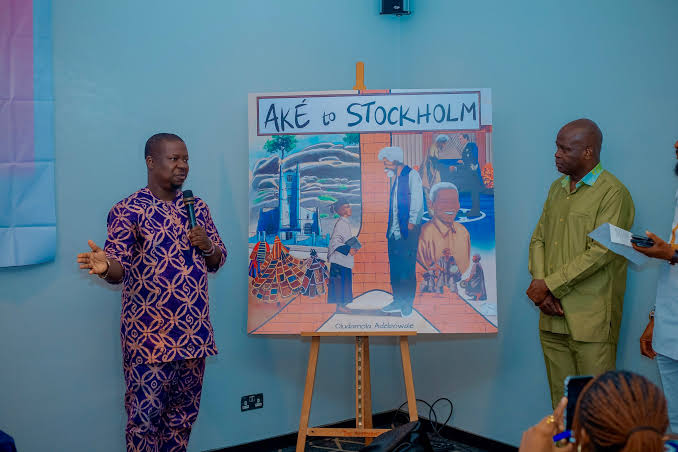
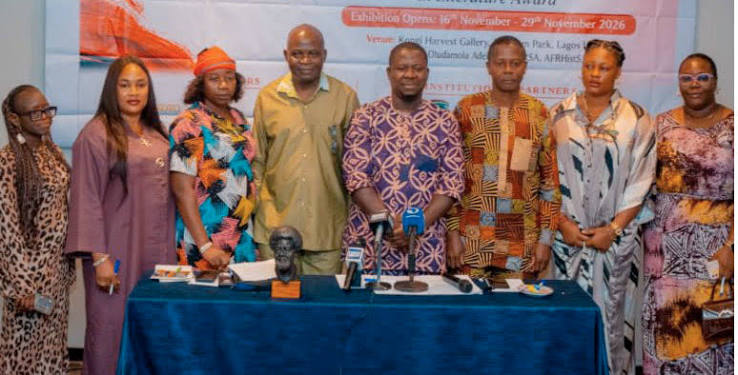
The Soyinka exhibition, “Ake to Stockholm,” opens November 17 at 3:30 pm at Kongi’s Harvest. Curated by Oludamola Adebowale of ASIRI Magazine, it features archival photographs, historical documents and mementos from Soyinka’s literary journey, marking 40 years since his Nobel Prize. A comic book adaptation and a documentary film accompany the exhibition, which runs through November 29.
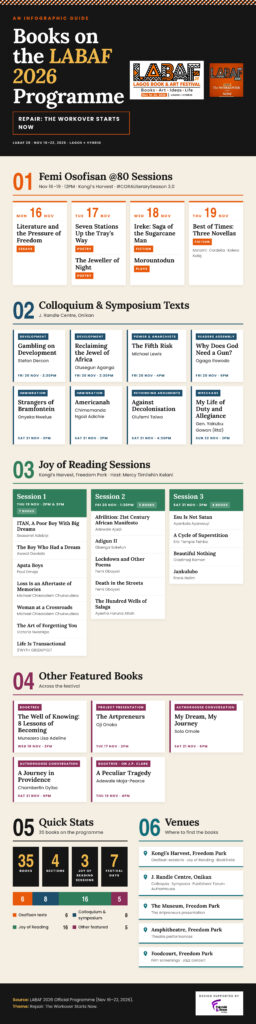
The colloquium series tackles the festival theme directly. “Arguments about Development” on November 20 at 2 pm at the J. Randle Centre features discussions of books by Stefan Dercon and Olusegun Aganga. “Immigration: Bandaging the wreckage” on November 21 at 2 pm examines Onyeka Nwule’s Strangers of Bramfontein and Chimamanda Adichie’s Americanah. “The Upending: Rethinking ‘settled’ arguments for repair purposes” on November 21 at 4:30 pm features Olufemi Taiwo’s Against Decolonisation, moderated by Akin Adesokan and Femi Morgan, with Kunle Ajibade as chairman.
The Readers Assembly on November 20 at 6pm features a performed reading of Why Does God Need a Gun? by Ogaga Ifowodo, winner of the $100,000 Nigeria Prize for Literature 2026. Nathaniel Olawoyin performs. The Ken Saro-Wiwa Prize for Book Review award ceremony follows at 6:30pm.
The Jazz Concert on November 20 at 8pm at the Foodcourt celebrates the Lagos Jazz Society at 10 and Inspiro Productions at 25, with a variety of bands.
The Green Festival and Mentoring
The festival’s youth programming is anchored by the Green Festival, running November 20–21. On November 20 at 9 am, secondary school students participate in the opening. An art workshop, “BARAKU: Innate attitude of an artist,” led by Wale Asubiojo, commemorates Soyinka’s Nobel anniversary through drawing. A mentoring session on November 20 at 11 am features Chude Jideonwo, co-founder of The Future Awards, speaking on “The Book in My Life.”
The CORA Youth Creative Club runs daily mentoring sessions for secondary school students from November 17–19 at 9 am. A “Pop Up Theatre on Freedom & civic responsibilities” on November 18 at 1 pm at the Basketball Court engages youths in political awareness through performance. A “Fingerprints of Humanity” art workshop on November 20 at 12 pm invites participants to create artistic interpretations of their fingerprints using drawing, painting, collage and printmaking.
The Details
LABAF 2026 runs November 16–22 at Freedom Park, Lagos Island, and the J. Randle Centre, Onikan. The full programme is available at the festival’s official channels. Most events are free. The theme is “Repair: The Workover Starts Now.”




Leave a comment