

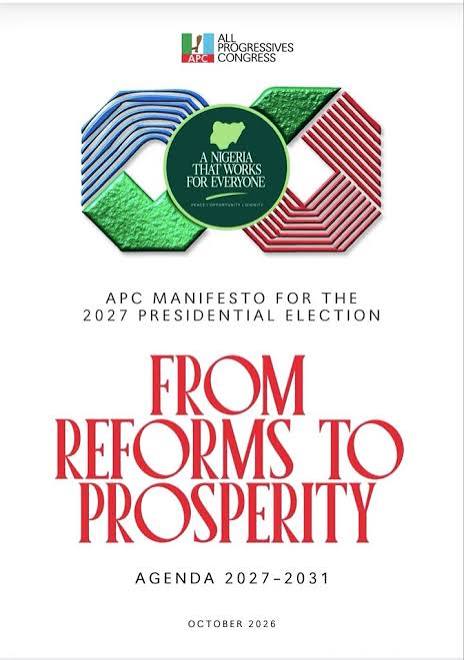
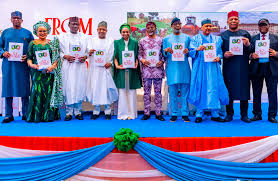
The All Progressives Congress has presented two manifestos in four years. The first, the 2023 Action Plan for a Better Nigeria, was a campaign document written by an opposition candidate asking to be entrusted with power. The second, From Reforms to Prosperity, is a governance document written by an incumbent asking for a second term and for the patience already shown in the first to be rewarded. Comparing the two reveals where the party’s thinking has matured, where it has simply repackaged itself, and where the gaps remain.
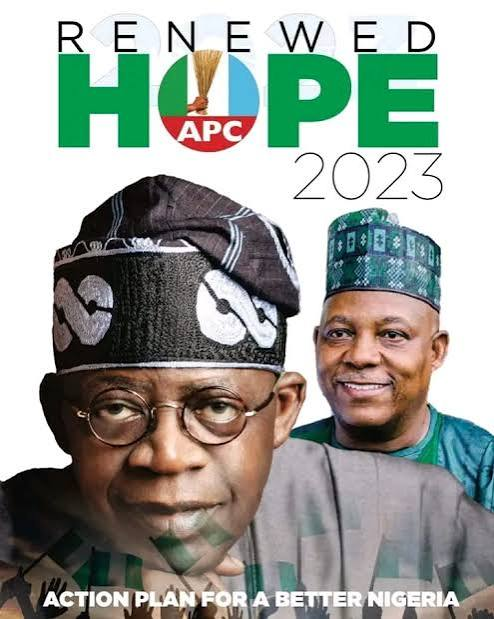
The 2023 Baseline: Aspiration Without Arithmetic
The 2023 document set out its commitments under a list of headings: national security, the economy, agriculture, power, oil and gas, transportation, education, healthcare, the digital economy, sport and entertainment, youth empowerment, women empowerment, social programmes, judicial reform, federalism and foreign policy.
Its defining characteristic was the absence of measurement. The power section acknowledged that Nigeria had approximately 12,000 megawatts of installed capacity, generated only 8,000 megawatts and distributed a maximum of 4,500 megawatts, but set no target for generation, transmission or distribution over the following four years. The security section promised to “recruit, train and better equip additional military, police, paramilitary and intelligence personnel” without specifying a number. The economy section promised to “turn Nigeria into a nation of creators, not just of consumers” without a growth rate, an export figure or a jobs target. It projected a GDP growth path of ten per cent in the chart that accompanied the text, but supplied no policy arithmetic to support it.
It also promised actions that the administration subsequently took and that the new document now reports as achievements: phasing out the fuel subsidy, merging the housing agencies into a single body, reforming the Bank of Agriculture, ending estimated billing through metering, and abolishing the multiple exchange rate regime. In other words, much of what the 2023 document promised, the government did. The gap between the two manifestos is not a gap between promise and delivery. It is a gap between a document that promised in adjectives and a document that promises in numbers.
The 2027 Document: What It Says and How It Measures
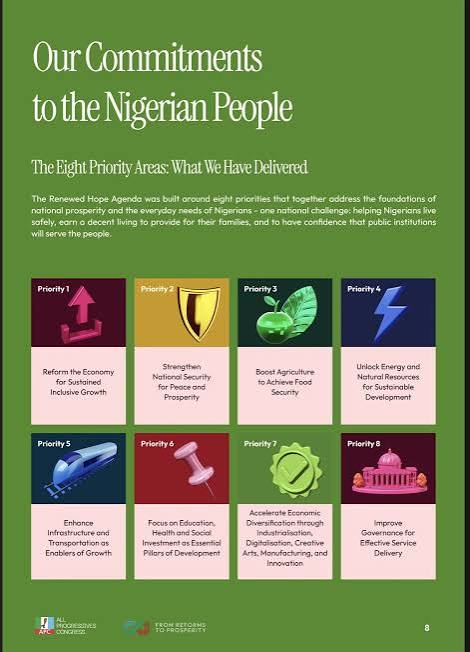
The new manifesto compresses the eight priorities of the Renewed Hope Agenda into four pillars: a Secure and Resilient Nation; Better Quality and More Affordable Life for Every Nigerian; Energy, Infrastructure and Economic Growth; and Effective and Accountable Governance.
Its most significant departure from 2023 is the introduction of measurement. Every pillar ends with a table headed “How Nigerians Will Measure Our Progress”, setting out what will be tracked, where Nigeria is today, and where it will be. Some of these are concrete. Power generation is to rise from an average of 4,022 megawatts and a peak of 5,800 megawatts in the second quarter of 2026 to at least 7,500 megawatts sustained average and 10,000 megawatts peak by 2031. Non-oil exports are to rise from US$6.1 billion in 2025 to at least US$15 billion a year. Manufacturing is to rise from 7.72 per cent of GDP to at least 12 per cent. ATC and C losses in electricity are to fall from 36.23 per cent to no more than 16 per cent. Consumer-price inflation is to fall from 14.63 per cent in September 2026 to at most 8 per cent by the end of 2031. Foreign direct investment is to reach at least US$5 billion annually. Consumer credit is to reach 50 per cent of economically active Nigerians by 2030, up from more than 350,000 Nigerians reached so far.
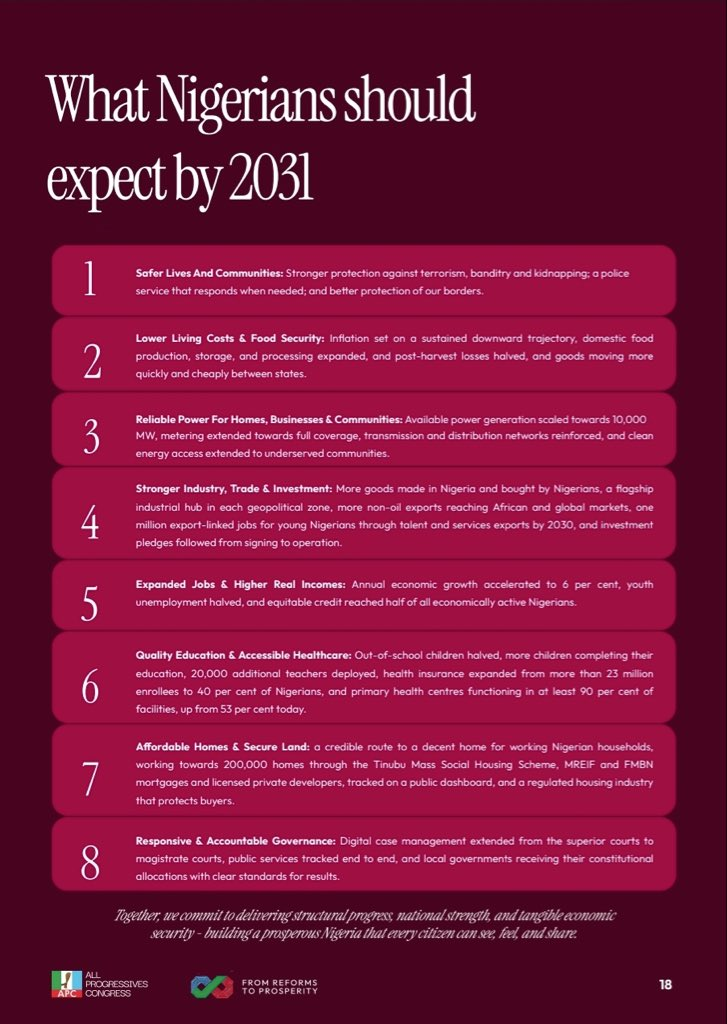
The document also introduces a delivery mechanism that did not exist in 2023: a public delivery tracker in which, in the party’s own words, “each commitment will carry a baseline, a target, a cost, an owner and a reporting date”. It commits to a First 100 Days programme of seven specific actions, including publishing baselines and named owners, publishing a quarterly cost-of-living basket, opening secured farm-to-market corridors with published security and output data, launching a Citizen Service Guarantee, and commissioning an independent audit of unfinished and under-used public assets.
This is a genuine advance in political thought. The 2023 document asked Nigerians to trust a promise. The 2027 document asks Nigerians to check a number. Whether the tracker is published, and whether its numbers are independently verified, is the test that follows.
What Has Changed in the Thinking
Three changes are substantive rather than presentational.
First, the diagnosis of the economy has moved from growth to productivity. The 2023 document spoke of an economy “unhelpfully designed to export raw material and import increasingly expensive finished products”. The 2027 document states the same problem with a sharper instrument. It reports that total foreign capital importation reached US$23.22 billion in 2025, but that only US$923 million of that was classified as foreign direct investment, with the bulk being portfolio capital. It then commits to measuring “capital actually deployed in productive assets, not headline investment announcements”. This is a more mature analysis. It recognises that hot money is not industrialisation.
Second, the federalism commitment has been operationalised. The 2023 document promised to “review the Constitutional legislative lists to ensure that States are given greater control over certain critical matters” and to “embark on a review of the federation revenue allocation system”. The 2027 document is specific: it cites the Supreme Court judgment of July 2024 affirming the financial autonomy of the 774 local governments, commits to publishing allocations to each council with performance standards, and promises to resolve the conflict between that judgment and Section 162 of the Constitution. It also commits to completing the Oronsaye mergers and to publishing exactly how subsidy savings are lowering the cost of governance. The 2023 document mentioned the Oronsaye report not at all.
Third, food security has been separated from agriculture and treated as a cost-of-living question. The 2023 document treated agriculture as a production problem: cultivate 65 per cent of arable land, expand irrigation, reform the Bank of Agriculture. The 2027 document keeps those commitments but adds a price floor through the N200 billion Guaranteed Minimum Price scheme, a strategic grain reserve with published reserve levels and releases, a monthly staple-food price tracker alongside headline inflation, and a commitment to halve post-harvest losses by 2030. It is the first APC manifesto to recognise that a farmer’s harvest and a family’s food bill are two ends of the same policy.
What Has Not Changed
Several things have not moved, and they matter.
The 2023 document promised to “establish a bold and assertive policy that will create the strong yet adaptive national security architecture and action to obliterate terror, kidnapping, banditry and all other forms of violent extremism from the face of our nation”. The 2027 document promises to “sustain intelligence-led kinetic operations against insurgent and kidnapping networks to degrade and dismantle their operating bases”. The language has changed from obliteration to degradation. That is more honest. But the structural commitment, to defeat armed groups militarily while addressing their recruitment through economic opportunity, is the same. Neither document explains how the military campaign will be sequenced against the economic one, or which comes first.
The 2023 document promised to “review and revise the Land Use Act” to streamline land conveyance. The 2027 document promises to “deliver the first phase of Land4Growth, one million digital land titles across 18 to 20 reform-ready states”. The Land Use Act itself remains unamended. Digital titling without statutory reform may produce certificates that are easier to issue and no easier to enforce.
The 2023 document promised that “government processes and procedures” in the power sector would be improved and that estimated billing would end. The 2027 document reports that customers on estimated billing fell from 7.22 million to 5.02 million, and that metering penetration rose from 44 per cent to 57.3 per cent. This is real progress. But it also means that roughly five million customers remain on estimated billing, and the target of full metering has been pushed to 2030. The 2023 document gave no date at all. The 2027 document gives one. Whether it is met is a different question.
The Gaps
Three gaps stand out.
The first is the security-food nexus. The manifesto’s second pillar promises affordable food and a halved post-harvest loss by 2030. Its first pillar promises safer farms. But the document does not connect them with a number. It does not state how much farmland is currently un cultivable because of insecurity, how many farmers are displaced, or what the security commitments are expected to do to food output and food prices. The insecurity data is well known: banditry and kidnapping in Benue, Kaduna, Niger, Plateau, Sokoto and Zamfara have removed whole farming communities from production. A manifesto that treats food security and rural security as separate pillars has not yet done the analysis that joins them.
The second is the financing of the commitments. The manifesto is rich in targets and silent on cost. It promises 154,800 housing units under the Tinubu Mass Social Housing Scheme, a capitalisation of the Renewed Hope Mortgage and Real Estate Investment Fund toward one trillion naira, 50,000 additional police officers, 28,000 additional army personnel, 30,150 civil defence personnel, 20,000 additional teachers, seven million additional meters, 200,000 homes, ten million tonnes of crude steel a year by 2030, and a services export target in the billions of dollars. It does not present a fiscal framework that shows how these commitments are funded within the debt-to-GDP ceiling of 60 per cent that it proudly reports at 36.85 per cent. The delivery tracker, if published, may answer this. The manifesto does not.
The third is the treatment of the opposition. The 2023 document was written by a candidate who expected to be in opposition. It promised judicial independence, respect for the rule of law and equality before the law. The 2027 document repeats those commitments, but it is written by an incumbent governing a country in which opposition parties are in court, opposition candidates are alleging arrest plots and opposition rallies are being disrupted. The manifesto’s governance pillar commits to “implement the National Policy on Justice and strengthen the National Judicial Council’s disciplinary timelines”. It does not address the more urgent question of whether the courts and the security agencies are being used against political opponents. A manifesto for accountable governance that does not name that problem has left a gap that voters will notice.
The Accountability Question
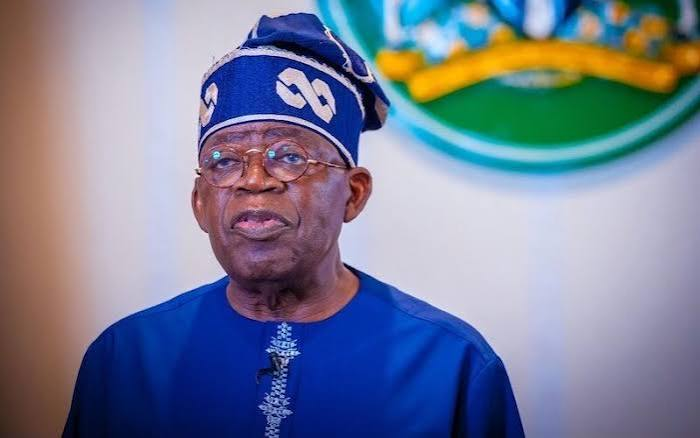
The 2023 document ended with a closing statement in which Tinubu wrote that “our appointment with our best destiny is preordained by the Hand that commits no fault”. The 2027 document ends with a closing statement that invites Nigerians to “hold us accountable” to metrics published in a delivery tracker.
That is an improvement in political rhetoric. But accountability is not a promise to be accountable. It is a mechanism. The APC has promised a public delivery tracker with baselines, targets, costs, owners and reporting dates. The first test of the 2027 manifesto is whether that tracker is published within the first hundred days, as promised. The second test is whether its numbers are verified by a body independent of the party and the presidency. The third is whether the tracker is updated when targets are missed, and whether missing a target carries any consequence.
If all three happen, the 2027 manifesto will be the most accountable governing document any Nigerian party has produced. If none of them happen, it will be a better-written version of the 2023 document: more precise in its promises, no more binding in its delivery.
The 2023 document promised a better Nigeria. The 2027 document promises to prove it, with numbers, by 2031. Nigerians have four years to check the arithmetic.








Leave a comment