

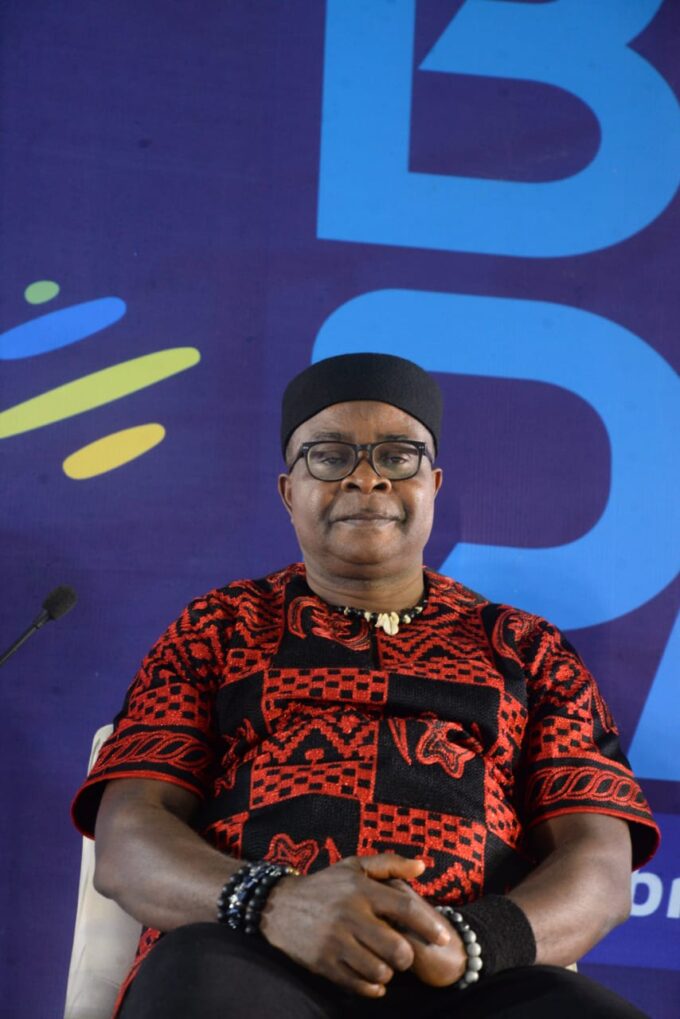
By Chibuzor Alli
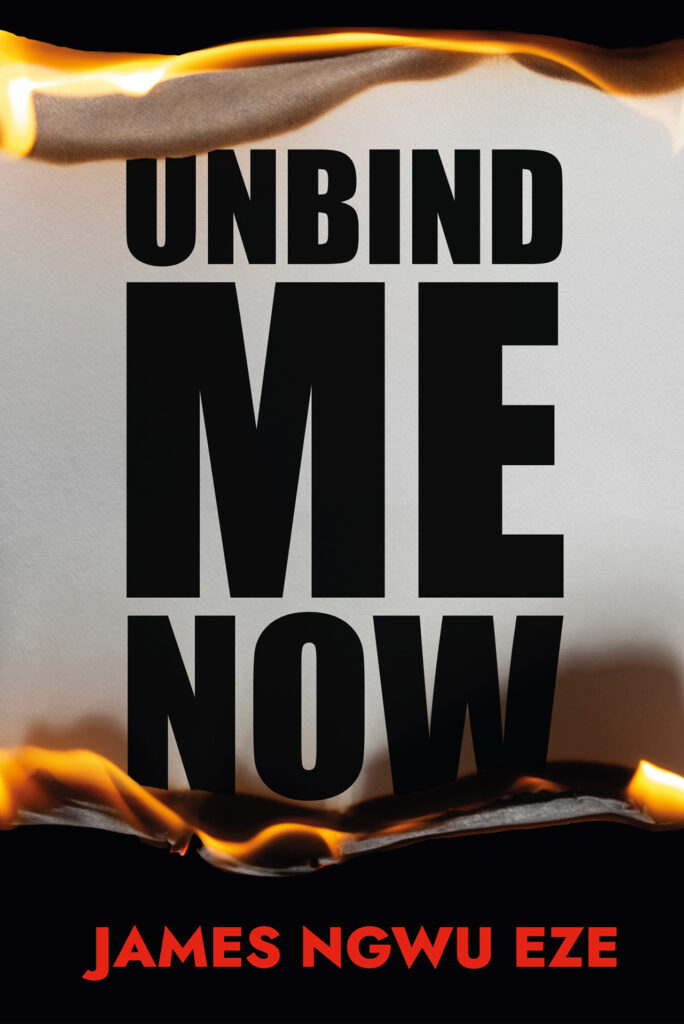
Outrage, identity and history run through James Ngwu Eze’s latest collection, Unbind Me Now, where poetry becomes a voice against injustice and erasure. In an interview with Chibuzor Alli, the poet reflects on his Igbo heritage, his writing and his return to the Nigeria Prize for Literature longlist.
Unbind Me Now is your second poetry collection, following Dispossessed, which was longlisted for this prize in 2022. How does this collection differ from your debut?
Dispossessed can be assessed from two major perspectives; it is a debut collection that carries a massive hint of innocence and a foretaste of the coming storm. It is both coming-of-age poetry and a song of lamentation. It is broken into three segments; innocence, transgression and atonement. Through these archways, the poet maps his journey from childhood (innocence), through (transgression) adolescence to atonement (adulthood).
In “Innocence,” the poet persona attempts a self-definition to demonstrate his journey into existence and the beginnings of his creative imagination. He also offers a rare view of his childhood years and the forces that shaped his poetic sensibilities.
Having sufficiently introduced himself, he stolidly evolves into a personage of acute curiosity in “transgression” where he unfurls like a petal to absorb and be absorbed into the intensities of youth. Those intensities came with fires that singed and purified his tongue for far more heavy utterances that manifested in “atonement” on the weighty matters of the day that kept him awake at night.
The poet persona’s journey in Dispossessed did not end on a happy, soothing note. It ended on the runway that would make for a smooth takeoff for a more onerous odyssey ahead. When a journey evolves from innocence through transgression to atonement and eventually to a wailing against the forces that have dominated one’s life, what is the next likely destination? His options are not many.
He either capitulates in total acceptance of his fate or builds a new muscle to blast his way through the furnace. Building these muscles requires a period of exfoliation and tenderness. That period gave birth to the book titled “Goosebumps,” a collection of 50 exquisite love poems drenched in tenderness.
Goosebumps is the in-between book which enabled the poet a moment of hiatal grace to regain his breath for “Unbind Me Now.” I am carefully tracing the arc from Dispossessed to Unbind Me Now to show you the tortuous growth trajectory of the poet persona. From this arc, it becomes easy to see that there are three stages; lamentation and helplessness (dispossessed), agency and action (Unbind Me Now) and the final outcome which hints at a third book that will complete the circle. As would be expected, Unbind Me Now shows significant ambition and growth.
While the poet persona mourned the death of innocence and wanton displacement in Dispossessed, he demands immediate action in Unbind Me Now. We meet a poet who has now grown enough muscles to press charges on the forces holding him and his society down for years.
He shows a streak of impatience, his voice quavering with outrage, his pain seeping into verses that burn holes without caring to stitch wounds left behind. He names his fears as he warns in the poem entitled The New Baptism:
i am from a place
where things
have lost their names
and my poetry
shall rename them.
He worries about erasure, about the extinction of minorities, and about genocide. He thinks that the first step to fighting a scourge is by calling it out in its proper name. Terrorism should be terrorism, not insurgency! That is a giant leap from the obsessions of “Dispossessed” I hope.
Your earlier work has been described as a “poetic representation of life” through the eyes of a poet. How does Unbind Me Now continue that exploration?
That description is apt. My earlier work presents life in its very familiar stages: childhood (innocence), youth (transgression) and atonement (adulthood) with its trademark weight of responsibility.
In much the same way, Unbind Me Now chats a different growth path that deploys fire as a dominant motif, signaling discontent, warning and witness. It makes its case through flames and smoke, in five carefully chiseled segments; Burning Bush, Slow Burn, Silent Ember, The Tenderness of Fire, The Hush we once lived in and To a Grieving Earth.
Unbind Me Now plucked tongues of flame from Dispossessed to continue the anxieties expressed in that book. The slight difference is that in Unbind Me Now, the poet persona assumes a fuller responsibility, appropriating the voice of his people to express their anger unwaveringly. He widens the scope of the engagement and erupts in a full throated growl with incendiary verses that stretch from the opening poem to the last one.
There is no let off even in the tenderest poems in the collection as even a poem which addresses identity and belongingness still manages to land with a thud;
it is enough to be human
to inhale the unseen air
and to flare as a fleeting spark
bright against the vast void
Indeed, a close reading of Unbind Me Now shows a progression of thought, a heightened artistic vision and a voice that refused to crack under unspeakable pressure.
What was the most challenging aspect of writing this collection?
The most challenging aspect of writing Unbind Me Now was the challenge of picking up outrage as a theme and distilling it through different dimensions and arteries of feelings without sounding repetitive or banal. There was also the danger of soaking the entire collection in unreasonable anger rather than redemptive anguish.
When I set out to write Unbind Me Now, I knew exactly what I wanted to say. What I did not know was how to say it without impeding the message. How to say it, not just with clarity but with an impulse that is universally recognizable. And that is where craft comes in. That is also where language kicks in.
The challenge was therefore to sculpt the architecture of a language that would be robust enough to carry my rage and delicate enough to affect the reader and conscript him for my message. Did I succeed in that effort? That is for the individual reader to decide.
You were the pioneer literary editor of Sunday Sun. How has your editorial experience influenced your own creative writing?
I think my journalistic background has actually made me a better writer. At the beginning of my career, two very important writers used almost the same word to describe my writing then. I can almost swear that none of them would remember this but I recall that my big brother and mentor Nduka Otiono once told me that my writing was “florid.” I also remember my dear sister, Chimamanda Adichie telling me that I wrote with a “flourish.” I didn’t see those observations as criticisms. I saw them as sharp thorns that kept me awake.
So, I was largely awake as the Literary Editor of Sunday Sun. I invested my wakefulness in my pursuit of excellence on the job which led to many life defining encounters with literary figures that shaped my personal understanding of arts and literary aesthetics.
I remember travelling from Lagos to Enugu to interview Prof. Ben Obumselu simply because I came across the “Acknowledgments” page of Labyrinths where Christopher Okigbo had intoned, “and to Benedict Obumselu for criticisms that continue to guide me along the paths of greater clarity.” I was intrigued by the depth of this personage that had the capacity to guide the great Okigbo to greater clarity and I felt that to understand Okigbo, I’d have to meet and talk to him. That quest opened Okigbo’s poetry up to me in a way that no poetry class would have done.
I also remember travelling to Port Harcourt to interview the great Gabriel Okara, whose, “The Call of the River Nun,” seized my creative imagination from childhood. I also interviewed the novelist Elechi Amadi at the same time in Port Harcourt. All those encounters heightened my understanding of the power of literature and served as my passport to serious writing. I would not have had the encounters if I were not a literary journalist.
The judges described the long-listed works as demonstrating “lyrical intensity, symbolic depth, and artistic innovation.” How much did these qualities feature in your process of creating this collection?
To be honest, I would sound extremely immodest if I were to lay such claims about my work. To my mind, that decision is for the readers and the critics and the judges. I don’t think that any writer should come out to lay direct claims to lyrical intensity, depth and artistic innovation. That does not belong to us.
Can you share some writings (both fictional and non-fictional) that influenced unbind me?
In all sincerity, I cannot think of any existing literature that influenced my decision to write Unbind Me Now. All I can remember is that I have read many good poems from poets whose works I greatly admire, but even so, the works I read are not outrage poems. They are great poems that address diverse themes. In retrospect, I am glad that I didn’t read any protest poems before writing Unbind Me Now.
The influence would have been unmistakable. Unbind Me Now came from extreme displeasure and a strong desire to speak for the voiceless. That is why the title poem “unbind me now” is the first poem in the collection after “divination time,” which is a prologue, introducing the poet persona into the traditional village square with fanfare as an important personage, and presenting the totems of his heritage; kolanuts, a hen mid-term, a ram with contoured horns and invoking the four market days to bear witness to his arrival.
The basic understanding here is that the poet persona is also summoning his heritage and asking for permission to speak for it. There is a resolve to ask difficult questions of the society which ways he seeks to change. Of course there are tonnes of protest poetry out there but I can’t remember reading any or being influenced by one.
How does your Igbo identity inform your poetry?
My Igbo heritage has a huge direct bearing on my poetry. I come from the same culture that produced the historic figures of the fabled Igbo Landing; the story of the 75 slaves who chose death by water than a life in bondage. I am also from the culture that produced the famous Aba Women’s Riots of 1929 which gave the colonial masters a taste of the strength of Igbo matriarchs.
And finally, I am from the state where coal miners rose to demand better conditions of service from the colonial masters in 1949 and stood their ground against the blaze of colonial guns which claimed 21 of them and triggered the spate of events that led to Nigeria’s independence, eleven years after.
And let’s not forget that my people were practicing democracy long before the Greeks found a name for it. How then can my poetry afford to be passive or conciliatory in the face of grave injustice? I come from a culture that asks questions and encourages everyone to say their mind. This heritage is at the core of my art, be it poetry or music.
You were longlisted for this prize in 2022 with Dispossessed. How does it feel to be back on the longlist?
I feel deeply grateful and fulfilled to be back on the long-list in 2026. Without meaning to sound immodest, I think it says something about my poetry. I feel greatly encouraged to write more, to push myself harder and strive for all the attributes that make for a great art in my next work. I must not also forget to thank the NLNG for having enough presence of mind to set up a system that rewards excellence among writers every year. It has served as a huge encouragement to many writers.
What does it mean to you to be longlisted alongside both veteran poets like Tanure Ojaide and emerging voices, and what do you think that means for Nigerian literature?
I think I am familiar with writing enough to know that it is difficult to convince a panel of literary judges to select a book among a plethora of choices. So, to make the long-list of eleven out of 223 poets that entered their works for this prize is a big endorsement in its own right. It means a lot to my entire career as a poet. When you throw in the fact that I am making a second appearance, it doubles the weight of being on that list.
To be judged and found worthy of recommendation for higher assessment should mean a lot to any writer. Meanwhile, I have a lot of respect for established writers but perhaps even more for emerging voices who have forced their way to reckoning with the fire in their works. I consider it a great honour to be listed amongst them. But to my mind, everyone on that list is a winner already. It doesn’t matter who finally goes home with the medal.
Quite frankly, this prize means the world to Nigerian literature and our revered literary tradition. It gives writers validation for their thankless efforts to create a world we can all aspire to build, to assume the role of the conscience of the society, and to preserve a great literary inheritance. Indeed, there is no gainsaying the importance of this gesture to the Nigerian letters.
The Advisory Board noted that the long-listed works “interrogate dominant historical narratives.” How does Unbind Me Now do this?
I have always believed that every serious work of art should interrogate dominant narratives, whether historical or contemporary. However, explaining how Unbind Me Now did that would amount to needless chest thumping. I think it is just enough to accept the verdict of the judges in this instance or seek the answer from what the critics say about the works.







Leave a comment