


By Chibuzor Alli
For Tares Oburumu, poetry is rooted in memory, place and history. In Flora’s Love Colony, he draws on the Niger Delta and Nigeria’s past to explore identity and belonging. Longlisted for the Nigeria Prize for Literature, Oburumu talks to Chibuzor Alli about the place that shapes his poetry and the journey behind his work.
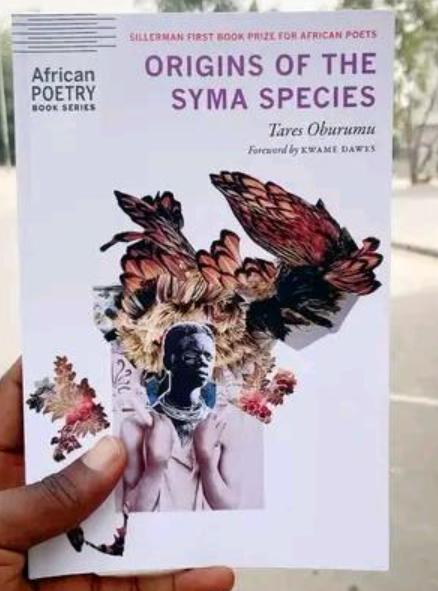
Your debut collection Origins of the Syma Species was a brief history of the neglected oil-producing region of Syma. Flora’s Love Colony seems to take a different turn. What inspired this shift?
Shifts are generative processes, moving from perspectives only to arrive at something completely different from the other. Where you see shift, I see alternates, not disrupting the flow that has always been the forte. The two collections say different things and are not different. Flora’s Love Colony is a call to a higher purpose within the origin of the Syma Species. All my life is a movement, without breaking the linearity as I see in a cycle, towards the end of something I am yet to grapple with, which I am convinced is endless. So is my poetry; historical, tracing what began in my absence to what present I embody, to what lies in the fog ahead. Both speak of the place I am from, to sustain it in forms and text.
Your work is deeply rooted in the Niger Delta. How does that region continue to shape your poetry in Flora’s Love Colony?
If I do not write about the things that make me, who would? You can now see the continuity, not the shift. Art itself is a lived experience even when it’s imagined. You can only imagine what you see, not what you cannot see. An attempt to see what you don’t see create for you the burden of the obscure and this is not what should be seen as literature. As a man, I carry in me the place of my birth, where I survived and where survived me, the link between who I was, who I am, and who I will be that is not foreign. It’s native. I want the world to see me through the lens I have produced as a child, in every case, my language never falters in telling it where I come, so it could see what it truly is.
How does your identity as someone from the Niger Delta inform your perspective on love and community?
How strange is it to me that we explain the world away using maps, borders, identity, culture and mores. The import of such things as we hold dear, confuses me, ⁰and they are as startling as they are inextricably tied to existence. Sad how I fall into the categorisation by being aware of who I am and where I am from, the color of my skin, or the shape of my face, the inflection of my voice, the way I pronounce my R and S, the points, low or high, from which I see, perceive and define the other who, perhaps, want my love, or do not know about it. We are all parts of the mystery life and love is, and that’s what matters, being parts.
What does “home” mean to you, and how is that reflected in this collection?
Home is where I am from. It’s origin. It’s sacred. It’s the root of one’s existence. It’s surreal, how you come to be, inhabitting a space long peopled before your arrival. You are its memory, the uncommon spirit. You know it like you know you are alive. Then from the blues, come the intruder who doesn’t know you, or your true self, that potential core from which the future emerges. Colonialism, whatever the argument, was unarguably evil. Still working on with patterns as subtle. I have to take care of the odds in this collection. And I am satisfied with how I tend towards home as a place we, as Nigerians, cannot give up for another.
How did you develop your poetic voice, and how has it evolved from your debut to this collection?
Voice comes and I am not aware of it, or how it has evolved over the years. All I know is that which I have been writing without a stop. When something has chosen you, you become its most prized part. Its will, practically, becomes yours. I cannot say how much of the effect its power have over me, I can only say I am blessed to have known what has chosen me, not to stultify me but that in that will I make progress. It’s perhaps the progress you call evolution. But I am not aware of it. Not yet.
The judges described the longlisted works as demonstrating “lyrical intensity, symbolic depth, and artistic innovation.” How much do you believe your work embody these qualities?
Flora’s Love Colony is my own way of living the life I have always wanted; deepening the essence of the unusual, finding peace in music, symbols and depth. Origins of the Syma Species was one way to live. Here’s another. I love calling things not by their names or nature but by what they wish or love to be known as against the conventional humour. There’s more to the history of Nigeria than we know. To write about it is not to conform to the inherent blandishment. If the language in that collection was achieved by calling a spade by what it is known, the beauty of it would have been lost.
You won the Sillerman First Book Prize and are now longlisted for the Nigeria Prize. How does this recognition feel different?
It makes me feel more Nigerian than I was a few months ago.
What does it mean to you to be longlisted alongside both veteran poets like Tanure Ojaide and emerging voices in Nigerian poetry?
I read Tanure Ojaide when I was in my pre-teen. It’s extraordinary as everyone would feel seated with one’s idols.
The Advisory Board noted that the longlisted works “interrogate dominant historical narratives.” How does Flora’s Love Colony do this?
Flora’s Love Colony is a book of history from a poet’s point of view. Dominant among the narratives are the transatlantic slave trade, the amalgamation and the Biafra War. I could not have written it without these events that have given Nigeria shape.
What role does poetry play in representing the experiences of marginalized communities in Nigeria?
I don’t know about such roles. The word ‘ marginalised ‘ doesn’t fit into my contemporary mind and how I have come to terms with it. I have a broader perspective, I guess.









Leave a comment