

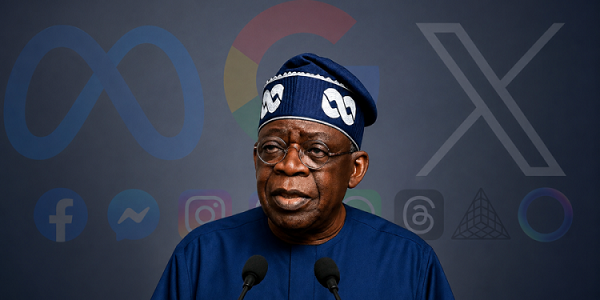
The FCCPC Probe into Meta, X and several artificial intelligence platforms has begun after allegations that global technology companies engaged in unfair business practices against Nigeria’s media industry. The investigation follows a directive from President Bola Tinubu and seeks to determine whether digital platforms violated competition laws or undermined local news organisations.
The Federal Competition and Consumer Protection Commission (FCCPC) announced the inquiry after receiving a presidential directive prompted by a petition from the Nigerian Press Organisation (NPO).
Tinubu orders investigation after media petition
The Federal Government directed the FCCPC to investigate the concerns raised by Nigeria’s leading media organisations.
The instruction came through a letter signed by the Minister of Information and National Orientation, Mohammed Idris.
According to the commission, the inquiry follows a petition submitted by the Nigerian Press Organisation. The body represents the Newspaper Proprietors’ Association of Nigeria (NPAN), the Nigeria Union of Journalists (NUJ), the Broadcasting Organisations of Nigeria (BON) and the Guild of Corporate Online Publishers (GOCOP).
The media groups argued that several global technology companies have adopted practices that threaten the sustainability of Nigeria’s news industry.
They specifically named Meta, Alphabet, X, formerly known as Twitter, and several Generative Artificial Intelligence platforms operating within the country.
FCCPC to examine competition and copyright concerns
The commission said the investigation will focus on allegations of abuse of market dominance and other anti-competitive practices.
It will also determine whether technology companies used copyrighted news stories, broadcast materials and other journalistic content without permission.
According to the petition, some platforms may have extracted or scraped media content to train Generative Artificial Intelligence models without obtaining proper authorisation from publishers.
In addition, investigators will examine claims that Nigerian media organisations have not received fair commercial agreements or adequate compensation for the use of their content.
The commission stressed that the investigation will also cover Generative AI companies providing services in Nigeria.
Tunji Bello promises transparent inquiry
FCCPC Executive Vice Chairman and Chief Executive Officer, Tunji Bello, assured stakeholders that the investigation would remain fair and evidence-based.
He said the commission recognises both the importance of a free media and the value of technological innovation to Nigeria’s economy.
According to Bello, regulators will carefully assess all available evidence before reaching any conclusions.
“We recognise the strategic importance of the media to Nigeria’s democracy and the equally significant role of technology in driving innovation and economic growth.”
He added that the commission’s responsibility is to establish the facts while ensuring that competition in Nigeria’s digital economy remains transparent and consistent with national laws.
Bello also emphasised that the inquiry should not be viewed as proof that any company has violated the law.
“This inquiry is not directed at any entity by presumption of wrongdoing. Rather, it is an opportunity to carefully examine the facts, hear from all affected parties, and determine whether any conduct has resulted in anti-competitive outcomes or unfair business practices.”
Previous enforcement actions and international examples
The FCCPC noted that it has previously taken enforcement action against Meta.
In 2025, the commission secured a court judgment that imposed a $220 million penalty on the technology company over alleged violations of the Federal Competition and Consumer Protection Act.
Meta has appealed that judgment.
The commission also referenced developments in South Africa, where the country’s Competition Commission investigated Google’s relationship with news publishers.
That process resulted in Google agreeing to pay approximately R688 million, or about $40 million annually, to South African media organisations for between three and five years as compensation for the use of their content.
The FCCPC believes similar issues deserve careful examination in Nigeria as digital platforms continue to play a larger role in news distribution and content consumption.
The FCCPC Probe marks another significant step in Nigeria’s efforts to regulate global technology companies and protect local media organisations. While regulators have not accused any company of wrongdoing, the investigation will examine whether competition laws, copyright protections and fair commercial practices have been respected. The outcome could influence how technology companies, AI developers and Nigerian publishers work together in the future.











Leave a comment