

Femi Morgan & Kehinde Folorunsho

All over the world, festivals serve as a representation of integral cultural beliefs and values that are taken to be cross generational. The activity transcends the enthralling immediacy of ethnic picturesques; it presupposes the interpretative associations of participants and observers alike. Still, within the margin of its sacredness, a traditional festival is believed to hold certain ingredients of meaning which can be substantiated throughout existing discourses. That is, past the first hand reports and eye witness accounts of the contents of a festival, there is usually a third party to be intimated.
The reason for this is a standby basis. The civilisation of a people is not a standalone availability of their occasional showbiz of ancestral heirloom. There is the need to translate that bequeathed exercise into an ideological framework with which mental lifers can relate. This is not a transmogrification of the original apologia as some civilised outlook on culture is wont to. But to provide a cemented relationship between tradition and modernity in its perceptive integrity. This follows that the societal evolution of a given people’s culture need be translated to an aperçu that accommodates a thought-provoking oversight within a contemporary culture (in this context, the accessibility of local tradition with the arsenal of Western education).

Nigeria as a whole brims with festivals. It is home to numerous ethnic groups – the most ethnically diverse country on the continent – and cultures. The land also houses one of United Nations’ recognised tourist attraction centers, the Osun Oshogbo sacred grove. These facts establish that cultural identity is the nucleus of ethnic consciousness in Nigeria with the implication that creative conditions are created to undergird the sustainability of these practices and to resist any fanciful hegemony. This explains why viable prospects are still being undertaken to investigate the ingredients of liveliness of a cultural festival; the philosophy on which it keeps thriving more so.
The throbbing pertinence of these commemorations is their representation. For one, this denotes what they stand for; for the other, it is the viability of their social pedigree. The former posits that tradition is the touchstone of a people’s aboriginal civilisation. It holds some complexity which cannot be dismissed as moribund patterns of an outlandish ideology or the dramatisation of a backwater legend whose inveterate praxis spells the plaguing underdevelopment of a nation. For the latter, it is the how and why we have survived the travesty of western ascendancy – education or religion. As a matter of course, this is not to create a melange of apologetics on the matter! The fundamental issue being addressed is the ideals and values that have become the onus of the enlightened to project within the margins of their own social visions as carriers, bearers, or observers of an authentic yardstick of cultural adaptation.

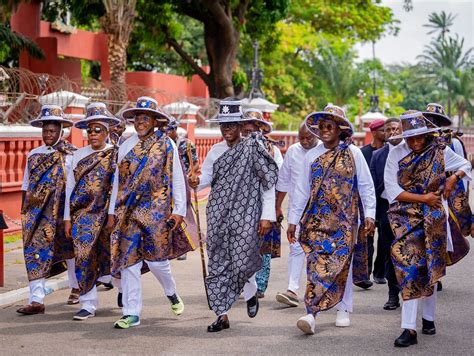
The subject of this criticism is the recently concluded Eyo Festival in Lagos. The festival, celebrated on the island part of Lagos, is one that holds the value of Lagos’ primary traditional inclination. It is celebrated occasionally, to mark and offer a dignifying passage rite to the canonical figures of the land – who are thought to be the founding fathers of the regions. By that token, some select families are the custodians of this exercise; they are the ones who regale the cloak in different displays of cultural ebullience. Its costume includes a large hat, a flowing white robe and a staff called the ọ̀páǹbàtà. The Your bearers parade the street in a show that entertains the onlookers and also rivets them to the self-styled manners of offering prayers to those who bid the function. This cause is directly indexed to the general Yoruba belief in ancestral spirits as being existent among their descendants and serve as the conduit to beat their prayers to the Supreme Being.
How is it that such a festival whose significance touches the heart of Lagos misses a mark of transcendental approbation? Besides her voltage tendency of a London prospect in terms of commercial activities, extravaganza, and modernity, Lagos is known to personify certain artistic traditional imprints. As a historical site, the vast water body that surrounds the state is testament to the experiences that are inextricable from the formulaic demography of peoples and cultures on the surface of its soil. In other words, Lagos water body is a polemic basis for tracing the fundamental bounty of origin. In the same breath, the aboriginal integrity of the Eyo Festival as a heirloom on the Island is fundamental to the needed pool of exigesis on how it fosters contemporary, cultural evolution.
The most immediate consequence of the absence of intellectual intervention is the reduction of culture to spectacle. Where there is no guided interpretation, flamboyance assumes authority: the white garments, the towering hats, and the choreographed procession lose their semiotic gravity and function chiefly as objects of fascination. In such a condition, culture no longer speaks; it dazzles. But a festival like Eyo is supposed to communicate memory and metaphysics; sadly, we had a dissolution into an aesthetic event whose value lies in its capacity to attract attention rather than to provoke understanding. Therefore, the masks and robes, intended to mediate ancestral presence, seem to have been consumed by the gaze of the crowd and the lens of the camera thereby making meaning recede while spectacle dominates.
Closely allied to this is the problem of epistemic exclusion. In the absence of televised conversations or symposia, the interpretive power remains the preserve of a closed custodial circle and knowledge of the festival becomes hereditary rather than dialogic. The educated observer encounters the festival only as spectators, not as participants in its significance. Now this is a silent gatekeeping that reinforces a hierarchy where access to cultural understanding depends on lineage rather than inquiry. This default renders representation restrictive rather than inclusive. Consequently, tradition retreats into guarded opacity. In this sense, the festival, while publicly displayed, remains intellectually confined with its deeper resonances accessible to only a select few.

There is also historical amnesia. Journalistic reports privilege immediacy; they record the colour of the moment and not necessarily sustain memory or interrogate origins. Without intellectual mediation therefore, the Eyo Festival becomes detached from its genealogies and socio-political roots. That is, the ritual persists, but its narrative continuity weakens. What survives is form without context. Over time, this detachment renders the festival vulnerable to distortion and fragments of meaning circulate without anchorage in history. The very elements that mark it as a living cultural practice leave only the external trappings of the celebration visible to the public eye.
Finally, the absence of intellectual engagement condemns the festival to cultural stagnation within a rapidly evolving urban context. Lagos is not a static cultural space: it is shaped by migration, religious plurality, and modern sensibilities. Without reflective discourse, the Eyo Festival remains ritualistically fixed. It survives through repetition rather than renewal. Tradition endures, yet thought does not advance alongside it. In this state, culture persists without vitality. It is only present in form but absent in relevance. While the city moves forward, the festival risks remaining tethered to ritual patterns that do not respond to contemporary challenges or evolving social consciousness.
To insist on intellectual intervention is not to demand the desacralisation of the Eyo Festival nor to subject it to the cold authority of abstract theory. It is, rather, to affirm that culture matures through thought. A civilisation that continually performs its heritage without interrogating it risks mistaking endurance for relevance. The absence of forums where meaning is examined leaves the festival suspended between reverence and spectacle. Inclusive representation, in this sense, is not achieved by widening attendance alone. It is achieved by widening interpretation. The value of cultural inheritance lies not only in its performance but in the capacity to engage minds, to provoke reflection, and to invite dialogue across generations and social boundaries.
The Eyo Festival occupies a privileged position in the symbolic imagination of Lagos. Yet symbolism unattended by critique risks exhaustion. For a city that prides itself on cultural dynamism and intellectual production, silence becomes an odd contradiction. The task before cultural institutions, scholars, and media platforms is not to reinvent the festival, but to render it intelligible beyond its immediacy. The masquerades, impressive though they are, require accompaniment by discourse. Until such platforms exist, the Eyo will continue to command the streets while evading the mind. It will dazzle without enlightening, celebrate without interrogating, and endure without evolving.
In all, the festival’s survival cannot be measured solely in terms of attendance, spectacle, or media coverage. Its endurance must be matched by a parallel cultivation of understanding, critique, and discussion. Only then can the Eyo masquerades transcend their immediate flamboyance and serve their true function as vessels of ancestral memory and social cohesion. Intellectual engagement is not an optional accessory to the festival; it is the necessary condition for its full vitality. Without it, the city celebrates, the crowd cheers, and the spectacle dazzles but meaning slips quietly into obscurity.











Leave a comment