

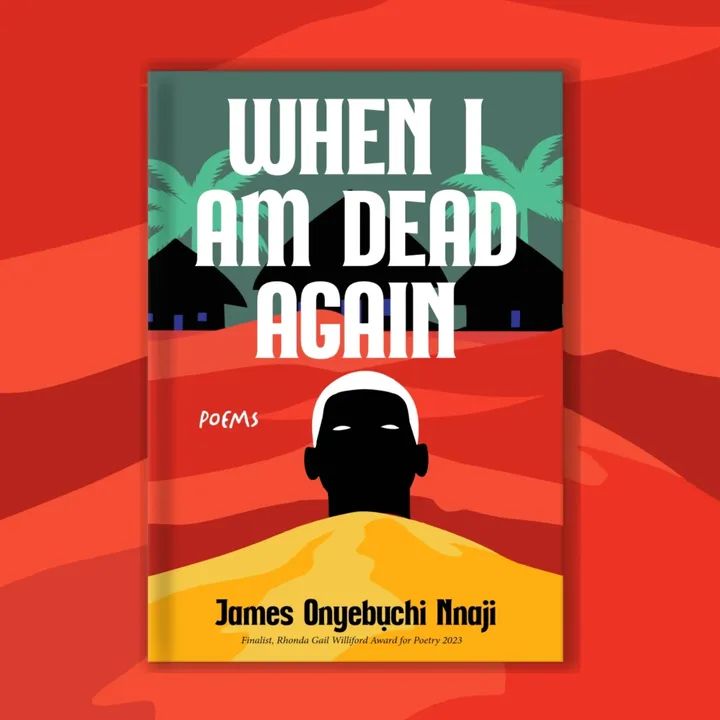
Prevailing Post-independence Disillusionment in James Onyebụchi Nnaji’s When I Am DeadAgain
Time and again, the artist has shown that we cannot dispute the present social order with certain implications of its correspondence with the past. That is, what currently obtains in society can be analysed with a lens of past events. These events could be political, historical, cultural or any other categorical institutions. It is not surprising to find at least two of these institutions intersecting in the reading of literature. It is this possibility that provides a backdrop for the issues raised in James Nnaji’s When I Am Dead Again (Dead Again hence).
Dead Again is a personal reflection on the socio-political trajectory of the poet-persona’s society. With vivid allusions and excellent spatial references, all indications point to Nigeria. This reflection is drawn from the consciousness of a continuing disorder. The poet, very much fascinated with the potential of the fatherland, is distressed at the downturn with which it has met. It revisits the prognosis of the past. It examines the possibilities of the present. Altogether it projects, as great works tend to establish, the seeming contraption for the future. In this regard, the poet samples the social conflicts that stare the nation in the face.
For context, Nigeria has had several internal political turmoils peaked at the Civil War. The consequence of it all is the underdevelopment we embattle. But even within that spectacle, Nanji raises a couple of questions. To be discovered are questions about the goal of nationalism; about lessons from the past; about the portents for the future. When these matrices are drawn, there is certainly going to be the conclusion that Dead Again masterfully presents vivid and fresh perspectives about the events that have always described our predicament as a nation. It questions the objectives we bring into nation building – both as individuals and as a group.
This sedulous work is an odyssey. It takes the reader through the historical and political interventions of forces at play. In light of the aforementioned social reality, history is influenced by politics and politics by history. This interplay creates layers of interpretation. The reader finds that even the supposedly personal submissions have their footing in a naturalist’s ideology. That is, an organism is affected both by heredity and environment. What a brilliant equilibrium! The environment here is the precarious conditioning by virtue of the obligations of patriotism. The consequence is mortality crises in significant characters of inhumanity. The narrative presents the eyesore of the chauvinist’s complacency.
For its historical underpinning, Dead Again raises concerns about the imperialist influences that plague Nigerian society. It revisits the past and uses its viable remnants to assess the extent of the progress we so profess. For example, the sham and spurious diplomacy of nations has always been a factor in the ideological underdeveloped of the nation. It also features in the economic regression and stagnation. All this is predicated on the clout of post-independence.
The discovery of fertile fleshpots of credulity. The dancing to the tune. The inordinate ambition. And the indiscreet subservience if not servitude. It is this prevalent parameter that creates the
build up of hereditary conditioning. James Nnaji has grasped a novel poetic power to underscore the timeless exposition of defunct Nigerian society.
While these last, the mode of expression is nothing short of éclat. Dead Again employs a use of language that fulfils the ultimate benchmark of poeticity. In sound, meaning, and syllable, James Nnaji’s diction is legendary. In fact, that, when explored, yields a magnitude of meaning. In addition, it immediately provides the scope of the reader’s perception and generally gives credence to the possible multiplicity of deductions. Self-sufficient also are the vivid images they depict. In it liveliness, James Nnaji’s language use is Okigboesque. Little wonder one feels, sees, tastes, smells and hears the atmosphere created in the fashion of a genius. More so is that this does not appear to be some pastiche, but a grasp of language that defines poetry writing. Besides this antecedence, there is no disputing the rigorous order of words, their choice and depth.
Similarly, Dead Again accomplishes its artistic merit and aesthetic value from the architecture of its devices. They are both rich and profound. By that feat, its expression achieves literariness, which the immediate aesthetics of the artistic experience. The collection of smiles, metaphors, allusions, alliteration, etc. rivets the reader to the enchanting modes and patterns through which the the messages come. They are moving and richly deployed to create a lasting image and impression long after the reading exercise comes to an end.
Although an initiated reader may ponder that certain words bring back the works of progenitor writers, that is not to depreciate the authenticity given. They are sheer yardsticks of reflection. To be precise, they serve as a lens to depict the foreshadowing that art has always given. They show vividly how true it is that life imitates art. It is from this seemingly arguable prism that the themes begin to emerge.
Dead Again has a multifaceted tapestry of relevant and topical themes. Quite inexhaustible and obtrusively exciting. Matters that affect persons, institutions and state run concurrently. By way of summary, it plausible to evaluate that they border between nostalgia and anxiety. But the overall caption for the possible deductions to come will be post-independence disillusionment. This is another landmark success of the anthology: to mirror the issues that scourge Nigerian society.
On that note still, Nigeria becomes a metaphor for Africa as a whole. A microcosm of the bigger picture. And the voice of the poet is the unanimous objection of many revolutionary-driven Africans to the amo coordination of the continent. It fingers the leaders for ineptitude, amnesia, ideological bankruptcy and characteristic traits of leadership affliction of Africa. No doubt, Dead Again is a relevant satire that provides some missing link for the contemporary reader. It brings to the fore the plight and predicament of a generation of observers. It is a deep poetic capsule of the yet unaddressed pathological needs of the agonised continent.











Leave a comment