

Adegoke Tope Mark
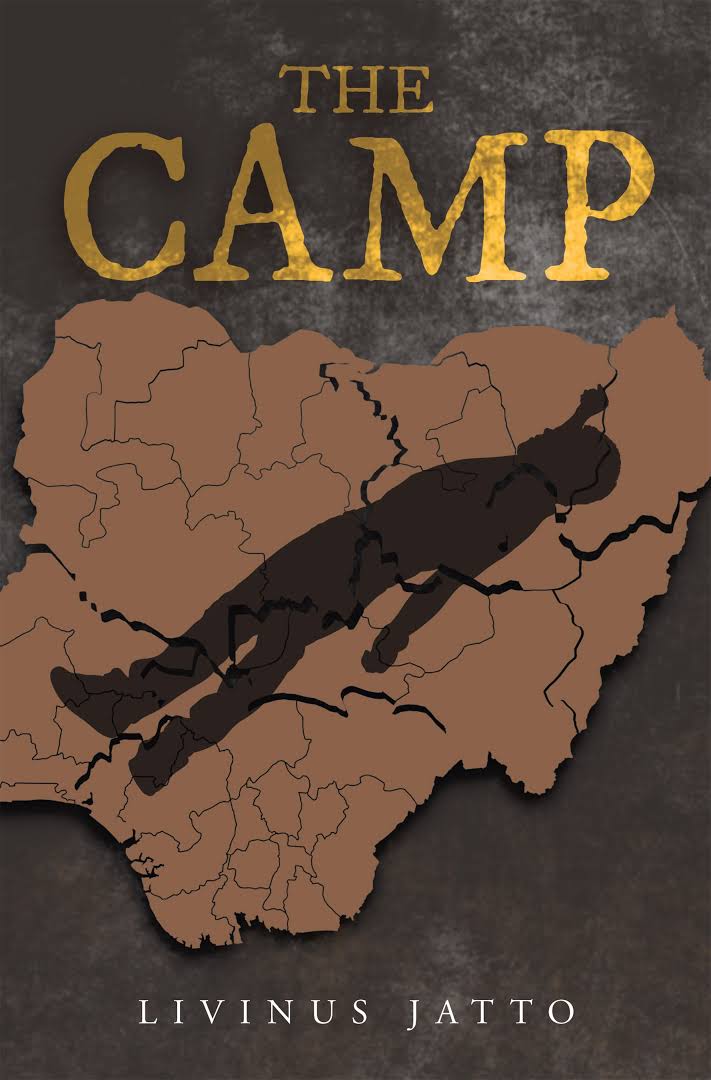
‘As the vehicle clambered up the last hill leading to Auchi town, the subtle petrichor of wet sand mixed with cow dung and the stench from overflowing dustbins lining the main road reminded him of home.’ The Camp, Livinus Jatto
What tribe you belong to, your state of origin, religion is somehow what are used as yardstick to gauge a Nigerian. It doesn’t really matter his qualification or merit, these defining yardsticks or measures are the sentimental tools for sizing up a Nigerian. Thus, the Nigerian identity is very much troubled at home too; it begs the question, what or where is home truly? This is the story of Paul Badamosi in Livinus Jatto’s debut novel, The Camp. Through this character’s many obstacles and development, we witness the displacement of a person within his own country, and how systems that favours ethnic bigotry and religion and mediocrity up-ends him at different stages of his life and career.
The novel is worked into eleven chapters, with every chapter short and titled to encapsulate the core theme it focuses on. In the opening chapter titled ‘A Camp Called Home’, it follows the origin of Paul Badamosi who became Faul Badamasi through the hand of the clerk who registered him into primary school:
He didn’t notice that the Hausa teacher called him Faul, with his Hausa accent. Neither was he aware of the future impact of the misspelling of his surname, which now read “Badamasi”. At first glance, Badamasi and Badamosi looked the same, but the politics of Nigeria made this almost innocuous difference a matter of survival. The Northerners spelt theirs Badamasi, while those from the Southwest, mostly Yorubas, and Binis in the Midwest spelt the same name Badamosi. Whichever way it was spelt, it meant approximately the same thing. (pg. 9)
Paul who was born to a stern and disciplinarian father learned from the onset of his childhood the complexity of his identity. His parents migrated from Midwest Nigeria somewhere called Tabo Gido-Ora to seek a new life in the northern part of Nigeria called Badaka State immediately after the Civil War. Badaka is a fictional state but resembles any cosmopolitan urban centres in the north that has various ethnic groups domiciled there. The author here is leaving the setting blank thereby creating a kind of template anybody with similar experience can copy theirs on. This makes the story ring true and shows the history of a nation is knitted with its peoples:
The difference between the North, the South, the East and the West replicated throughout the whole national life of Nigerians and defined Paul’s growth and development as it did the growth and development of the country. These differences determined who could legitimately claim to have a stake in the entity called Nigeria. It shaped Paul’s evolution. It also played an important role in the stunned growth of the country. Both Paul and other Nigerians conduct themselves as if they were internally displaced. (pg. 9)
As the narrative is centred on Paul, it follows his frustrations and disappointments in his quest to arrive at a place or point where he can call home. When he decides to visit his parents’ hometown, he discovers home is just an idea as he has become an alien in his parents’ state of origin. They come from a minority group as ‘Midwestern Northerner’. He also discovers that baggage comes with certain advantages and disadvantages. The advantage being that standard could be lowered for him to scale through educational challenges. The author writes that the pass mark for JAMB, a tertiary entrance examination in Nigeria, can be lowered for northerners to fulfil the federal quota or character as stipulated by the constitution. This, he attests, through the protagonist entry into the university. The advantage he thought he had soon turned into a big disadvantage as he couldn’t apply for a bursary from his Badaka State because he is not legitimately recognised there because his parents only settled there and therefore cannot lay claim to his place of birth. Although Paul later abandoned his law degree when he was on the cusp of completing it and joined the arm forces, this displacement and his complex identity still dogged and slowed down his rise in the army. Since he didn’t have any godfather, especially one from his state of origin who could push him up, he remained so long, as ‘foot mat’ in his military career.
Even when he is transferred to Lagos, a place that supposed to be neutral for all ethnic groups, this turned out to be a disillusion, as his tribe and religion is always contestable. He discovers the religion one practises is among the deciding factors in getting promotion or friendly gestures from superior officers:
It is impossible to draw the line between the ethnic and religious politics in Nigeria. Political masters have used the potent poison of religion to lace the equally potent poison of ethnicity. (pg. 38)
In the army as the story shows, there are also military officers who play these cards too. Which made some lower rank officers succumb to or play the religion card by converting to the religion of their superior. But for Paul Badamasi, power is the last thing on his mind. His modest dream is just to be an excellent paratrooper. As the story progresses, he soon discovers he cannot be entirely faultless in the eyes of those who don’t wish him well based on these grounds of ethnicity and religion. He is roped in a plot of aiding and abetting smugglers. The trial lasts several months while he is in detention before he is exonerated of the charge, he didn’t commit nor have any hand in. It makes one wonder by setting up the military rank like that, it is very reflective of everyday Nigeria reality, especially in the wake of #EndSARS protest against police brutality and injustice. It shows that the Nigerian army is much like the Nigerian society at large, where people can easily be framed up for offenses they didn’t commit.
Another thing that is prominent, one of the divisive tactics mostly used by Nigerian leadership is ‘our thieves’ against ‘the other thief’. This is premised on a faulty logic that one’s kinsmen who engages in nefarious activities is tolerable than others. This is usually used to whip up sentiment that a bad leadership who is one’s kinsman is more tolerable than the other. This makes Paul military career cumbersome which will make him to reconsider career, which will make him to ponder where or what home really is. Although he has since concluded that the idea of the Nigerian nation is nothing but a vast IDP camp where a lot of people are systematically displaced, but will he find a home where he can finally root himself, raise a family and be happy? The final chapter of the novel is a thesis on what is really home.
Livinus Jatto here in his debut novel, The Camp weighs in on the fundamental and controversial issues besetting Nigeria. As the novel shapes the displacement of a man in his supposed nation, it is an overtly essayistic novel. There is no plot guiding the story, which in itself is not a wrong thing, but it turns out to be much more of a treatise that characterises the modern man in contemporary Nigeria. For those who might not know about the failings and bigotry prevalent in Nigeria, it might be an eye-opener but for a reader who is very familiar with all the ills of the Nigerian nation might find it inundating and overdone. Nevertheless, the novel in the hands of any reader will make them ponder the idea of home and where one might eventually find lasting peace.










Leave a comment