

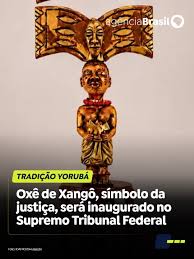
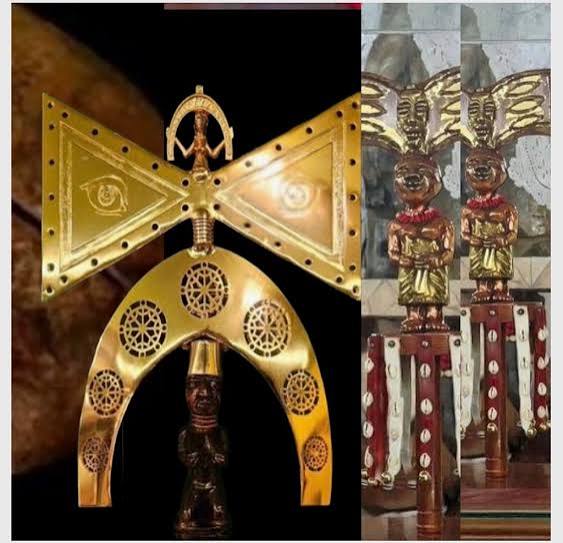
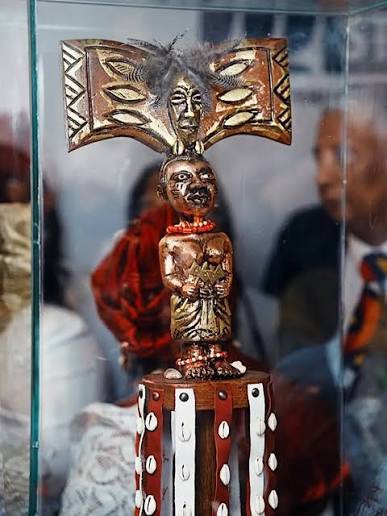
On 17 November 2026, three days before Brazil’s Black Consciousness Day, the country’s Supreme Federal Court (STF) unveiled a 64-centimetre sculpture in the hall of its Salão Nobre in Brasília. Titled Osè Wura Otito, or ‘Golden Axe of Truth‘, it depicts the Oxê (Yoruba: Ọ̀ṣé), the double-bladed axe of Ṣàngó, the òrìṣà of thunder, fire and justice.
For Nigerians, and especially for those who trace Ṣàngó to Ọ̀yọ́, the instinct is to read it as a victory lap. The more useful reading is to ask what actually happened, and what it does and does not prove.
What the Ọ̀ṣé Installation Represents
Crafted by Bahian artist Rodrigo Siqueira from wood, copper and gold leaf, beads, coral and cowries, the piece sits near the entrance to the plenary, within a collection that already includes references to classical mythology and Christian tradition. Its two blades face opposite directions, a visual argument that a judge must weigh both sides before deciding. Court president Edson Fachin framed the installation as an institutional commitment grounded in constitutional protection for religious worship, and the Court says the work will remain permanently in its collection.
A domestic victory, built on law
The sculpture did not arrive through diplomacy. It was donated by the Institute for the Defence of the Rights of Afro-Brazilian Religions (Idafro), which petitioned the Court in 2025 for a Yoruba symbol of justice, arguing that if the crucifix has a place in public institutions, the Oxê can too.
That argument rested on a unanimous STF ruling of November 2024, which held that religious symbols in public buildings do not, by themselves, breach state neutrality. Rio de Janeiro’s Court of Justice had already received a sacred axe of Ṣàngó in December 2024, reported as a first for Brazil’s judiciary, and courts in Bahia and São Paulo also hold the symbol. Brasília is the culmination of a movement, not the start of one.
From Ọ̀yọ́ to Salvador
Yoruba tradition remembers Ṣàngó as a king of Ọ̀yọ́ who was deified after his death, and his cult travelled with the reach of the Ọ̀yọ́ state, the dominant Yoruba power of its era. That history matters here because of what came next. As Ọ̀yọ́ fractured in the early nineteenth century, war and instability fed the Atlantic slave trade, and large numbers of Yoruba-speaking people, known in Brazil as Nagô, were shipped to Bahia. They carried òrìṣà worship with them. In Brazil it took root as Candomblé, where Xangô remains among the most venerated deities; Salvador’s historic Casa Branca terreiro is dedicated to him.The axe in Brasília is therefore Ọ̀yọ́’s heritage returning not as an export, but as something preserved by people who were forcibly removed from it.
What it says about global reach
The thesis that Yoruba civilisation has global reach holds, and the evidence is well documented. UNESCO has inscribed the Ifá divination system on its intangible heritage list, and the Òṣun-Òṣogbo Sacred Grove is a World Heritage Site. Yoruba-derived religion is embedded in Cuba, Brazil, Trinidad and across the diaspora. The highest court of a country of more than 200 million people now giving physical form to a Yoruba conception of justice is a striking addition to that record.
There are, however, two qualifications worth making.First, the recognition is Afro-Brazilian before it is Nigerian. Xangô in Candomblé has evolved for two centuries under its own conditions, and the credit for this moment belongs to Brazilian terreiros, lawyers and activists, not to any Nigerian institution. One federal deputy quoted at the unveiling said it matters for a majority-Black country to see itself represented. That is a statement about Brazil’s identity more than about Nigeria’s influence.
Second, a symbol in a hall is not a policy. The very existence of an institute dedicated to defending the rights of Afro-Brazilian religions suggests that recognition has not been automatic. Whether the Oxê changes how Brazilian institutions treat these traditions in practice is a question the sculpture cannot answer on its own.
What Nigeria should take from it
Recognition abroad is only as durable as the story kept at home. Ọ̀yọ́ heritage sites, archives and Yoruba-language education are where Nigeria can build on an interest Brazilians have sustained for generations. Cultural diplomacy and heritage tourism between Nigeria and Brazil, including links with Bahia’s Yoruba-rooted communities, are practical and under-used channels.The golden axe in Brasília is a reminder that Yoruba civilisation has travelled far, largely without institutional backing from the place it began. The more interesting question is what becomes possible when that backing finally arrives.








Leave a comment