


When Tony Joy left home at 16, she had no money, no plan, and no connections. She had one thing: a quiet belief that her life could mean far more than what she had been told it was worth.
Nearly two decades later, that belief has become the Durian Foundation, a rural development organisation working across four Nigerian states and in Kenya, Zambia and Uganda. By its own count, Durian has reached more than 150,000 people, 25,000 of them directly. Joy is an Ashoka Fellow, a Queen’s Young Leader and an Associate Fellow of the Royal Commonwealth Society.
Her work rests on a plain argument. “There is nothing wrong with being rural,” she has said. “What needs to change are the systems that make rural communities remain excluded.”
A Promise Not to Return a Failure
I first met Joy in 2009, when I was a final-year student in the Department of English at Obafemi Awolowo University, and she was a freshman. What drew me to her was a style of dressing that some would have described as tomboyish and found repulsive, but I found it fascinating. I didn’t know her backstory at the time, and our interaction was brief due to the gap in years; perhaps if I had a chance to interact with her more, I would have realized that the tomboyish demeanor and style were, unlike other women who affect that personality, not a rebellion against gender norms, but a physical manifestation of what would become a woman on a mission, and one who didn’t mind doing the hard and “dirty” (literally, not figuratively) work to achieve it
That mission led her to volunteering, and it became her first classroom in organising. She coordinated the Ondo State chapter of the Feed One Project Nigeria from 2013 to 2014, locating communities in need, managing volunteers, and raising funds. From 2015 to 2016, she did the same for the YALI Network Face2Face in Ondo State, and in 2016 she volunteered with VSO’s International Citizen Service on poverty alleviation. Her first large initiative was a volunteer-led clean-up campaign, Operation Keep Nigeria Clean, which spread across several states.
The turn came in 2016. A small grant from the Malala Fund let her screen the film Malala in a rural community, and the conversations afterwards were sobering. She found high rates of teenage pregnancy, children out of school, domestic abuse and the marginalisation of women. Joy had a different proposal: train the women to turn local waste into products, and she would find the buyers. She leased a plot of land in the community and began.
That community was Imafon, in Ondo State, and the organisation she built there took its name from a fruit. The durian smells unpleasant and tastes wonderful, and Joy wanted communities to see the value in what others dismiss.
Turning Waste into Wages
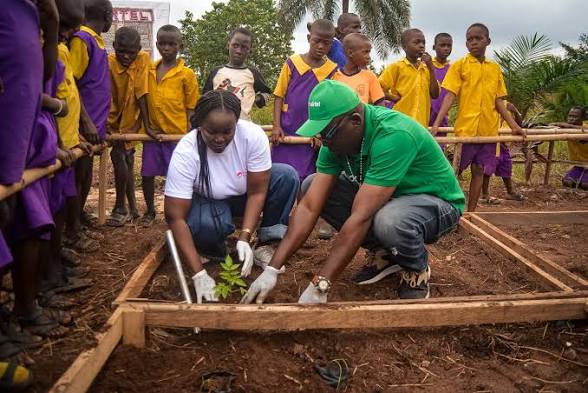
Durian works through three pillars: education, agriculture and vocational training. Before it enters a community, the team maps local waste, mostly from cocoa, bamboo, banana, and plantain production. Then it trains people to make something of it.
Cocoa pods become African black soap and skincare. Bamboo becomes furniture and handcrafts. Fabric offcuts become bags and garments, and cassava peelings become livestock feed. The enterprises are built to feed each other. Cassava shavings go to a pig farm, and the manure goes back to the cassava fields. As Joy put it on the Impact Boom podcast: “One group’s waste feeds another organization’s value, and then it just goes round and round.”
The women organize into cooperatives, and the cooperatives are linked to fair-trade markets and buyers. Durian’s commercial arm, Durian Africa Ltd, links what communities produce to markets, so that the change pays for itself. Its hub is the Crafts Village in Imafon, a circular-economy centre with departments for skincare, Garri, textiles and bamboo.
The work reaches beyond enterprise. The Itaja Women Fellowship aims to make rural women “findable and fundable”. In recent months, Durian has engaged more than 35 women, built an individual business dashboard for each, and paid trained fellows to support them weekly. The Rural Green Fellowship trains young people in climate-resilient farming. The Rural is Cool tournament and conference, meanwhile, are meant to change how rural life is seen, by outsiders and by rural people themselves. This year, Durian also gave the farmers it works with proper farm boots, a small purchase with a plain logic: those who feed the country should be able to work safely.
Staying Long Enough to Matter
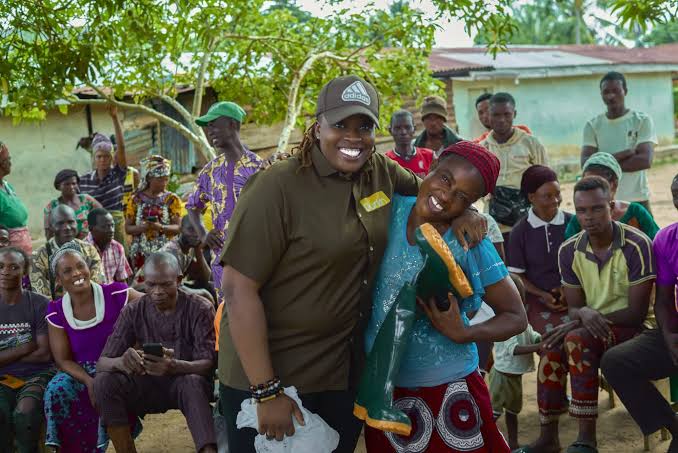
What separates Durian from many rural programmes is time. The foundation stays five to seven years in each community, because, as Joy says, systems need time to outlast the people who built them. It also insists on starting from what a community already has. “We don’t go outside communities to empower communities,” she notes in interviews.
Durian Foundation works across four Nigerian states and in Kenya, Zambia, and Uganda, with 25,000 direct beneficiaries and over 150,000 people reached. Through education, agriculture, and vocational training, Durian tackles what keeps rural communities stuck: the limiting beliefs they have been taught about themselves, economic dependency, and neglect of the land they live on. Ashoka’s profile describes participants earning roughly $40 to $50 a month, and more than 30 ventures that have grown out of the clusters.
In Imafon, the evidence is also spoken. The community’s king, HRH Oba Samuel Adegbehingbe, credits Durian with “exposing our women and youths to viable opportunities”. A Durian beneficiary who has become a member of staff, Mama Taiyelolu, says that after soap-making training and adult literacy classes the foundation became “hope to me and many other women in this community”.
The model has also won recognition. Durian’s work has been honoured by Ashoka, SAP, the Social Enterprise World Forum, Impact Boom, Economist Impact and the World Connect Foundation.
Not one to rest on her laurels, Joy has not just worked to better the lives of others; she has kept studying too. After graduating with second-class upper honors in English and Literary Studies from Obafemi Awolowo University in 2014, she has gone on to complete a Master’s Degree in Agribusiness at Rome Business School Nigeria in 2025 and has also acquired an MBA certification in Strategic Business Leadership from Nile University, Abuja, in 2025.
The Next Decade

For the 16-year-old Joy who left home, the impact her adult self has made, and the recognition she has achieved nearly two decades later would be beyond her wildest dreams. But for the adult Joy, there is still so much work to be done. In several of the communities where Durian works, insecurity has pushed farmers off their land. Young people drift to the cities, women struggle to get finance, and places rich in resources stay poor. Climate disruption and weak infrastructure add to the strain.
Joy continues to innovate to battle these constraints. Dunni by Durian, Durian’s latest initiative under her leadership, is an AI-powered agricultural extension tool that gives farmers timely advice, in local languages, on crops, livestock, weather and market prices. Farmers reach it through channels they already use: WhatsApp, SMS and voice notes. The Itaja programme aims to reach 1,500 rural women each year with business skills, bookkeeping and mentorship. It also creates paid roles for the younger women who support them.
Ever the visionary and planner, she already has a 10-year plan for Durian. By 2036, Durian wants its ecosystem to create or enable 10,000 sustainable jobs across Africa’s rural and green economy. It plans to do that by building profitable businesses, developing capable people, and strengthening networks that keep value inside rural communities.
It is a large goal for an organisation that began with a leased plot of land and a plan to turn a village’s waste into income. But Joy has spent her adult life proving that small, unlikely beginnings can grow. A teenager who left home with nothing now argues, with evidence, that rural Nigeria is not a problem to be fixed from outside. It is an economy waiting for the right systems.
That is why Tony Joy belongs among the Brave Nigerians: she did not wait for permission, or for rural communities to be noticed, and she has stayed long enough to see what grows.












Leave a comment