

Brother Jero is not a character who stays buried. He is a prophet, after all, and prophets have a way of resurrecting precisely when their followers need them most.
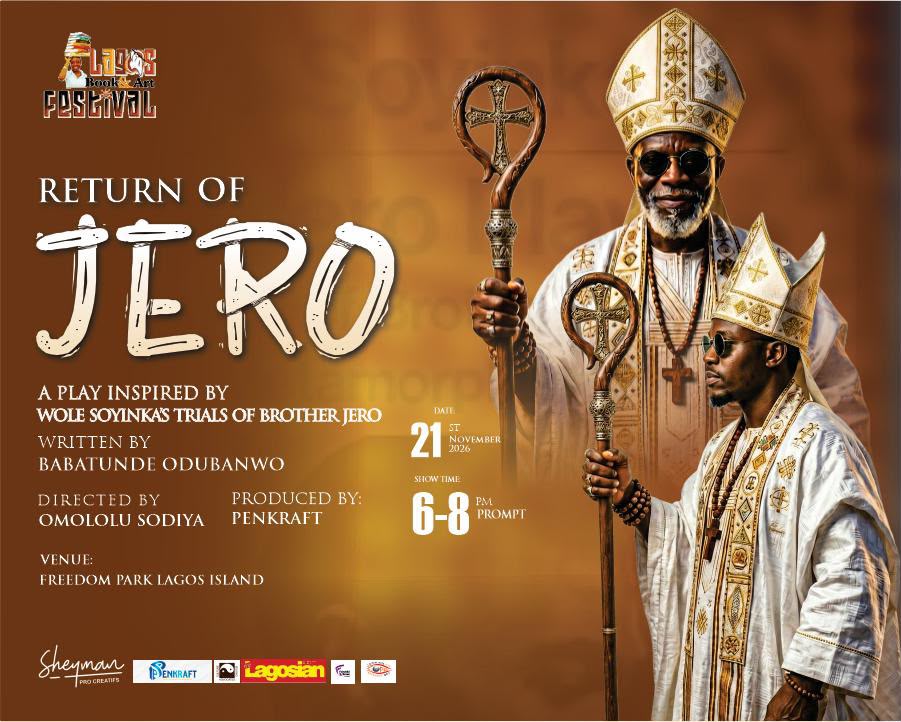
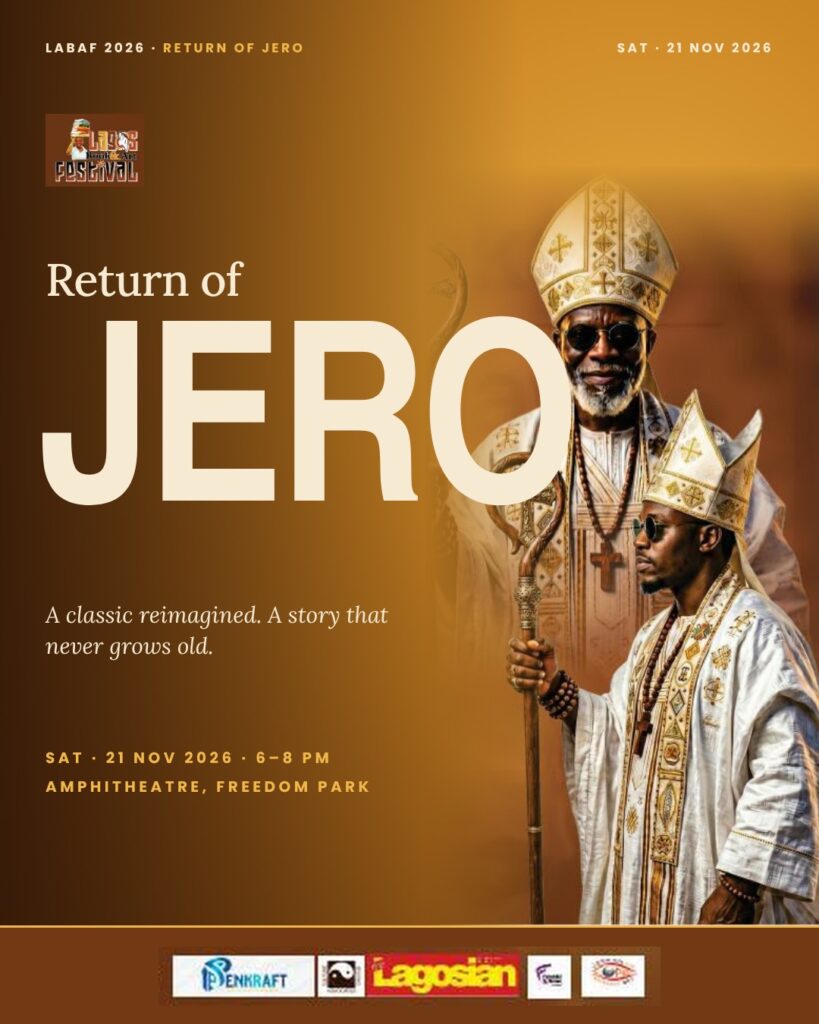
Babatunde Odubanwo’s Return of Jero, a contemporary reimagining of Wole Soyinka’s 1960 satire The Trials of Brother Jero, returns to the stage on Saturday, November 21, at the Amphitheatre, Freedom Park, Lagos, as part of the Lagos Book and Art Festival (LABAF) 2026. Tickets are available via EventPorte.
This is not the play’s first resurrection. It premiered in July at the J. Randle Centre for Yoruba Culture and History in Onikan, timed to Soyinka’s 92nd birthday and the 40th anniversary of his Nobel Prize . The Punch reported that the production “captivated audiences” with its blend of “wit, satire and social commentary,” incorporating “contemporary characters, music, choreography and modern visual storytelling” . Odubanwo described it as “an artistic dialogue between generations” .
But the return to LABAF is something else. LABAF is not a birthday party. It is the Committee for Relevant Art’s annual reckoning with Nigerian letters, a festival that takes books seriously enough to argue about them. Placing Return of Jero within that context signals that Odubanwo’s adaptation is not mere tribute. It is a proposition about what Soyinka’s satire means now.

Why Jero Still Works
Soyinka wrote The Trials of Brother Jero when he was twenty-six, a student at University College, Ibadan. The play follows a beach prophet who has turned salvation into a trade, manipulating followers with promises of political power while keeping them, as Jero himself admits, perpetually dissatisfied. “To keep them dissatisfied,” he says, “is the way to hold them for a longer period of time”.
The satire was sharp in 1960. It is sharper now. Nigeria’s religious economy has grown into a multi-billion naira industry, with pastors commanding followings that would make Jero envious. Politicians seek sanctuary in churches. Desperate citizens surrender agency to men who promise shortcuts to prosperity. The faithful are kept dissatisfied, not unlike Jero’s customers, ensuring continued patronage.
Brave Nigerians, reviewing the July premiere, put it bluntly: “If Soyinka’s play was a premonition, modern Nigeria has become its chilling fulfillment”. The production “asks uncomfortable questions: Have we learned anything from Brother Jero’s deceptions? Or have we simply created bigger, more sophisticated versions of the same exploitation?”
That is the question LABAF audiences will face on November 21.
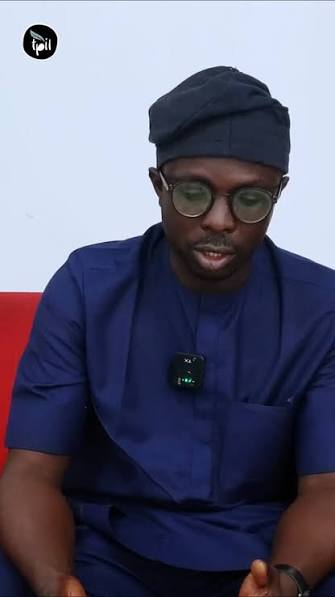
Babatunde Odubanwo — The Playwright
Odubanwo is a playwright, poet and cultural advocate whose work is defined by rigorous research and a preoccupation with history, power, and memory. Though he came from a finance background, he has spent years building a coherent body of work in Nigerian theatre, largely rooted in the Bariga arts community rather than institutional patronage.
His repertoire includes Maren (co-written with Femi Adebajo), a biodrama of Wole Soyinka based on several years of research and staged for Soyinka’s 90th birthday; Idi Amin, a study of dictatorship and freedom staged at LABAF 2025; Beere Arolu, an epic retelling of Epe’s history; and Mark My Words (co-written with Femi Morgan), a tribute to scientist-poet Mark Nwagwu.
His approach is that of a writer who treats canonical texts as living arguments rather than monuments. For Return of Jero, his reimagining of Soyinka’s The Trials of Brother Jero, he secured Soyinka’s approval—a significant judgment from a writer famously protective of his work. He frames the adaptation as “an artistic conversation between generations,” a cultural bridge rather than a tribute.
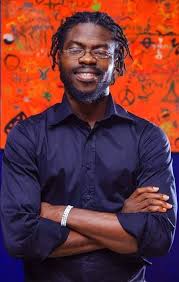
Omololu Sodiya — The Director
Sodiya is an actor, director, and theatre practitioner with over a decade of stage and screen experience. He trained at the University of Lagos, where he was adjudged best actor in his first year, and by 2008 had won best actor honours for Ahmed Yerima’s Yemoja and Olurounbi at the National Theatre.
He has performed in approximately thirty stage plays, including Ola Rotimi’s Our Husband Has Gone Mad Again and The King Must Dance Naked. His television credits include Tinsel and Africa Magic’s Itura.
Sodiya’s artistic philosophy is rooted in discipline. He insists that acting is “a real business” requiring rigorous training, comparable to law or medicine. He is critical of actors who skip research and preparation. His directorial work on Return of Jero brought immersive stagecraft, live music, choreography, and elaborate costumes to Odubanwo’s text.
What They Share
Both men refuse to treat Nigerian theatre as a stepping stone. They have chosen the harder path, smaller audiences, thinner margins, no guaranteed recognition, because the work matters. Their collaboration represents a model of artistic practice in Nigeria where institutions are weak, and funding is scarce: two artists who have decided the work is worth doing anyway.
The Bariga Connection
One detail from the July premiere deserves attention. The Bariga Arts Collective’s involvement is not incidental. Bariga, a waterfront community along the Lagos Lagoon, is home to approximately sixty theatre companies. The production notes describe it as a place where the arts have converted “otherwise street soldiers into theatre performers”. Soyinka’s original Jero practiced on the Bar Beach shoreline. Staging his return with artists from a waterfront community brings the satire full circle, grounding it in the lived geography that inspired it.
What This Means for Nigerians
For audiences at home, Return of Jero is an invitation to laugh at what we have become. That laughter is uncomfortable, which is the point. Soyinka’s satire has always worked by making us recognize ourselves in the fool. When Jero escapes through a window, shouting that his roguery is now “allied to power,” we are meant to think of the prophets we follow and the politicians who protect them.
For the diaspora, the play is a reminder that Nigerian theatre is not waiting for permission. Odubanwo is producing without major institutional backing, without government subvention, without the infrastructure that Nigerian arts policy keeps promising and failing to deliver. He is doing it because the story matters, because Soyinka’s warning has not aged, and because LABAF provides a stage.
The Details
Return of Jero stages Saturday, November 21, 2026, at 5 pm (though EventPorte lists a 6 pm start; check with organisers) at the Amphitheatre, Freedom Park, Lagos. Tickets are available via EventPorte. LABAF 2026 runs through November 22.






Leave a comment