

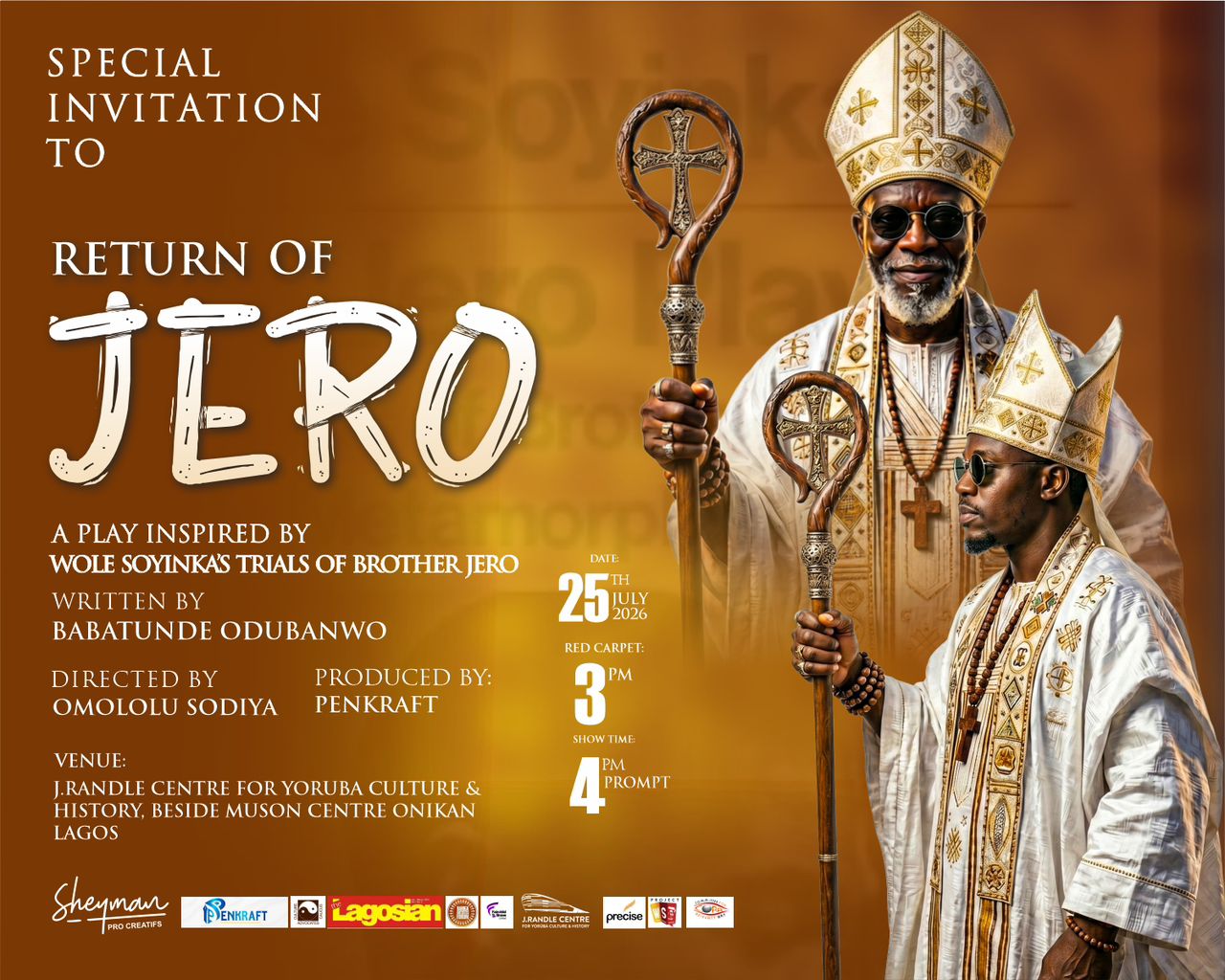
Come July 25, 2026, Lagos will bear witness to a theatrical reckoning. “Return of Brother Jero,” inspired by Nobel Laureate Wole Soyinka‘s classic satire “The Trials of Brother Jero.” The play takes stage at the prestigious J. Randle Centre for Yoruba Culture and History. Its timing could not be more urgent.
This is not nostalgia. This is a mirror held up to a nation still drowning in the very hypocrisy Soyinka skewered sixty-six years ago.
The Soyinka Prophecy That Refuses to Die
When Wole Soyinka’s “The Trials of Brother Jero” premiered in 1960 at the dining hall of Mellanby Hall, University College, Ibadan, he was just twenty-six years old. The young playwright, who would later become Africa’s first Nobel Laureate in Literature, had already seen something that would haunt Nigeria for generations to come.
| Event | Return of Brother Jero |
| Written By | Babatunde Odubanwo |
| Directed By | Omololu Sodiya |
| Producers | Penkraft |
| Sponsors/Supporters | Sheyman Pro Creatives, Culture Caucus Advocates, The Lagosian, Fairchild & Brave, J Randle Centre, Precise, Projects WS, Committee for Relevant Art |
| Red Carpet | 3:00 PM |
| Showtime | 4:00 PM |
| Venue | J. Randle Centre for Yoruba Culture & History, beside MUSON Centre, Onikan, Lagos |
| Date | July 25, 2026 |
The play, Trials of Brother Jero, follows Brother Jeroboam, a charismatic beach prophet practicing on Lagos’s Bar Beach. Jero has turned prophecy into a lucrative “trade.” He manipulates followers, including the beleaguered Chume and his formidable wife Amope, who is also Jero’s creditor, with promises of political power and social status.
However, beneath the satire lies something darker. Jero understands that his followers are “customers,” and “to keep them dissatisfied is the way to hold them for a longer period of time.”
The play’s ending offers no comfort. Brother Jero emerges “a more sinister figure than he began,” his roquery “now allied to power,” capable of eliminating ordinary people who threaten his empire. Soyinka was not writing for laughs. He was issuing a warning.
As one observer later noted, “we may have laughed over Jero’s escapade as a womaniser and a debtor, little did we realise that the play even as a satire was a premonition of a country that may be damned by religious and political hypocrisy.”
The Soyinka Prophecy Fulfilled
If Soyinka’s play was a premonition, modern Nigeria has become its chilling fulfillment.
Today, the prophet’s trade is a multi-billion naira industry. Religious leaders command vast followings, political influence, and material wealth that would make Brother Jero blush.
The “commercialization of faith” has become the dominant model, salvation as a commodity. Politicians find sanctuary in churches. Desperate citizens surrender their agency to “men of God” who promise shortcuts to prosperity. The very institutions that should empower people instead render them docile.
As one commentator writes, “Nigeria, the most populous black nation in the world is also tagged, the most religious in Africa, considering the proliferation of churches and pastors all over the country.”
A social activitst said that religion has become a “collaborative vehicle to oppress people and to make them docile instead of rebel against sociopolitical and sociocultural structures” that continue to marginalise the majority. The faithful are kept perpetually dissatisfied, not unlike Jero’s followers, ensuring their continued patronage.
This is the world that “Return of Brother Jero” confronts.
The Return: Reimagining a Soyinka Classic
Playwright Babatunde Odubanwo’s new work does not merely revisit Soyinka’s satire. It extends it into a present where the spiritual manipulation Soyinka warned against has become the fabric of Nigerian society.
The production asks uncomfortable questions; Have we learned anything from Brother Jero’s deceptions? Or have we simply created bigger, more sophisticated versions of the same exploitation?
The venue choice, the J. Randle Centre for Yoruba Culture and History, beside MUSON Centre in Onikan is deliberate. This is a space dedicated to preserving Yoruba heritage, positioning the play within a broader cultural movement.
Bariga: Where the Shoreline Inspires the Stage
The Bariga Arts Collective’s involvement in “Return of Brother Jero” is not incidental, it is integral to the production’s soul.
Bariga’s landscape is inseparable from the play’s inspiration. Like the original “Trials of Brother Jero,” which was set on the Lagos beachfront, Bariga straddles the shoreline of the Lagos Lagoon. The community is surrounded by water from the coastal lines along the Third Mainland Bridge, with fishing communities existing in close proximity.
This geographical reality connects the production to the very landscape that Soyinka used as his stage. The beach prophets of Soyinka’s play found their natural home along the waterfront; the return of Brother Jero, staged by artists from a waterfront community, brings the satire full circle.
The arts has offered “inspiration for young people in under-resourced areas where options for employment or further education are extremely limited and the temptations of less desirable career paths are ever present, “Bariga today is home to approximately sixty theatre companies, converting “otherwise street soldiers into theatre performers,” stated a culture curator.
This is the community that has inspired the reenactment of “Return of Brother Jero.” It is a community that has lived the stakes of Soyinka’s satire, not as distant observers, but as people who have seen the arts transform lives and reshape futures.
Profiles
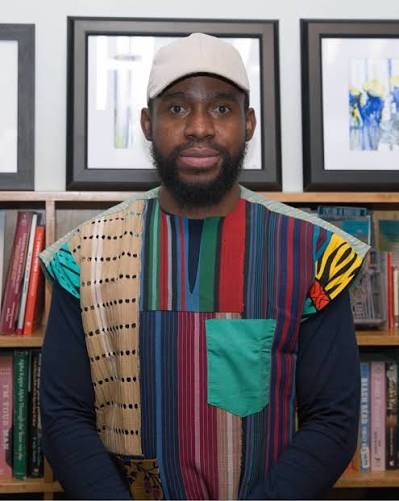
Babatunde Odubanwo: Playwright, Poet, and Cultural Architect
Babatunde Odubanwo is a consummate playwright, poet, and cultural advocate whose creative vision is at the heart of Return of Brother Jero. His body of work demonstrates a fearless engagement with Nigeria’s most pressing social and political questions, delivered with nuance, wit, and unflinching honesty.
Odubanwo’s most significant recent work is Maren, a play he co-wrote with Femi Adebajo to honour Nobel Laureate Wole Soyinka on his 90th birthday. The title carries deep significance, it is the name given to Soyinka by his grandfather. The play delves into Soyinka’s extraordinary life, set against the backdrop of military dictatorship and political turmoil. Speaking about the inspiration, Odubanwo explained it was driven by “the long-standing and admirable stance of one of the living legends of Africa, Professor Wole Soyinka, on humanism and democracy.”
His previous works include Idi Amin (2025), staged at the Lagos Book and Arts Festival is a bold historical commentary on dictatorship and freedoms—and his forthcoming play, co-authored with Femi Morgan, Mark My Words (For Professor Mark Nwagwu), a deeply personal tribute to the renowned Nigerian scientist, poet, and columnist. His portfolio extends to numerous other stage works that have cemented his reputation as a major voice in Nigerian theatre.
Beyond the stage, Odubanwo is a versatile professional specialising in arts, media, film, events planning, and content management. His consistent excellence has earned him recognition, including nominations for the prestigious Africa Magic Viewers’ Choice Awards (AMVCA).
Omololu Sodiya: Actor, Director, and Theatre Practitioner
Omololu Sodiya is a highly respected figure in Nigerian theatre and film, with a career spanning over a decade. His journey from reluctant theatre student to celebrated performer and director exemplifies the transformative power of rigorous training and unwavering dedication to craft.
Sodiya began his professional acting journey in 2005, but it wasn’t until 2007, during his training at the University of Lagos, Akoka, that he committed fully. He said, “My dream was to become a visual artist and not an actor, but after gaining admission into the University of Lagos to study theatre art, and I was adjudged best actor in my first performance in my first year… I began to have a rethink.” The recognition proved prophetic, in 2008, he was adjudged best actor in both Professor Ahmed Yerima’s Yemoja and Olurounbi at the National Theatre.
Sodiya has performed in approximately thirty stage plays, including Ola Rotimi’s classic political satire Our Husband Has Gone Mad Again, ITAN (The Story) alongside Hafiz Oyetoro (Saka), and The King Must Dance Naked at Glover Memorial Hall. His television credits include roles in Africa Magic’s Itura, where he plays Ayanniyi, and the popular series Tinsel. His filmography includes Project Assault (2025) and The EXCO, where he plays Hon. Seun.
Sodiya is a passionate advocate for rigorous training. He said, “acting is a real business, it is just like you being an accountant or a lawyer; you need to be properly trained.” His meticulous preparation involves researching each role thoroughly. In May 2026, he took part in “The Anatomy of an Actor” at Alliance Française Lagos, performing alongside Bolu Essien and Imoh Eboh.
His role as director of Return of Brother Jero draws on his extensive experience across stage and screen—qualities that position him to guide this important production with vision and authority.
A Nation in the Mirror
“Return of Brother Jero” arrives at a moment when Nigeria desperately needs the mirror that satire provides.
Soyinka’s play, as scholars note, “captures exact scenario of religion and politics of his times and exposes the vices of his society.” Odubanwo’s “Return” promises to do the same for ours, to hold a mirror to a nation where religion has become, for too many, the opium that dulls the pain of injustice rather than the force that demands its end.
Conclusion
This is not simply a play. It is an intervention. It is the work of artists who understand that the stage can be a weapon in the struggle for a more honest, more just society.
The return of Brother Jero is the return of a question: Will we continue to be “customers” of religion, manipulated and exploited by those who profit from our desperation? Or will we demand more—more honesty, more accountability, and a faith that liberates rather than enslaves?
On July 4, at the J. Randle Centre, the stage will offer an answer.
“Return of Brother Jero” stages at the J. Randle Centre for Yoruba Culture & History on July 25, 2026. Red carpet at 3:00 PM, showtime at 4:00 PM.
READ ALSO: The Gift of Poetry: A Masterclass with Tade Ipadeola






Leave a comment