


By Culture and Lifestyle Desk

Atiku Abubakar’s recent lament that Nigerian girls abroad are turning to prostitution is not wrong in its observation. It is wrong in its geography. The plague he describes is not an export. It is a domestic industry, manufactured in Nigeria, sustained by Nigerian conditions, and exported only when the local market becomes too crowded to absorb the supply. To speak of prostitution abroad without confronting the factory floor at home is to treat a symptom as a cause and to let the actual architects of this crisis escape scrutiny.
The comments attributed to the Atiku family circle in recent weeks have framed the issue as a moral emergency unfolding on foreign soil. Titi Atiku Abubakar, speaking in Abuja at the presentation of a trafficking report, said Nigerian girls are becoming a “nuisance” in overseas countries and that international partners want them to “stay at home and do whatever they want to do in their homes, in their country” . The sentiment is understandable. The diagnosis is incomplete.
The numbers tell a different story. The National Agency for the Prohibition of Trafficking in Persons secured 93 convictions of human traffickers in 2025 and intercepted more than 2,500 potential victims who were being recruited for exploitation within and outside Nigeria . In collaboration with international partners, NAPTIP rescued over 370 Nigerian victims from Ghana, Senegal and Côte d’Ivoire . These are not abstract figures. They are Nigerians who were trafficked from Nigerian communities, through Nigerian borders, often with the complicity of Nigerian facilitators. The plague begins here.

The Domestic Factory Floor
The academic literature on transactional sex in Nigeria is unambiguous about the driving forces. Research on young women engaged in what they call “hustles” has found that money was the primary motivation, with unemployment cited as the central structural factor. One young woman quoted in the study put it plainly: “We hustle to find money because is money that bring us here. Not that we are in our fathers house or our aunties’ house. Therefore, we came here to find money. So we don’t have choice.”
The statistics validate the despair. Youth unemployment in Nigeria hovers above 35 per cent, while underemployment among young graduates exceeds 53 per cent . Informal sector employment accounts for over 92 per cent of working Nigerians. When more than half of your educated young people cannot find work that matches their qualifications, the informal and criminal economy does not merely absorb them. It consumes them.
A study of young women in Lagos State rehabilitation centres found that over 53 per cent affirmed that economic vulnerability at home pushed them into sex work, and 53.6 per cent agreed that the poor economic situation of the country influenced their decision . The researchers concluded that “sex tourism and irregular migration are economic survival strategies, not lifestyle choices”. Leaving Lagos and travelling abroad, including for sex work, is driven by the desire to escape poverty, fulfil family commitments, and achieve financial independence.
The “Japa” phenomenon is itself a driver. Young women enter the hook-up industry not only for immediate cash but to “secure connections with wealthy Nigerians for opportunities for overseas relocation.” The prostitution Atiku laments abroad is, in many cases, the second stage of a journey that began with economic exclusion at home. The destination is foreign; the departure lounge is Nigerian.

The Rebranding of Survival
What has changed in recent years is not the existence of transactional sex but its cultural packaging. Yesterday’s “Olosho” is today’s “Private Chef.” The transaction is now “runs,” the client is a “sponsor,” and the business, dressed in Zara and ring lights, is treated as an entrepreneurial lifestyle. This rebranding is not merely linguistic. It is a psychological operation that deletes the societal feedback loop, leaving a generation unable to hear the alarm.
Investigations in Enugu revealed that students in higher institutions have increased their “hook-up” activities, otherwise known as “decent prostitution,” for money-making purposes. Some use the proceeds to pay school fees and take care of younger siblings. They arrange for sexy pictures to be displayed in hotels to attract high-profile clients, collecting between N3,000 and N6,000 per night . These are not women who chose prostitution over a career. They are students who chose prostitution over dropping out.
The internet is replete with dating sites that function as marketplaces and dark zones where nudes and explicit videos are traded as commodities. An idle mind is indeed the devil’s workshop, but the devil here is not moral weakness. It is structural exclusion dressed in the language of choice.
The Marriage Economy and the Sexual Contract

There is a deeper dimension that Atiku’s lament does not touch. Many Nigerian eligible bachelors do not have the economic wherewithal to marry. The traditional expectations of bride price, accommodation, and the ability to provide have become insurmountable for a generation of men who cannot secure stable employment. The result is a demographic crisis of delayed marriage and frustrated aspiration.
For young women, the calculus shifts accordingly. If marriage is not a viable economic partnership, and if formal employment is closed, then transactional sex becomes not a deviation from the path but the path itself. The outlook becomes one of money-seeking enterprise because the alternative is dependency without security. This is not a failure of female morality. It is a failure of the economic contract that once made marriage a rational choice for both parties.
The Media’s Complicity
The media is not innocent in this. Nigerian films and music videos have become subtle vehicles for sexualising the mind, reducing human beings to their sexual parts and presenting transactional relationships as aspirational. Sex is power in another language, but it is deeply psychological, and when it is commodified in popular culture without critique, it shapes the aspirations of the young. A fifteen-year-old watching a lifestyle funded by transactional intimacy and hearing it called “securing the bag” is not merely watching a video. She is receiving a curriculum.
The Trafficking Pipeline
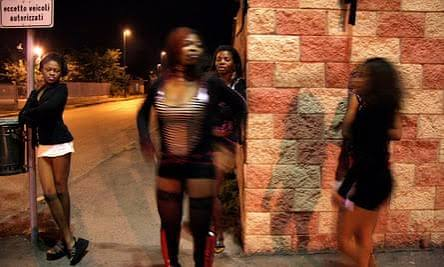
The connection between economic exclusion and trafficking is not speculative. It is documented. Sex trafficking accounted for 51.5 per cent of identified victims in 2023, 54.8 per cent in 2024 and 52.3 per cent in 2025, according to the United States Department of State’s Trafficking in Persons Report . Nigeria ranks 11th out of 54 African countries with high levels of human trafficking, with a score of 8 out of 10 on the Africa Organised Crime Index .
In August 2025, NAPTIP rescued 25 women in Abuja who had been recruited from Kano, Jigawa and Katsina with promises of well-paid domestic work in Saudi Arabia. The women, aged between 17 and 43, had travelled to Abuja expecting to receive travel documents but were left waiting for traffickers . This is how the pipeline works. It begins with a promise of work, a promise made credible by the absence of any alternative.
The story of Blessing, a 16-year-old trafficked to Mali with promises of a job in a mobile phone shop, is instructive. She was forced into prostitution, deprived of food and water for three days when she refused, and told her freedom would cost 1.5 million CFA. She was servicing clients for less than $4 before she escaped . Her trafficker was a Nigerian woman known as “Mommy Love.” The predator was not foreign. The predator was local.
Responding to Ololade
Ololade’s article in The Nation, which prompted this response, is right to raise the alarm. But the alarm must be calibrated to the actual emergency. The root cause is not pornography, though pornography is a symptom. The root cause is exclusion: economic exclusion that denies young people the dignity of work, social exclusion that denies them the stability of family formation, and political exclusion that denies them any voice in the decisions that shape their lives.
A generation that has been told to wait its turn while the old refuse to retire has learned that the queue is not moving. When the queue does not move, people leave it. Some leave the country. Some leave the formal economy. Some leave the moral boundaries that once seemed fixed. The plague Atiku sees abroad is the visible tip of an iceberg whose mass sits in Nigerian cities, Nigerian villages, and Nigerian homes where young people are making impossible choices because every other option has been foreclosed.
What Must Be Done
The response cannot be moral condemnation alone, though moral clarity matters. The response must be economic. Nigeria must create pathways to dignified work for its young people. It must reform the education system so that graduates emerge with skills the economy actually demands. It must address the marriage economy by tackling the housing crisis and the cost of living that make family formation impossible for a generation.
NAPTIP needs increased funding and training, and the agency has acknowledged the capacity gap: its 14 shelters served 2,221 victims in 2025, a fraction of those rescued . But enforcement measures address the supply of victims, not the demand for the transaction. Until Nigeria’s economy offers young women a genuine alternative to selling themselves, the supply will continue.
Atiku Abubakar is right that Nigerian girls are being reduced to tools in the hands of sexual predators. But he is wrong to locate the crime abroad. The predators are here. The market is here. The conditions that produce the supply are here. And until we name that truth, the plague will continue to spread, and the ships will continue to sail, and the girls will continue to leave, and the nation will continue to mourn a crisis it refuses to see.
The root cause is not pornography. It is exclusion. And exclusion begins at home.











Leave a comment