


By Chibuzor Alli
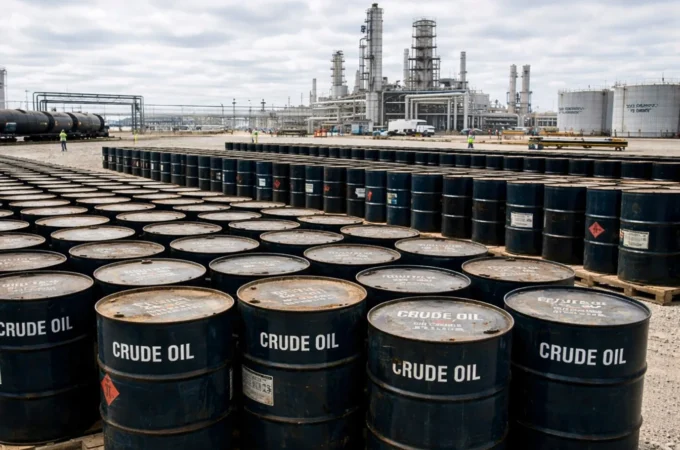
Nigeria’s oil revenue could fall by more than 60 per cent from 2030 as global demand for crude oil declines, potentially worsening fiscal and economic instability, a report has warned.
The report, based on research by the E3G think tank and published by The Guardian UK on Tuesday, identified Nigeria among oil-producing countries that could be severely affected by the global shift away from fossil fuels.
It attributed the risk to Nigeria’s heavy dependence on oil revenue and limited economic diversification, as countries increasingly turn to renewable energy and electric vehicles.
The report said global oil demand was expected to plateau over the coming decade, with a peak likely in the early 2030s.
This could force oil-producing countries to compete for a shrinking pool of crude buyers, with higher-cost and less diversified producers facing greater revenue pressures.
It projected that Algeria could suffer an 87 per cent decline in oil revenue, while Nigeria’s revenue could fall by more than 60 per cent from 2030.
Oil revenue decline threatens fiscal stability
The report warned that falling oil income could leave affected countries struggling to finance basic public services and service their debts, potentially triggering fiscal crises with wider security implications.
Oil revenue accounts for more than 40 per cent of government income in 17 countries globally, according to the report, with the proportion reaching between 70 and 90 per cent in countries including Iraq and Libya.
For Nigeria, the report said declining oil revenue could weaken the government’s capacity to provide public services and create wider economic and security challenges across Africa.
Beth Walker, a co-author of the report, said governments were not adequately preparing for the consequences of declining oil demand.
“Governments are not thinking about and not prepared for these outcomes. The transition becomes riskier for everyone when oil producers are left to adjust on their own and oil markets are left to manage themselves. Producer fragility becomes a global security risk,” Walker stated.
Walker said the expected problems would not necessarily emerge as a single global crisis but through a series of national fiscal crises that could develop into unrest, migration and security problems.
She identified Nigeria as a particular concern because of its population and influence in Africa.
“Most of these problems are on a much larger scale than Venezuela, and they could all unravel just as the UK and Europe’s capacity to contain live conflicts is drained,” she said.
Global oil demand faces structural shift
The report said the global transition away from oil was already under way, with the growth of renewable energy contributing to declining oil consumption in several countries.
China, previously a major source of rising global oil demand, was also experiencing a downward trend in consumption, partly because of the rapid adoption of electric vehicles.
India’s future oil demand remained uncertain and could become pivotal in determining how quickly global crude demand declines.
The researchers, however, warned that delaying the energy transition would not resolve the underlying risks posed by climate change.
“None of this is an argument for slowing the transition. A slow but chaotic transition can be just as destabilising as a fast one, maybe even more so,” another co-author of the report, Maria Pastukhova, said.
Report calls for support for oil-dependent economies
The E3G study was reportedly compiled over two years and involved “war-gaming” of different scenarios involving declining oil demand with more than 100 public servants and experts from around the world.
It called on governments, the International Monetary Fund, the World Bank and private financial institutions to work together to help oil-dependent economies prepare for declining oil revenues.
The report warned that without adequate preparation, the global shift away from crude oil could create fiscal pressures in vulnerable producer countries and contribute to wider economic and security challenges.










Leave a comment