

By Political Analysis Desk
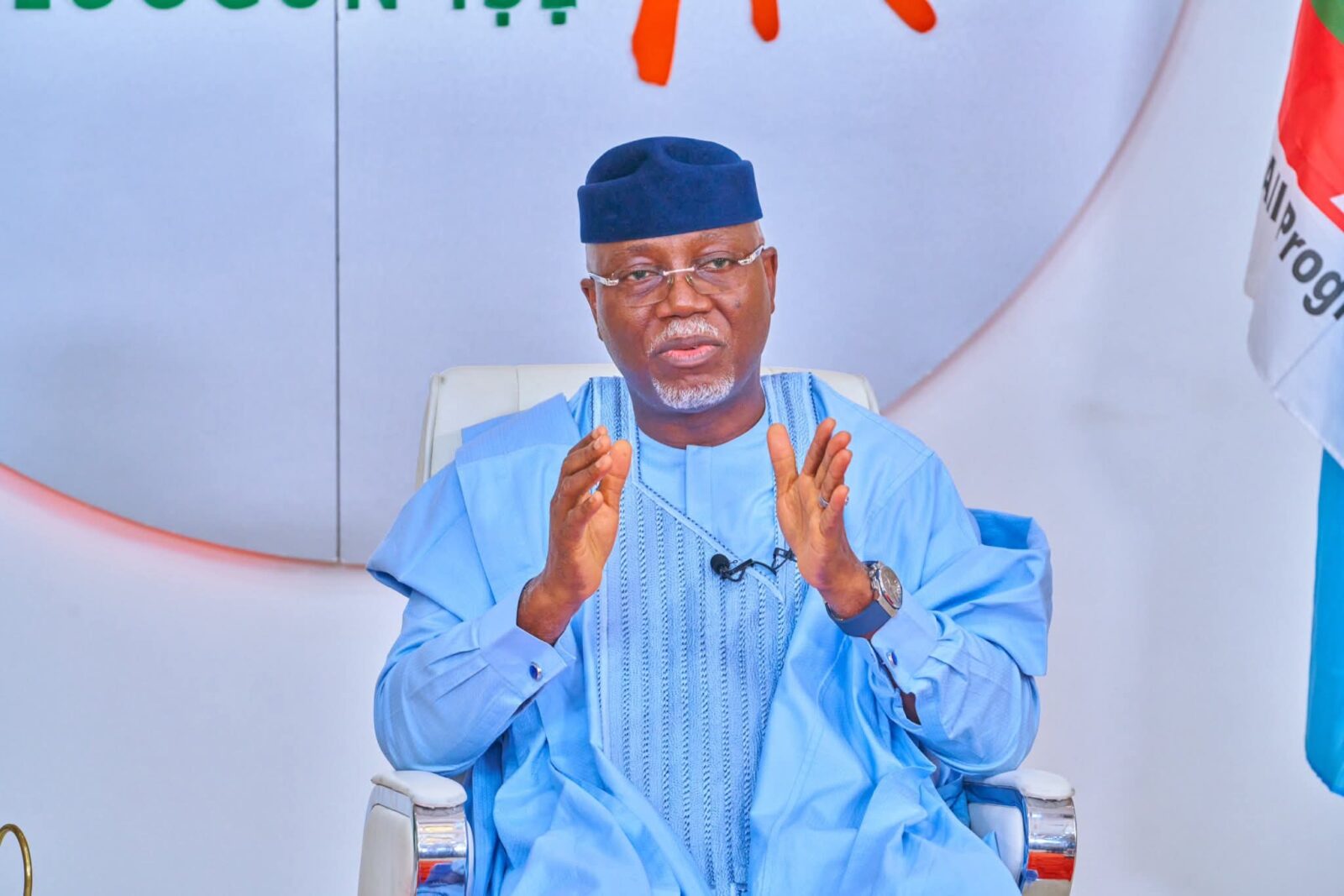
The political fault lines running beneath Ondo State have begun to shift in ways that could reshape the electoral landscape of Nigeria’s South-West. At the epicentre of this tremor are two men: Governor Lucky Aiyedatiwa, the constitutionally recognised leader of the All Progressives Congress in the state, and the Minister of Interior, Olubunmi Tunji-Ojo, a man whose grassroots mobilisation has made him a political force in his own right. The tension between them is no longer a quiet rivalry—it has become a full-blown earthquake that threatens to destabilise the very foundations of President Bola Tinubu’s re-election project .
The battle lines were drawn long before the recent exchange of words between the governor’s camp and the minister’s defenders. It began with the APC National Working Committee’s decision to overturn Governor Aiyedatiwa’s consensus list for National Assembly candidates—a move that left the governor’s preferred aspirants displaced and his political authority in question . The governor, sources say, had gambled on a strategy of reconciliation, reaching out across the eighteen local government areas to heal divisions within the party. But his efforts, according to his aide Dr Debo Akinbami, have been systematically frustrated by the minister’s camp. In a statement that laid bare the depth of the schism, Akinbami accused Tunji-Ojo of using political structures and supporters in the state to undermine the governor while quietly pursuing his own governorship ambition .
The allegation is weighty, but it has been met with a vigorous defence from Tunji-Ojo’s side. Richard Olatunde, former Chief Press Secretary to the late Governor Rotimi Akeredolu, has dismissed the accusations as unfounded, arguing that the governor’s camp should present evidence of its own mobilisation for Tinubu before criticising the minister’s efforts. “As we speak, where is the visible structure Governor Aiyedatiwa has put in place for President Tinubu’s re-election in Ondo State?” Olatunde asked pointedly . He defended the minister’s support for more than fifteen pro-Tinubu groups across the state, describing them not as political tools but as vehicles for genuine grassroots engagement—medical outreaches, youth programmes, and community initiatives that have tangibly improved lives .
The PBAT Mandate Elders Forum, led by Chief Demola Ijabiyi, has amplified these concerns. In a recent address to journalists, the forum questioned the governor’s commitment to Tinubu’s re-election, claiming that his support groups had become inactive shortly after their launch, his advisory council remained dormant, and his visible public engagement had been “strikingly inadequate” . Ijabiyi, an octogenarian party chieftain, revealed that he had personally approached the governor to initiate an elders’ forum but received no response, forcing him to seek the minister’s support instead . The forum’s critique went further, alleging that council funds remained under the effective control of the state government and that the governor’s dissatisfaction with the primary outcomes could undermine party cohesion .
Meanwhile, the political temperature has risen to alarming levels. Former Speaker of the Ondo State House of Assembly, Jumoke Akindele, has raised the alarm over what she describes as surreptitious anti-party activities by aggrieved APC members now working with opposition candidates to vote out their own party’s contenders in 2027. “To stay in a party and work against it is not only unconscionable; it is dishonourable,” Akindele declared, warning that the consequences would “in no small measure affect the party in the state” . She took a swipe at the reconciliation committee set up by the state party, dismissing it as “nonsense” and arguing that it was composed of those who had been “robbed,” making genuine reconciliation impossible. “Who is offended? Who is seeking reconciliation? Who is supposed to appeal to whom?” she asked .
Akindele’s warning echoes the caution of Razaq Obe, a former Commissioner for Energy who lost his ticket in the NWC reshuffle, who has drawn on bitter historical precedent: in Ondo South in 2019, when the party emerged with a controversial candidate, the PDP won. “So we are facing a similar situation,” Obe observed. “If it’s not addressed, the cascading effect might not even impact the National Assembly election alone, but the presidential election in Ondo State” . Olusola Oke, a party chieftain, has attempted to calm the waters, expressing confidence that Tinubu would still win Ondo convincingly despite the internal discord. “I was also cheated in the last gubernatorial primary,” Oke admitted, “but I felt the interest of the party must be paramount” .
Yet the concerns are not easily dismissed. A socio-political group, Agba Imole Renewed Hope Agenda, has called on President Tinubu to intervene directly, warning that the governor’s “excessive centralisation of power” and “systematic sidelining of constitutionally recognised office holders” could undermine the party’s electoral chances . The group also raised concerns over the alleged marginalisation of Deputy Governor Dr Olaide Adelami, describing it as politically unwise and administratively harmful .
At the heart of the crisis lies a fundamental question: who is genuinely working for Tinubu’s re-election, and who is merely using that cause to advance personal ambition? The governor’s camp insists that Aiyedatiwa’s priority is to reconcile party members and secure a united platform for the president, while Tunji-Ojo’s defenders argue that the minister’s visible grassroots mobilisation deserves recognition, not vilification . Ijabiyi has sought to frame the rivalry as ultimately convergent: “We have pro-Tunji-Ojo and pro-Governor Lucky Aiyedatiwa, but both teams are working towards the same purpose—Tinubu’s re-election. If both of us are working towards the President’s re-election, I don’t see any problem in that” .
But as Akindele has warned, the cracks are already showing. “You cannot beat a child and also tell him when and how to cry,” she observed, acknowledging that the aggrieved have a right to feel wronged . The question now is whether the national leadership—and President Tinubu himself—will act decisively to prevent the earthquake from becoming a political tsunami. As one source put it, the party’s “ship is without doubt heading for a rock in Ondo State and the ship would wreck unless the captain stirs it off the rocky track.”








Leave a comment