

By Political Analysis Desk
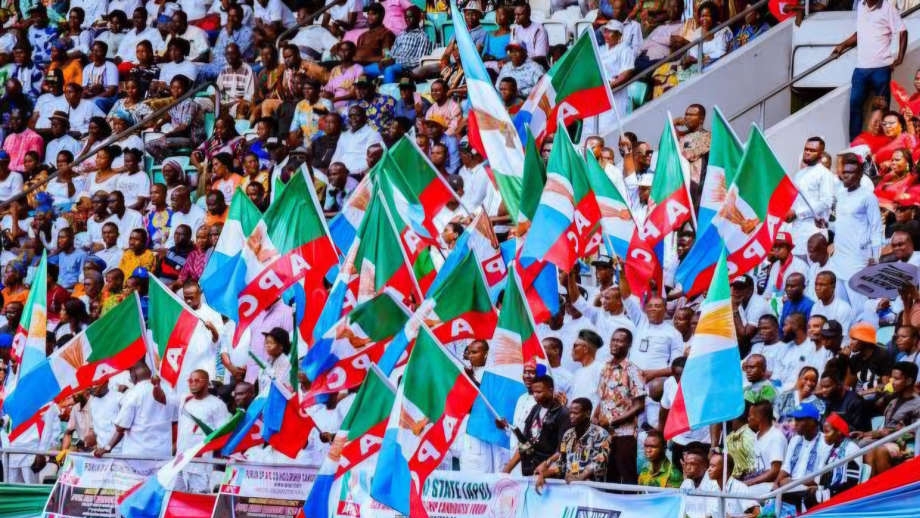
In the heart of Nigeria’s commercial capital, a political story is unfolding that could reshape the electoral map of the South-West. On the surface, the All Progressives Congress appears unshakeable in Lagos, having held power in the state for over two decades with a grip that has often seemed impervious to opposition. From Bola Tinubu to Babatunde Fashola, Akinwunmi Ambode, and Babajide Sanwo-Olu, the ruling party has maintained an enviable record of electoral victories, consolidating power across the state’s twenty local governments and thirty-seven Local Council Development Areas. But beneath this concrete fortress, cracks are beginning to appear—and the tremors are being felt from the corridors of Alausa to the streets of Badagry.
The ruling APC has handed its governorship ticket to incumbent Deputy Governor Obafemi Hamzat, setting the stage for what promises to be a high-stakes battle . Hamzat’s endorsement by the Governance Advisory Council, the powerful kitchen cabinet of Lagos politics, has been presented as a consensus, but the reality is more contested. The party’s internal machinery, however, has proven resilient. In May, Hamzat secured the governorship ticket after receiving broad support from various sections and leaders of the party, including President Bola Tinubu himself, who endorsed him as the consensus candidate while a host of aspirants withdrew and queued behind him .
The Badagry Factor: Compensation or Tokenism?
To address the longstanding agitation from the Badagry division—a region that has never produced a governor in Lagos’s fifty-seven-year history—the APC has chosen Princess Damilola Sonayon-James as Hamzat’s running mate . The traditional rulers of Badagry, led by the Aholu of Kweme Kingdom, Oba Olalekan Sejiro, had called for the governorship seat to be zoned to the area in 2027, citing justice, equity, and fairness . Oba Sejiro had argued that despite its contributions to Lagos and Nigeria’s growth, Badagry Division remains the only traditional division in the state that has not produced a governor since Lagos State was created in 1967 .
Sonayon-James, forty-one years old, currently serves as the APC Deputy State Woman Leader and previously held office as Supervisor for Agriculture and Social Services in Badagry West Local Council Development Area . She is a governance and development professional with over fifteen years of experience spanning public policy, institutional development, sustainability, and community engagement . Her nomination had earlier received the endorsement of President Tinubu and the Governance Advisory Council . Lagos State APC Chairman Cornelius Ojelabi described her as a committed party member with experience across public policy, governance, and community development, expressing confidence that the Hamzat–Sonayon-James ticket would provide the blend of experience, innovation, and grassroots engagement needed to drive the state’s development agenda .
But the question remains: does the selection genuinely address the grievances of Badagry, or is it a calculated gesture designed to pacify without empowering? The compensation of Badagry remains a double-edged sword. While it addresses a longstanding grievance that opposition parties have exploited, it risks being perceived as mere gesture politics if Sonayon-James’s role is not accompanied by meaningful development and influence. As one observer noted, the division’s marginalisation in terms of governorship representation has been fueling agitation, and political stakeholders insist that 2027 presents an opportunity to correct the imbalance .
The Alliance’s Unlikely Pairing: Rhodes-Vivour and Gbadamosi
In the opposition camp, the African Democratic Congress has assembled a ticket that presents a different kind of challenge to the ruling party. Gbadebo Rhodes-Vivour, one of the most recognisable opposition figures in Lagos politics, has chosen Babatunde Gbadamosi as his running mate . The decision has raised eyebrows across the political spectrum, not least because Gbadamosi is a politician whose experience and ambition might have suggested a gubernatorial ambition of his own. Yet Gbadamosi has framed his acceptance of the deputy slot as an act of generational mentorship, arguing that the time has come for younger Nigerians to lead, rather than being perpetually told they are “leaders of tomorrow” .
Gbadamosi, in explaining his decision, cited Nigeria’s political history. He recalled that the Action Group government in the Western Region in the 1950s was led by Chief Obafemi Awolowo, who was in his early forties, while several of his colleagues were in their twenties and thirties. He also referenced Anthony Enahoro, who at twenty-three demanded Nigeria’s independence on the floor of parliament. Turning to Lagos, Gbadamosi observed that Mobolaji Johnson became the state’s first military governor at thirty-one and surrounded himself with older and more experienced men, including Adeniran Ogunsanya, S.L. Edu, and Ganiyu Olawale Dawodu . According to Gbadamosi, the combination of youthful leadership and experienced advisers helped produce one of the most impactful administrations in Lagos’s history. “Gbadebo Rhodes-Vivour is in his early forties—a perfect time when the energy of youth meets the wisdom of experience,” he declared .
Gbadamosi’s political journey has been marked by losses and defections. He has contested the Lagos governorship twice under the PDP, was the Action Democratic Party’s candidate in 2019, and contested the Lagos East Senatorial by-election in 2020. Nevertheless, he has cultivated a significant social media following, and his ability to capture public attention remains a valuable asset. The ADC deputy governorship candidate has urged Lagos residents seeking what he described as a better state to support the Rhodes-Vivour-Gbadamosi ticket in the 2027 election, accusing the political establishment in Lagos of decades of poor governance . “If you want to Make Èkó Great Again, and build a better Lagos than the one we have all endured for the last 27 years, please join Gbadebo Rhodes-Vivour and I, and help us to chase away the locusts that want to feed on your children’s future,” he declared .
The Demographic Tectonics: The Igbo Card and Non-Indigene Votes
Beyond the candidates themselves lies a demographic reality that could shift the electoral calculus. The Igbo population in Lagos, estimated at approximately forty-five percent of the state’s residents, has become an increasingly vocal constituency. According to reports, Igbo community leaders and stakeholders in Lagos have warned the ruling APC that they will not support or vote for the party unless their demands are fulfilled . In a communique issued after a stakeholders’ meeting, Ndigbo leaders called for political inclusion, requesting tickets to contest the Federal Constituencies of Ajeromi-Ifelodun, Amuwo-Odofin, and Oshodi-Isolo—areas where Igbo residents constitute a major voting bloc .
The communique, addressed to the APC National Chairman, the Lagos State Chairman, and the Governance Advisory Council, argued that for decades, the ruling party has consistently excluded Igbo candidates from its Federal House of Representatives tickets in these constituencies, despite Igbo loyalty and contributions to the party’s electoral successes . This ongoing exclusion, the leaders warned, conveys a negative message suggesting that Igbo loyalty and contributions are disregarded, and many now see it as deliberate neglect or even hostility from party leaders .
This is the card that previous opposition governments have been playing with increasing sophistication. The assertion that Lagos is “no man’s land”—a phrase that has sparked significant anger among many Yoruba who consider it their ancestral land—has been weaponised in political contexts, often sparking ethnic tensions . The 2023 elections intensified these divisions, with accusations of intimidation against Igbo voters in areas where they are the majority to ensure the success of the APC . The Yoruba, in turn, no longer trust the Igbos, perceiving that they want to take over governance . This ethnic calculus is a dangerous game, and it has the potential to destabilise the carefully constructed alliances that have sustained the APC’s dominance.
Political observers increasingly argue that the 2027 elections in Lagos and parts of the South-West may no longer be won exclusively through traditional indigenous political structures . The state has evolved into a massive melting pot populated by millions of Nigerians from different ethnic nationalities, particularly Igbos, Edos, Urhobos, and other South-South communities whose economic influence and voting strength continue to grow steadily . Former Minister of State for Defence, Senator Musiliu Obanikoro, has resurfaced prominently in political discussions, with many analysts believing he may hold one of the most important political assets the APC currently needs: the ability to reconnect the ruling party with non-indigene voters . Obanikoro, who cultivated relationships with Igbo, Edo, Delta, and Urhobo communities over decades of direct political engagement, is seen as a potential bridge-builder for the ruling party .
The PDP’s Receding Horizon and the Fragmented Opposition
The Peoples Democratic Party, once the dominant force in Lagos politics, appears to be in a state of disarray. Its governorship candidate, Engineer Adedeji Doherty, has been described as a veteran who has contested several times, but his emergence appears more a reflection of the party’s weakness than its strength . The PDP’s collapse to 62,449 votes in 2023—a fraction of its 2015 performance—represents a catastrophic decline that no amount of rhetoric can easily reverse .
The figures from previous elections illustrate the scale of the challenge facing the opposition. In the 2015 governorship election, APC secured 811,994 votes while PDP garnered 659,788 votes. Four years later, APC polled 739,445 votes against PDP’s 206,141. By 2023, APC recorded 762,134 votes, while the Labour Party emerged as the main challenger with 312,329 votes . Rhodes-Vivour’s 2023 performance established a baseline that he could build upon, representing the strongest opposition showing in Lagos since 1999. Yet the margin remains substantial.
The Guardian’s analysis characterises the opposition as “too weak, fragmented, and internally divided to effectively translate grievances into electoral gains” . The PDP’s internal divisions, combined with the emergence of multiple candidates across different parties, threaten to split the anti-APC vote. The NDC, a relatively new entrant, has presented Funsho Doherty, while the Labour Party’s decision to align with the ADC has left its own structure uncertain . Deep divisions among the challengers may undermine their chances, even as opposition parties mount their most crowded challenge yet to APC dominance .
The APC’s Structural Dominance
Despite the warnings, despite the fragmentation, despite the demographic shifts, the political structure of the APC in Lagos remains formidable. Unlike many states where political structures are built around individuals and collapse after elections, Lagos APC has evolved into a sophisticated political machine supported by an extensive grassroots network, a formidable mobilisation structure, and the Governance Advisory Council . This structure has enabled the party to remain dominant despite changing political circumstances and occasional internal disagreements . For supporters of the ruling party, this continuity represents stability, effective governance, and political maturity .
However, critics argue that the prolonged dominance of a single political bloc has created a political environment where electoral competition is increasingly weak and alternative voices struggle to gain traction . This concern has become even more pronounced as the 2027 election approaches. Ordinarily, worsening economic realities, rising transportation costs, insecurity, housing challenges, unemployment, flooding, and traffic congestion should provide fertile ground for opposition parties seeking to mobilise public frustration against the government . Yet many observers believe that despite growing dissatisfaction among segments of the population, opposition parties remain too weak to capitalise .
Conclusion: A Fortress with Cracks
The APC has weathered previous storms, including Peter Obi’s 2023 presidential victory in Lagos, which caused alarm within APC circles but did not translate into governorship defeat. The Governance Advisory Council has endorsed Hamzat with the blessing of President Tinubu himself, and the party’s institutional strength—its grassroots network, its financial resources, its access to federal patronage—remains unmatched.
For Rhodes-Vivour and the opposition coalition, the path to victory requires not just unity but a seismic shift in voter behaviour that has not materialised in two decades. The 312,329 votes he secured in 2023 demonstrated that there is a constituency for change, but it also demonstrated the scale of the mountain he must climb. As the APC spokesman, Mogaji Seye Oladejo, noted, the party maintains one of the most extensive political networks in Nigeria, with functioning structures at ward level, across Local Government Areas and Local Council Development Areas, as well as at the state and federal levels .
The compensation of Badagry, if managed effectively, could neutralise a longstanding grievance. The selection of Sonayon-James addresses the geopolitical imbalance that had become a liability . And the APC’s response to the demands of the Igbo community could determine the trajectory of the 2027 elections in the state . As Joe Igbokwe, a prominent APC chieftain of Igbo extraction, has declared, Igbo members of the APC in Lagos are mobilising extensively to ensure President Tinubu records a resounding victory in 2027 .
The cracks beneath the concrete fortress are there—the question is whether they will remain cracks, or whether they will become fissures that bring the entire structure down. Unless something drastic happens—a collapse of APC unity, a major scandal, or a dramatic realignment of ethnic voting patterns—the APC’s concrete fortress in Lagos will likely hold. As one observer noted, the decision will rest on a combination of political strategy, party consensus, and public acceptance . And in that calculation, the APC’s twenty-year dominance gives it an advantage that no amount of opposition unity can easily overcome.







Leave a comment