


One of the concerns of contemporary literature from Nigeria has been the struggle of the individual against the reality of migration. On that score, the writer does not paint relocation abroad in the sentiments of escapism; rather, they do so to aptly underscore the circumstances of survival. Therefore, the ‘japa’ rave remains a closed scenario within the ambit of uninformed criticism. It would therefore take the traveller to dispel the delusion of migration as essentially a dream fulfilled. If anything, it is layered with coping mechanisms. This is what the reader encounters in Ololade A. Obadina’s For This UK I Go Dey Okay (For This UK hence).
The anthology is a packet of thirteen poems that explore the poet-persona’s impression about living in the UK as a Nigerian. The gem of the poems is the meditation on identity, perhaps racial malice; but most significantly, the real question of what it takes and what it means to seek a better working and living condition abroad. It moves the reader to question their erstwhile opinion – if not delusion – that it is an easy way out of economic devastation once one has their visa stamped at all. That is, For This UK is a reaction to and resolution about the hassles of adapting to weather, economic, and socio-political conditions of migration.
The poems are an expression of inner conflict. What runs through the mind of the persona is an hitherto unhatched reality that economic struggle only happens under a more beautiful living condition in the UK, and not that it gets any less problematic. Against the backdrop of less work for more wages; or even a trackable unit of work for more palpable financial security, the migrant “keep seventeen tabs open.” This is a spotlight on the double yoke condition of working abroad. It suggests that economic struggle is a mutually interdependent anomy. And that there are only better social amenities to tackle the haze – unlike homeland where that security is out of reach.
Similarly, this tells on the hustle culture of Nigerians; young Nigerians. Despite the challenges, rather than back down, the persona affirms in “The Arrival” that she “dey learn new rules for old life.” Apparently, the adjustment to new realities has always been their tough skin against the unprecedented challenges. To “learn new rules” will suppose the evolution premise of the human condition: adaptation to environment as a survival mechanism. In this regard, – and for the migrant – the individual needs to first unlearn the illusion of better grounds for financial security and accept the social flaws that permeate class stratification everywhere. This is predicated on the rise of capitalism as a major social contraption of class existence in the modern world. It is only spectacularly undermining in the case of the African youth having their future mortgaged by their political reality. Although, this anthology does not say, the implications undercut a couple of the poems.
This prolongs into the psychological response to this long-standing condition. From the days of the British play, Look Back in Anger by John Osborne till this present day, potential has had one cause or another to explode in rage. And Obadina aptly does justice to that subconsciously. One of the poems entitled “Wearing a Mask” is such a swell of poetic brilliance. This is so because it captures the bottled-up feelings of existential crisis. Again, this is not explicitly given, there are implications of depression, isolation, burn out, etc. occasioned by the workaholism imposed on the young, promising, and ambitious individual under a capitalist dispensation. Commentary on this ubiquitous phenomenon, the idea of “a mask” is relatable, realistic, and deeply moving.
More predominantly is the absurdist approach enacted in the tone. The persona, in coming to terms with the situation on the ground, redefines success in the proportion of life’s ordinariness. It would seem that the meaning of life begins to divulge itself the moment the individual faces the core and content of an inescapable flaw – the dent and curse of the human species. But more directly, the poet-persona rationalises success as a gamut of victories and not the sheer belief that “peace would come in a paycheck” (in I dey UK But I’m Not Okay, Part 1). Ambition is fuelled with money but does not end there: there are several ingredients of success found in living life in bits and tons of gratitude for the extraordinary little things.
The identity crisis in the poems, though secondary, is also highly significant. It accommodates origin and nationality. To have carried indigenous cities with her creates in the poet-persona a lens of resilience – generally Black resilience and indestructibility – against the invidious condition of rationalising psychosocial breakdown. Again, identity is reflected in the instrumentality of language: the Nigerian pidgin. It suggests the conquest of ideological superiority and reaction to the subordination – if not subjection to – of linguistic identity. In more ways than imagined, in fact, the use of pidgin in the poems, indexes nationality, and the exclusivity of language sophistication identified with African poetic parole.
Among the several literary devices deployed in the poems, irony and paradox stand out. One of the poems entitled “Loneliness in a Crowd” exemplifies the paradox most. The conflicting reality and satirical sophistication make the poem an individual’s analysis of the derisive condition of migration. There are metaphors, smiles, rhymes, consonance, and related sound and rhetorical elements in the poems that drop the message in the reader’s consciousness. Satirical in tone and reflective tone, the poems finger governments for frustration of the youth, the elusiveness of dream, and the plague of workaholism.
With themes such as migration, identity, individualism, isolation, economic struggle, climate reality, political instability, hustle culture, optimism, and many more, For This UK is a thought-provoking contemporary Nigerian anthology of poems whose thematic concerns resonate with the reader more palpably and directly than the recurrence of sheer historical and political undertones of the nation’s – and continent’s at large – curse of socio-economic devastation.
The anthology is an inexhaustible germ of poetic angst in contemporary Nigerian Literature. It addresses in a relatable proportion a thoroughness in inner conflict resulting from socio-political dysfunctions and harsh economic climate. It combines relics of literary modern era and the disenchantment in contemporary era to exemplify the unspoken human breakdowns of Modernist disillusionment.
Ololade A. Obadina is a poet and writer based in the UK. Combining a background in complex analytical casework within the public sector with a lifelong dedication to literature, Ololade crafts verse that balances meticulous attention to detail with deep thematic resonance.
First Published on Vanguard Newspapers.
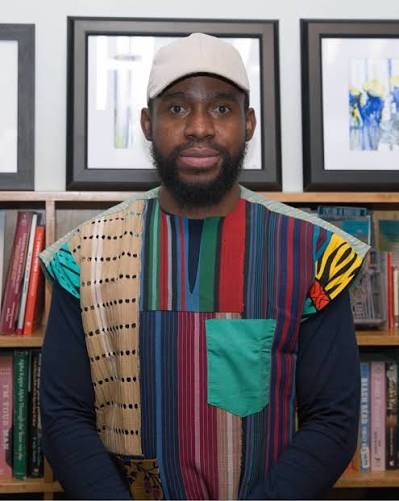
Femi Morgan is a creative writer, culture influencer and journalist. He is the author of The Year of Fire, a poetry collection that was shortlisted for the Glena Luschei Prize for African Writing. He is also the founder of Artmosphere Nigeria, and the Curatorial Director at Griots and Bards—both arts and culture organisations foster robust social and cultural engagements in Nigeria.












Leave a comment