

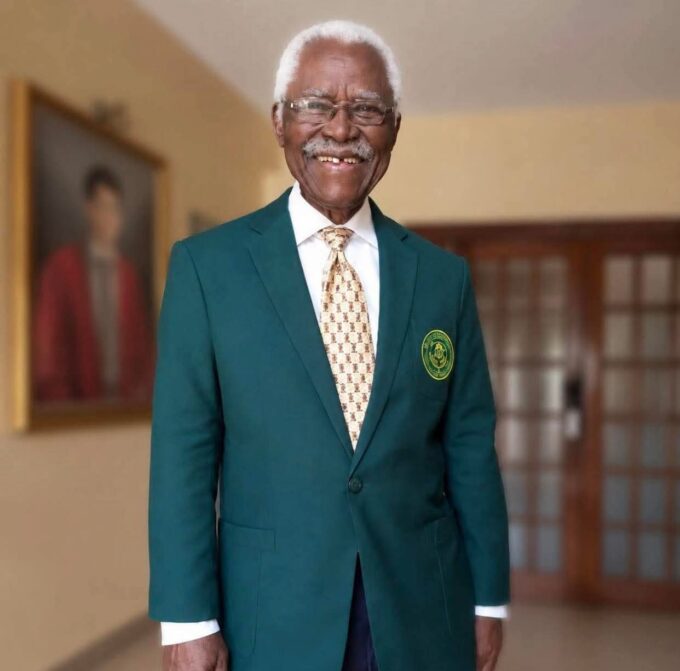
The name Ayo Bamgbose is not a name that you will find in pop culture trivia about the pioneers of the study of humanities in Nigeria, and indeed in Africa, perhaps because unlike the likes of Wole Soyinka, Chinua Achebe, D.O. Fagunwa, Cyprian Ekwensi, and other literary giants, Bamgbose’s life work was in Linguistics, a field that does not readily lend itself to work that can be read for leisure, or prescribed as reading for secondary schools. Yet as the first African to achieve a PhD in Linguistics and the first ever Professor in that field, much like Bishop Samuel Ajayi Crowther is regarded as an icon for translating the bible into Yoruba, Emeritus Professor Ayo Bamgbose NNOM, FNAL should be regarded as an icon for his seminal role in elevating the field of Linguistics in Nigeria and indeed Africa.
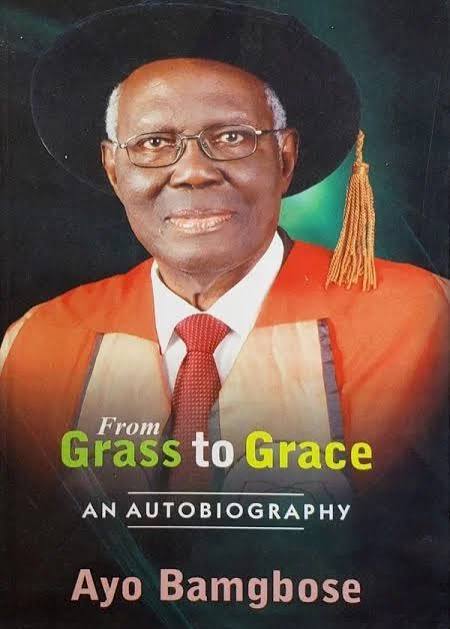
Born Ayorinde Bamgbose on January 27th 1932, in Odopotu, now in Ogun State, Nigeria, to an Anglican Priest, Revd. Sangodipe Bamgbose who is a descendant of Sango worshippers. Perhaps in another era, Ayorinde, with his tall, imposing frame, would have been a leader in the armies of Oyo,(where the Orisa whose patronymic he bears, ruled), holding aloft the Ose and casting fear into the hearts of enemies, but the gentle giant, who remained a lifelong Christian, was destined to cast an equally imposing shadow in a different field entirely, the field of Linguistics. Professor Ayo Bamgbose had his education at St Andrews College, (now Emmanual Alayande University of Education, Oyo) from 1948-1951 and then to the University College, Ibadan, from 1957-1960. He then proceeded to the University of Edinburgh where he got his PhD in Liguistics (becoming the first Nigerian to do so) in 1963.
Immediately after his Ph.D., he was appointed Lecturer at the University of Ibadan in October 1963 and rose quickly to become Senior Lecturer in 1966 and Professor in 1968, a post he held until he retired in 1990 (not counting a contract appointment that ended in 1992). Professor Bamgbose participated in practically all facets of University life. He was the pioneer Warden of the Postgraduate Hall, 1968-1969 and subsequently Hall Master, 1976-1978. He was Head of the Department of Linguistics and African Languages for a record period of ten years, 1969-1975 and 1977-1981. He was Dean of the Faculty of Arts, 1971-1973 in which capacity he chaired the Jos Campus Committee that supervised the establishment of this Campus of the University that was later to become the University of Jos. Other notable assignments were the Chairmanship of the Senate Committee on the General Studies Programme, 1986-1987 & 1988-1990 and that of the Senate Publications Committee, 1988-1990. Professor Bamgbose’s scholarly expertise was always in demand.
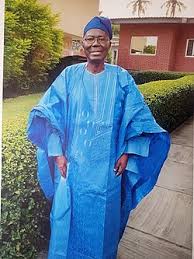
He has been guest lecturer at over 30 universities spread across Africa, Europe and the United States of America. In particular, he has been Visiting Professor, University of Hamburg (Germany), 1979-1980, University of Illinois, Urbana-Champaign, (USA), 1993-1995, University of Leipzig (Germany) 1997-1999 and Visiting Fellow, Clare Hall, University of Cambridge (U.K.), 1987-1988.
Writing this piece about Emeritus Prof. Ayo Bamgbose is perhaps more personal to me, because in 1986, he agreed to supervise the PhD thesis of a certain Adewale Bandele Adegbite, who was one of his final PhD supervisees before he retired from the University of Ibadan in 1992. That event brought the two men together, and they developed a lifelong relationship that moved beyond a student-mentor relationship, after the latter acquired his PhD in 1991, to what was akin to a father-son relationship until Prof. Bamgbose’s passing.
Growing up, the names Ayo Bamgbose, and Professor Adebisi Afolayan (the founding head of the Department of English, Obafemi Awolowo University Ile-Ife, who also passed earlier this year) were names to be spoken with the kind of reverence reserved for highly respected grandfathers. Not that my dad would have gone that far of course, but if he wanted us to pray to Ayo Bamgbose every morning, he wouldn’t have had a lot of resistance. With his name being the most ubiquitous in my dad’s library, and the thick volumes with his name on them that intimidated even the voracious reader that I was, It wouldn’t have been too hard for my credulous, childish mind to believe that Ayo Bamgbose was infact God.
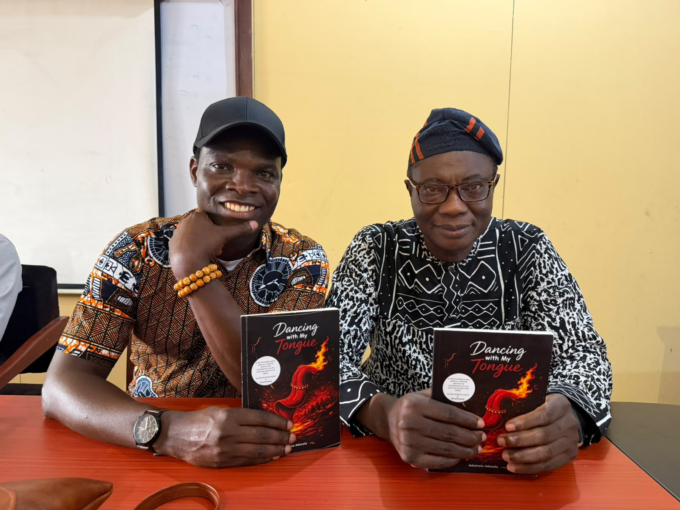
I had the opportunity to meet the legend himself for the first time in 2001, when I was almost 12, at a Linguistics conference that I accompanied my dad to at the University of Lagos. Of course an academic Linguistics Conference was not a place for an 11-year-old, so I couldn’t follow much of what was said (at any rate, I only attended the opening day, and spent the remaining days at my aunt’s house with my cousins) but Prof. Bamgbose was one of the standout memories for me not in the least because of my Dad gushing to me about how he is his “academic father”. It would take a number of years before I grasped the concept of PhD supervision, and “academic fatherhood” but even then, I believed that the white-haired grandpa talking to me quite affectionately, could be my dad’s father with his tall imposing stature compared to my dad’s smaller one.
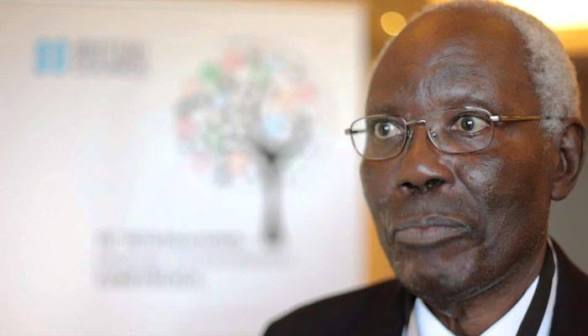
It would take about 8 or 9 years after that first meeting, before I finally started to understand just how much of an impact that Ayo Bamgbose had on the study of Linguistics in Nigeria. His PhD thesis was the first work to apply a linguistic theory to a Nigeria language, in other words. He was the first scholar in the field of Applied Linguistics in Nigeria. Not just that, he was one of the pioneering scholars in that field globally. it means that he was the scholar to establish that African languages (in his own case Yoruba) are not just babble by primitive cultures, but that they have their lexical and grammatical structures that can be analyzed using the same linguistic theories that is used to analyze the various western variants of English. He didn’t stop there either. He proceeded to further establish that language isn’t just about grammatical rules and theory, it can also be used to understand society and how people think and live. Hence the concept of Nigerian English as a variant of English that is not a “broken” form of British English, spoken by those who are too primitive ignorant to grasp the “purer” form, but a unique standalone variant that captures the psychology, sociology and politics of the people who use it. To simplify that even further, if you see a word like “chewing stick” or “Go-Slow” inside the English dictionary, you now know who made it possible.
Ayo Bamgbose isn’t just the father of Applied Linguistics, his work is also seminal, and frequently referenced, in the field of African Languages, Sociology, Psychology, Philosophy and even in Education. It then that I came to realize that his name being ubiquitous in all the reference sections of the books in my dad’s library was not a coincidence, he had simply created the blueprint that other scholars in the field have continued to build upon till today. Regardless of whatever new frontiers that African Applied Linguistics expand into, there will always be the thread that goes back to the name that started it all, Ayo Bamgbose, PhD.
Emeritus Professor Ayorinde Bamgbose was a warrior who never carried a weapon, he was an activist who never carried a placard, he was a cultural advocate who from his privileged position in the ivory tower changed the perception of the world towards African languages and broadened the frontiers of knowledge. History will remember him kindly.





Leave a comment