

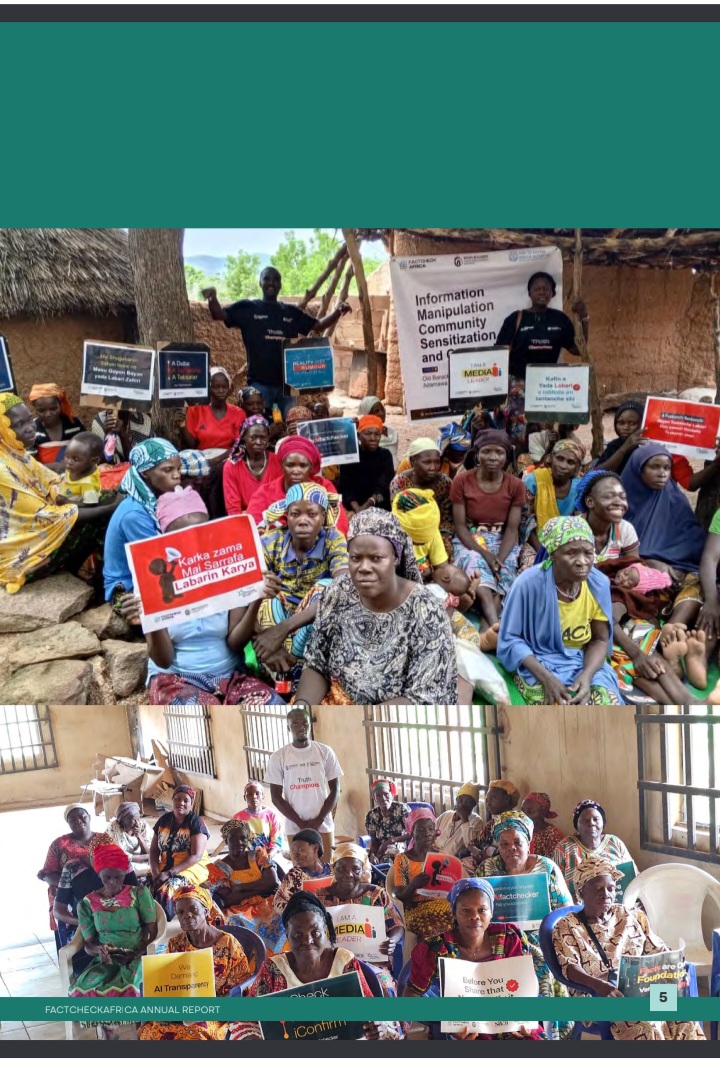
Most fact-checkers build tools. This one is building infrastructure and the distinction matters.The conventional playbook for a fact-checking organisation looks roughly like this: hire journalists, publish debunks, build an audience, repeat. FactCheckAfrica, launched in 2022 as FactCheckElections and headquartered in Osogbo, Nigeria has followed a different playbook entirely. Its 2025 Annual Impact Report, released this month, reveals an organisation that has quietly moved from reactive debunking to systemic intervention. Here are five ways it is doing something the sector has not seen before.
1. It put verification inside WhatsApp, not beside it
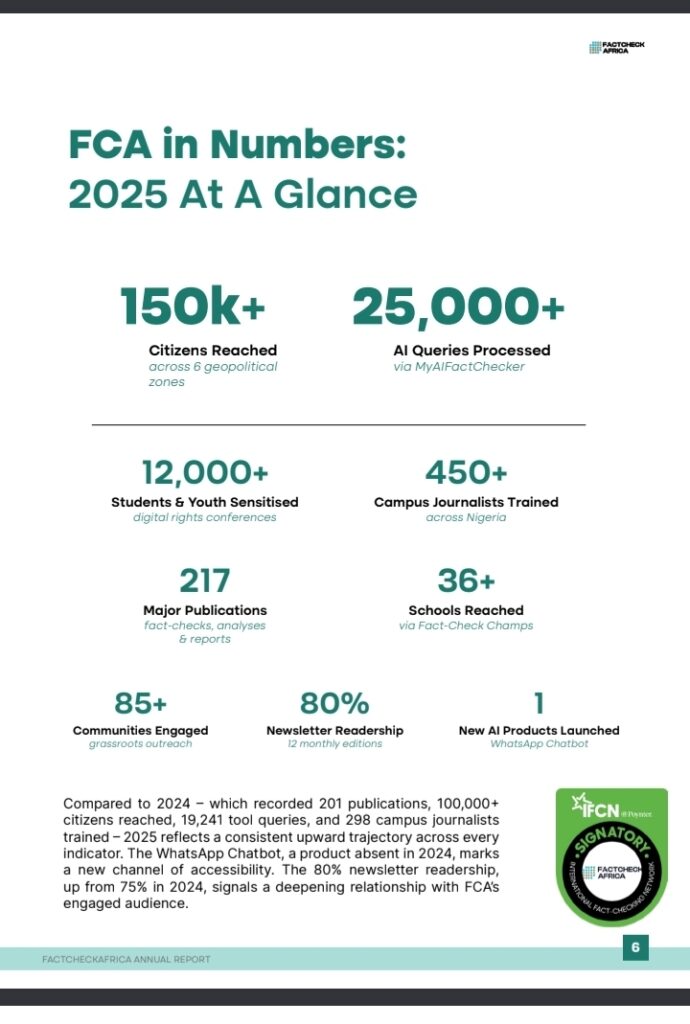
The standard approach to digital fact-checking is to build a website, publish your findings, and hope people find them before the misinformation does. FCA took a different route. In 2025, it deployed a WhatsApp chatbot that allows citizens to submit claims and receive near-real-time analysis without ever leaving the platform where misinformation is most likely to reach them. The chatbot works in low-bandwidth conditions — a non-negotiable design requirement in contexts where reliable data access is uneven — and includes voice-to-text functionality for users who cannot read or type. This is not a feature addition. It is a rethinking of where verification has to live to be useful.
2. It built an AI tool that speaks Africa’s languages
MyAIFactChecker, described as Africa’s first AI-powered fact-checking platform, processed over 25,000 verification queries in 2025. But the architectural choice that sets it apart is not speed or scale. It is language. The platform supports Yoruba, Hausa, Igbo, Swahili, Arabic, and French, alongside English. That is not a cosmetic localisation layer. It reflects a foundational argument: that a verification tool designed for Africa cannot treat English as the default language of truth. False claims circulate in every language communities use. The tools meant to counter them should too. Most civic-tech products have not made this argument in code. FCA has.
3. It embedded fact-checking into university curricula before students enter newsrooms
Reaching journalists after they have already developed their habits is a late intervention. FCA went earlier. In 2025, the organisation formally integrated a fact-checking curriculum, developed through comparative analysis of programmes at 133 universities globally — into the mass communication departments of Kwara State University and the University of Ilorin. More than 12,000 university students were sensitised overall. The long-term logic here is straightforward: if verification literacy becomes part of how a generation of Nigerian journalists, communicators, and content creators are trained, the need for reactive debunking shrinks. It is a pipeline play, not a headline play.
4. It taught children to question before they believe
Even earlier than the university intervention is the Fact-Check Champs initiative — a 30-card flashcard game covering how to spot fabricated content, the mechanics of misinformation, and the vocabulary of verification. Since its launch in January 2025, the programme has reached over 36 schools across Lagos, Oyo, Borno, Sokoto, Jigawa, and other states. This is the furthest upstream FCA has gone. It is not trying to correct false beliefs after they form. It is trying to build the cognitive habits that make people harder to mislead before the misinformation arrives. No other fact-checking organisation operating on the continent is doing this at scale.

5.It showed up at the global AI governance table, and said something specific
African voices in global AI policy conversations tend to be invited late, listened to briefly, and quoted rarely. FCA’s Convener attended the Paris AI Action Summit, Global Fact 12 in Rio de Janeiro, the Africa Facts Summit in Dakar — which drew over 200 participants from 20 countries, and COP30 in Belém. What made those appearances meaningful was not attendance but argument. FCA has been consistent in naming what the sector calls the ‘Liar’s Dividend’: the way deepfake proliferation allows bad actors to dismiss genuine evidence as AI-generated, undermining the evidentiary environment entirely. That is a specific, technically grounded contribution to a debate that often stays abstract. Showing up with a clear position is different from showing up.












Leave a comment