

A sweeping CBN directive requiring all payment data to remain on Nigerian soil by January 2027 has drawn applause from regulators and alarm from industry. The real question is whether the country’s infrastructure can absorb the ambition, and who ultimately bears the bill.When the Central Bank of Nigeria issued its circular on payment system supervision earlier this month, the directive landed quietly, the kind of regulatory update that earns a press release and a few industry reactions before disappearing into compliance schedules. But make no mistake: the CBN’s order that all payment transaction data generated within Nigeria must be stored and managed on local servers, effective January 1, 2027, is one of the most economically consequential financial regulations the country has issued in years.
The policy covers every institution that touches the Nigerian payments stack, deposit money banks, microfinance banks, mobile money operators, switching and processing companies, payment terminal service providers, and a long list of other licensed operators. All of them must now ensure that the data trails produced by Nigerian transactions never leave Nigerian soil. The apex bank has been clear: full compliance is mandatory, and sanctions await those who fall short.
On the surface, this is a data sovereignty play a move to keep sensitive financial information subject to Nigerian law and Nigerian regulatory scrutiny. In practice, it is a structural economic intervention with costs, winners, and risks that deserve close examination.
The Infrastructure Gap That Now Has a Deadline
Nigeria’s digital payments market has expanded at a remarkable pace. Electronic transactions have hit record volumes, mobile banking has gone mainstream, and a generation of fintech companies has built billion-dollar businesses on digital rails. What has not kept pace is the domestic infrastructure required to host all of that activity locally.Many of the country’s largest financial institutions, and virtually all of its internationally backed fintech firms, currently rely on offshore cloud services and foreign data centres to store and process transaction records. The economics have been straightforward: offshore cloud infrastructure from providers like AWS, Google Cloud, and Microsoft Azure offers reliability, scalability, and pricing that domestic alternatives have rarely matched.
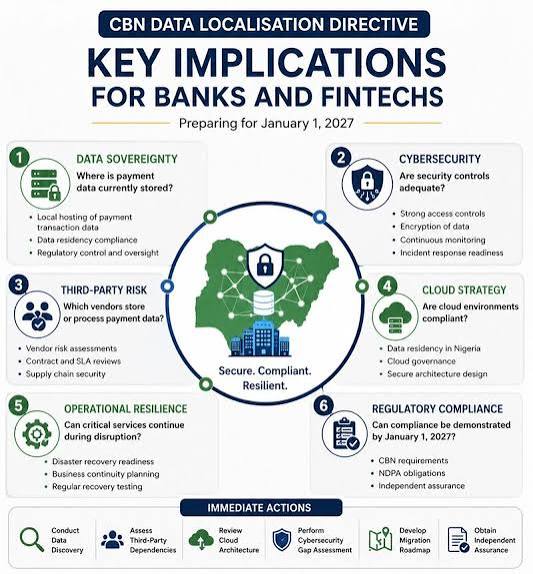
The CBN’s directive effectively ends that calculus.By creating a hard regulatory deadline, the apex bank has simultaneously created one of the clearest demand signals Nigeria’s domestic data centre and cloud market has ever received. Local infrastructure providers stand to benefit significantly as institutions scramble to migrate systems, expand on-shore hosting capacity, and build the redundancy required to meet compliance standards. Investment in this space, long constrained by uncertain demand, now has the anchor workload it needs to justify scale.
Compliance Costs and Who Absorbs Them
The financial burden of compliance will not fall evenly. Large commercial banks with existing domestic infrastructure and dedicated technology budgets are best positioned to absorb the migration costs. For mid-tier fintechs and smaller payment operators, the calculus is considerably less comfortable.Technology architecture reviews, data migration projects, local hosting contracts, and the cybersecurity hardening that accompanies them are not cheap undertakings — particularly in an environment where the naira’s purchasing power constrains capital expenditure planning. Companies that built their systems on the assumption of global cloud infrastructure will face genuine engineering and cost challenges in compressing what might naturally be a multi-year transition into a 19-month window.The concern is not merely financial. Nigeria’s power supply remains one of the most persistent structural risks to technology infrastructure in the country. Critics of the directive, including fintech workers who aired their views publicly after the circular was published, have flagged electricity reliability as a central vulnerability: a mandate to store critical financial data domestically is only as strong as the uptime the domestic infrastructure can guarantee.The CBN has not published detailed guidance on how institutions should meet the technical requirements beyond the localisation obligation itself, leaving significant implementation risk in the hands of individual operators.
Transparency, Market Structure, and the Bigger Picture
Data localisation is only one strand of the CBN’s wider regulatory reform. The same circular introduces ultimate beneficial ownership disclosure requirements, mandating that all payment operators identify and report the individuals who ultimately own or control their businesses, even where shareholding is layered through complex structures. For internationally backed players like Flutterwave and Paystack, both ultimately controlled by foreign investors, this adds a new layer of governance scrutiny to their Nigerian operations.The circular also introduces market concentration limits. No single institution controlling more than 25 percent of card issuance will be permitted to simultaneously hold more than 15 percent of merchant acquiring market share. This is a structural intervention aimed directly at preventing the kind of dominant-player lock-in that has characterised parts of Nigeria’s payments ecosystem. Combined with mandatory monthly market share reporting, the CBN is constructing a surveillance and accountability architecture for the sector that goes well beyond data storage.Taken together, the reforms signal something important about where the apex bank sees Nigerian financial services heading. The era in which speed of growth could outpace regulatory accountability is closing. The CBN is demanding that the infrastructure of Nigerian payments be locally accountable, transparently owned, and structured so that no single failure, whether of a dominant institution or an offshore server can destabilise the system.

The Enforcement Question
Whether this ambition translates into durable change depends on enforcement. The CBN has a track record of issuing strong directives and then applying them unevenly — and the industry knows it. January 1, 2027 is both a compliance deadline and a credibility test. If the apex bank pursues sanctions against major defaulters with the consistency it has promised, the directive becomes a landmark. If it becomes another regulation honoured more in aspiration than in practice, the infrastructure investment it is designed to catalyse will stall.For now, the financial sector is watching, planning, and calculating. The CBN has made its intent clear: Nigeria’s payment data belongs in Nigeria. The cost of making that true, in capital, in engineering, and in institutional will, is the real story the next 19 months will tell.













Leave a comment