

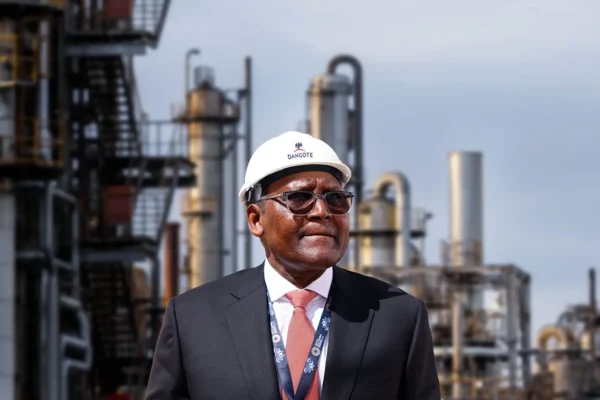
Aliko Dangote Businesses have become a major force in Africa’s economy. From cement production and oil refining to food processing and logistics, the billionaire entrepreneur has built one of the continent’s largest business networks.
What started as a small trading operation in 1977 has grown into a vast industrial empire. Today, the Dangote Group operates across several sectors and employs thousands of people throughout Africa.
According to Forbes, Aliko Dangote’s net worth stood at $28.5 billion in 2026, while the Dangote Group was valued at approximately $32.6 billion. The company has also committed $22.6 billion to a broader $45 billion expansion strategy planned across Africa.
From Trading Goods to Industrial Powerhouse
Aliko Dangote showed an interest in business from an early age. As a child, he bought sweets with his pocket money and resold them for profit.
His formal business journey began in 1977 after receiving a loan from his uncle. Initially, he traded commodities such as rice, sugar, fish, and salt.
During the 1990s, however, he shifted his attention to manufacturing. That decision transformed the company’s future and laid the foundation for one of Africa’s largest industrial groups.
The Dangote Group now aims to reach a valuation of $250 billion and annual revenue of $100 billion by 2030.
Logistics and Transportation Businesses
The Dangote Group maintains a strong presence in logistics and infrastructure.
One of its key assets is Greenview Development Nigeria Limited (GDNL). The company manages Terminal E at the Lagos Port Complex in Apapa. The terminal handles bulk cargo linked to the group’s flour and sugar operations. Its concession agreement with the Nigerian Ports Authority spans 25 years.
The group also operates Dangote Sinotruk West Africa Limited. This company assembles heavy-duty commercial trucks in Ikeja, Lagos.
The facility can produce up to 10,000 trucks annually. It also supports around 3,000 jobs nationwide.
Bloomberg reported that Dangote plans to purchase 10,000 compressed natural gas trucks. The first 1,500 units are expected to arrive during 2026.
In addition, the group owns a majority stake in Peugeot Automobile Nigeria (PAN) in Kaduna. The company assembles passenger vehicles and strengthens Dangote’s industrial portfolio.
Food Production and Consumer Goods Operations
Food production remains another important pillar of the Dangote empire.
NASCON Allied Industries Plc manufactures salt, seasonings, and vegetable oil for consumers and industries. Company filings revealed a 325 percent increase in profit during the 2023 financial year.
The group also operates a large tomato processing facility in northern Nigeria. The project supports local farmers and helps reduce dependence on imported tomato paste.
Dangote Rice forms part of the company’s broader agricultural strategy. The business focuses on large-scale rice cultivation and processing across Nigeria.
Meanwhile, Dangote Sugar Refinery ranks among Africa’s largest sugar producers. The company supplies households as well as major beverage and confectionery manufacturers.
The group has proposed merging Dangote Sugar, NASCON, and Dangote Rice into a larger food conglomerate.
Outside Nigeria, Dangote is investing $162 million in a sugar refinery and a 25,000-hectare irrigated farming project in Ghana’s Bono Region.
Refining, Cement and Fertilizer Lead Expansion
The Dangote Petroleum Refinery remains the group’s most ambitious project.
Located in the Ibeju-Lekki Free Zone, the refinery processes 650,000 barrels of crude oil daily. Industry reports estimate its value between $20 billion and $22 billion.
Commercial production began in 2024 after years of development.
Expansion plans are already underway. Reports indicate the refinery could reach 1.4 million barrels per day within the next 30 months. If achieved, it would surpass India’s Jamnagar Refinery and become the world’s largest refinery by capacity.
The complex also plans to increase polypropylene production from 900,000 metric tonnes to 2.5 million metric tonnes annually.
According to public records, the refinery has handled roughly 800 vessels since operations began. It also meets Euro VI fuel standards.
Another major asset is Dangote Cement. Established in 1992, it is Sub-Saharan Africa’s largest cement producer.
The company operates in ten African countries. These include Nigeria, Ghana, Ethiopia, Tanzania, Zambia, Senegal, Cameroon, South Africa, Congo, and Sierra Leone.
Its Nigerian plants are located in Obajana, Ibese, and Gboko.
Dangote Cement currently has an integrated production capacity of about 55 million tonnes annually. The company aims to increase that figure to 80 million tonnes by 2030.
The Dangote Fertilizer complex is also a key contributor to the group’s growth. The facility produces three million metric tonnes of granular urea each year.
It remains Africa’s largest fertilizer production plant.
The group is expanding its fertilizer operations into Ethiopia. Investment plans have grown from $2.5 billion to more than $4 billion.
The project includes a 110-kilometre pipeline, a 120-megawatt power plant, a polypropylene packaging facility, and a two-million-tonne NPK blending plant.
Dangote’s Multi-Billion-Dollar Growth Strategy
The Dangote Group continues to pursue aggressive expansion across Africa.
Between 2026 and 2030, the company plans to invest $45 billion in refining, petrochemicals, fertilizer, cement, and energy infrastructure.
Reports also suggest the group is considering a $17 billion oil refinery project in Mombasa, Kenya.
In Southern Africa, Dangote is leading a $1 billion investment programme. The initiative covers cement production, power generation, and a 2,000-kilometre petroleum pipeline connecting Namibia and Zimbabwe.
These projects reflect the company’s long-term ambition to strengthen industrial development across the continent.
The story of Aliko Dangote Businesses is one of remarkable growth and strategic expansion.
From a modest trading company established in 1977, Dangote has built a business empire that influences transportation, agriculture, manufacturing, energy, and infrastructure across Africa.
Today, the Dangote Group stands at the center of several transformative projects. With billions of dollars earmarked for new investments, the company continues to shape Africa’s industrial future while creating jobs and driving economic development throughout the continent.






Leave a comment