

Rummaging For Omen is a Discovery and Expression of Self Fuelled by A Sense of Urgency
Michael Chiedoziem Chukwudera
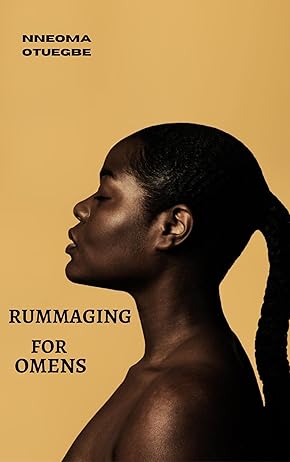
Everybody lives, experiencing at different points in their lives different epiphanies at different points. These new realizations are often born from growth or are a reaction to an event which happens to one, and changes the foundation of their beliefs. The mind of the open-minded and open-hearted is inevitably subject to changes because of life’s intricacy. We find sometimes, even, that how we react to events which happen to us is different from what we had expected from ourselves. This unpredictability of the human existence is a constant source for wonder and relearning. The new anthology of poems, “Rummaging for Omens” by Nneoma Otuegbe, published by Baron Café (November 2021) is an anthology of poems which partly portrays the life of a poet from this vantage in a poet’s life.
“I never believed in ghosts, until my father died,” Nneoma Otuegbe wrote recently on her Facebook page, where she narrated the story of how her alarm where she lives in Wolverhampton, England, went uncontrollably off on the morning her father died. Five months after her father’s death, when she returned back to England from Nigeria, she was playing music from her playlist when suddenly, the music, “…..” came on. It was not as much the fact that the message of the song was consoling, as the fact that it was a song, Nneoma had never heard before that baffled her. These series of experiences, would lead, not just to her reconsideration of the existence of ghosts, but also to the titled Poem of her anthology, “Rummaging for Omens”.
In the poem, she writes in Stanza 2 and 3, “Only yesterday I had a father/ As sturdy as a rock./ A little unforgiving but rather /One of life’s reasons not to mock/ They say your blinding light/ Has shone brightly one last time/ And suddenly dimmed shyly at night /Like a half-moon retreating into the ashen skies”: A harrowing reflection of having learnt of her father’s death. The reflection captures succinctly, the spectacle of the morning after her father’s death when she came across what she now sees as an omen. About this omen she writes, in Stanza 6 and 7 of the same poem: “Was it an omen?/ When the Spiders wriggled with groping hands/ Across my scalp/ As I do now in search of unbroken time?/ Was it an omen?/ The Alarm wailed untampered Like a woman in the throes of birth.” The very moment when the poet comes across this omen, is to her, a moment of epiphany. One that is to linger for a long time in her life, and is reflective in her art, as she asks in the final line of the poem, “Would this groping for omens be my lot for all eternity?” In this way, the first poem of Otuegbe’s anthology introduces us to a collection of poems in which the poet reflects on her life, loss, anguish over Nigeria, love, regrets, epiphanies in the course of 69 poems.
Otuegbe’s poetry is highly introspective and conversational. The anthology is a body of work through which the poet discusses with her reader, her journey of rediscovering life and herself in the age of womanhood. The voice in the poetry reflects a lot of things, but womanhood and introspection stands out. In-between the journey of womanhood and the introspection which lights a torch on the charted course of the journey, we find the strength of the poet in her voice. In the journey of womanhood, her reflections roam from regret to the wisdom of age to the astonishing experience of motherhood. About her son, Uriel, she writes, “This body has birthed kings and warriors/ Through millennia/…Christened for paradisaical light/ Darkness squirms at the sight of you/ And I, your vessel I marvel at the details in the stars/ And your choice of me to be your mortal guide”: Here in, employing the anecdote of the story of the angel, after which her son was named, to express being humbled with the experience of childbirth.
The main element of Nneoma’s introspection are the factors of place and time where everything which inspires her art occurs. A young Igbo woman from Nigeria— a country seeing worse times, every passing day—living in Britain. Naturally, she expresses her anguish over the country in the poems, “Monsters-in-Chief” and “Golden Jubilee” where she cries out about the faulty Nigerian leadership and Nigeria’s lack of direction in a golden jubilee. This does not stop the expression of homesickness which plagues almost every poet in exile. For home, though an arbiter of bitter experiences, is also the abode of many unforgettable memories, which the mind houses. “Isn’t it common knowledge?/That bitter leaf leaves a sweet aftertaste on its wake” in the poem, “Home Skies” brings this connection to life.
The influence of the Ghanaian poet, Kwesi Brew is an obvious influence on Otuegbe’s work. Her poems, like his, are a product of simple reflections which draw their depth from striking and relatable imagery. She writes a poem, “Rainy season” as a response to Brew’s landmark poem, “Dry Season”. And she employs his simple and striking exploration of imageries to describe the polar opposite of the season which caught Brew’s eyes. Even Kwesi Brew’s poem of departure, “Mesh” set the tone for two other poems in the anthology titled, “The Beginning and End” and “We have come here Again.” The resemblances in this poem are evident. Also in “Drink and Live” She writes, “If you have never seen the sea/ as she sets off to meet her lover, the ocean/ to pour on him her six-hourly love,/ nor seen her radiant smile of return/ then I think you ought to drink and live” an imagery of love and its peculiar motion very typical of Brew’s influence.
In “Rummaging for Omens”, Otuegbe does not just Rummage for Omens, she rummages for herself, mostly on the melancholic aspects of her life. Her muse is in part inspired by, not just the loss of her father, but missed opportunities and regrets, and in the final poems, we hear the sigh of regret in the voice of the poet: “I hate the woman I have become./ Loving what has already been loved,/ imploring what has already come./ The air I crave has already been breathed./ Yet I discard forever for a stolen moment,/ asking for what has already been received.” Elsewhere in “Chronicle of Lost Things”, she writes, “Another reason I tell my tale/ is because I felt my heart bleeding last night/ and I was sore afraid for/ I would hate to die with an untold tale.” And Otuegbe expresses to us, the sense of urgency which fuels her art. “Rummaging for Omens” becomes a collection of the search for signs, the study and expression of self—put down, for posterity by a poet, whose eagerness to record her place in history is stronger than her fear of vulnerability; this is the book’s greatest gift.











Leave a comment