

An Adult Review of The Lost Little Masquerade by Lolade Adewuyi
Suleiman Galadima
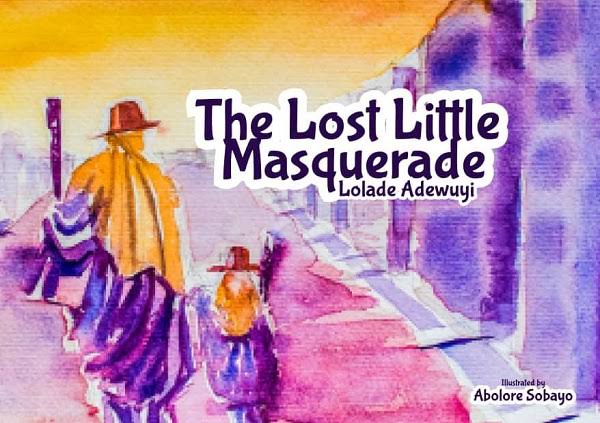
‘You are now complete’ he said. He smiled as he remembered that years before, his father had done the same thing for him.’
A sense of completeness gives one a sense of confidence that is imbued in reconnecting the past to the present and asserting oneself as one with the landscape.
Taju, a young boy who bears the features of his father is brought into oneness by the Eyo Adamu Festival in The Lost Little Masquerade, a children’s book written by Lolade Adewuyi and illustrated by Abolore Sobayo. The boy is handed his Akete and Opambata as a subtle rite of transition.
The Iga Olowo clan is a text for identity. Identity is the core of ones being and the bud of all contexts. This means that when all falls to the ground and pretexts and globalisation is dissolved by its self-developed tension, the person recovers and returns to the primal, the people for whom the intercistices of culture is perculiar.
When the Iga Olowo clan joins the larger group of masquerades, it becomes a community of shared ideals, shared dance steps, and a convergence of shared beliefs. Unfortunately, what ails Nigeria is the disconnectedness of ideals and vision. This is what the Eyo Masquerade hints to many–the temperance of celebrating culture and the nostalgia of tradition which extends to the values of unity in the symbolic space where Nigeria’s independence was once celebrated.
Lagos was once a small village. What the Eyo Masquerade does is renact its tradition and culture in a cosmopolitan space. The masquerades become one with nostalgia and imbue the presence of their ancestors without disrupting social and commercial activities that stage the biases of cosmopolitanism. Perhaps, the fascination of the Eyo Festival by the author is that it reaches the same cultural crescendo that the Olympics attain in bringing the creme of society into a historical space of celebration and competitiveness, while entertaining the other members of society with the twin decimals of dread and excitement.
While masquerades are meant to scare people with their mystic, they are also meant to create a sense of traditional order, a comradeship, and disrupt the monotony of the existential paradigms. The author of the book is also acutely aware of the use of palm fronds and the Opambata, made from palm tree. A symbol of the exploration of the natural resources within the landscape, which are available, not only for industry but also for culture.
Taju becomes lost when people flooded the square. Order is lost after the celebration of the festival. It seems that as suspended time wields itself back to cosmopolitan chaos one is capable of losing touch with culture. Entertainment remains but culture is trying to find a safe place to accommodate the population that asserts itself in the space of discourse.
When Taju began speaking with the policewoman. In the abode of chaos, Taju deploys the language of the colonial and seeks help from an agent of government to find his way back home. Taju is not a stark illiterate. One is won’t to believe that those interested in retaining their cultural festivals are often at the lower rung of education and enlightenment. Taju is a young man able to quickly find his feet in emerging African reality while remaining conscious of his cultural heritage.
Constable Folashade helps Taju find his way home but not without some difficulties. Folashade meets an Eyo Masquerade who given the secrecy of faces and gender beliefs, may decide not to help find the Iga Olowo clan. Constable Folashade eventually tries again and this time meets with the Iga Olowo group on the ‘Western Gate’. What a fascinating exit point for a father Eyo who is willing to reveal the person behind the mask for the sake of the son. The motif of ‘guidance’ and ‘knowledge’ reoccurs in both time modern and cultural frames.
One would easily love to ask the author, was the Nigerian Police unaware of the differences between the Iga, so as to help identify the various groups and help secure the masquerades better? Was she briefed of the schedules of the events or was she left to her own devices? This is perhaps ‘adult-speak’ from a mind who knows that the Nigerian government and its agencies are mostly disorganised and mostly unprepared for managing crisis during festivals and cultural ceremonies. On the flip side, perhaps the answer lies in the volume of silences between the traditional and the modern, and the fact that most personalities in the modern sphere bear a certain angst around the traditional. Nevertheless, inserting the policewoman as a symbolic resolution to the story tells us of the importance of order and security even in the most celebratory of ceremonies.
The work is a children’s book filled with symbolic meanings for an adult reader. The paintings of Abolore Sobayo, originally on water colour and canvas, helped to further create layers of codes, situate landscape and present an impressionable piece of collaborative art. While it may help bolster inquisitiveness and tourism in young lads, it is bound to set in motion reflection and nostalgia in many who have enjoyed the Eyo Festival.
The Eyo Festival may be seen as having enjoyed some level of research documentation which has led to quite a number of books, photography projects, exhibition and essays but rarely do we find a book about the same discourse as a children’s book. This book introduces the children to the Eyo Festival and hopes to spark an interest in the rich and varied culture of the Nigerian life. For children of African descent, the search for identity and completeness starts early and the book contributes to the frame from whence the world can be understood. It is a conversation starter for children and may encourage adults to search into culture in order to satisfy the new interests of the young.













Leave a comment