


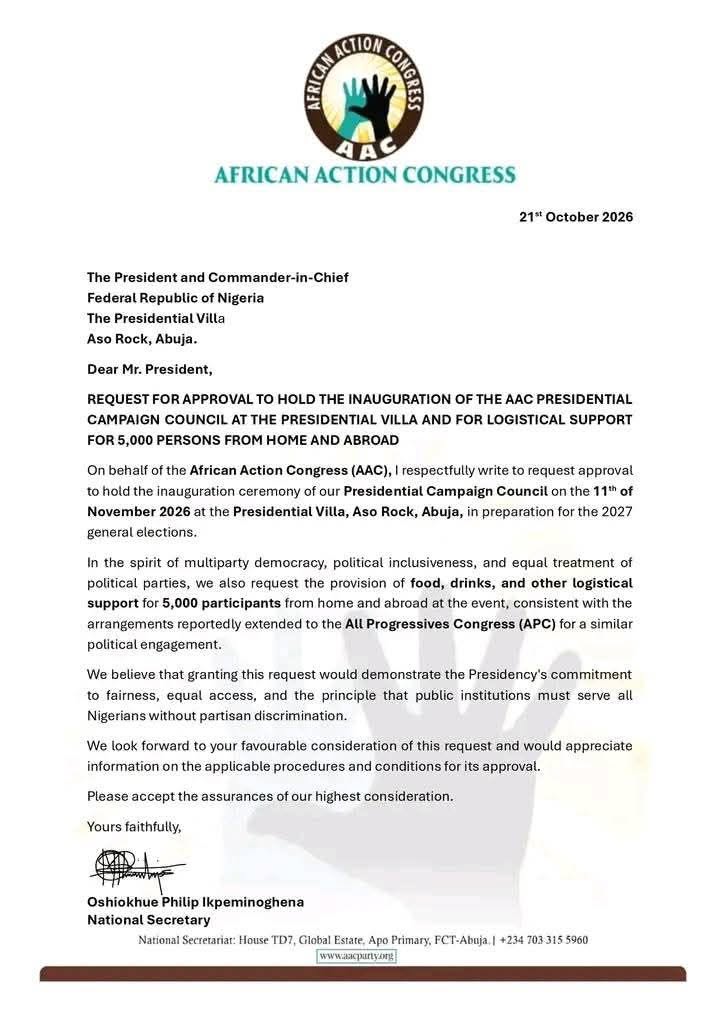
The exchange began with a request. The African Action Congress asked to hold the inauguration of its presidential campaign council at the Presidential Villa, and for logistical support for five thousand participants. It was an audacious ask, the kind of provocation Omoyele Sowore has built a career on. The response came from Ajibola Basiru, the All Progressives Congress National Secretary, on Channels Television’s Politics Today. Sowore, he said, was a “skit maker” and a “comedian.” Rejected ballot papers, he added, had won more votes than Sowore’s party in 2023.
What followed was not a conventional political spat. It was a public excavation of a shared past, and a reckoning with what that past has become.
The Photograph and the Claim

Sowore’s response came on X, accompanied by a photograph. The image, he said, was taken in 1998, when he led the Congress of Progressive Youths, and he and Basiru were “in the trenches fighting against military dictatorship.” He recalled that Basiru had been expelled from the University of Ilorin in 1992 for student activism, and that he, alongside Kunle Adegoke, now a Senior Advocate of Nigeria, had received Basiru at the University of Lagos and provided “an enabling environment to apply to re-enter the university, gain admission, and study Law.”
The claim was precise and personal. It was not merely that Basiru had once been a comrade. It was that Sowore had helped him when he was vulnerable, and that Basiru had since become the thing they once fought against.
Basiru’s reply was equally precise. He denied any prior relationship with Sowore before his admission. He had scored 310 in his UTME, he said, the highest among law applicants that year, and had been admitted on merit. The claim that Sowore provided an “enabling environment” was, in his words, “outright falsehood.” He maintained his description of Sowore as a comedian and accused him of misleading young people with a false revolutionary persona.
The factual dispute is unresolvable from the public record. What matters is the symbolic weight each man attached to it. For Sowore, the claim of assistance was evidence that Basiru’s current position was built on a foundation of solidarity he now denies. For Basiru, the denial was a refusal to accept that his achievements were owed to anyone, least of all a man he now considers politically irrelevant.
The Villa Is Not a Party Office
The request that triggered the exchange was not a whim. It was a diagnostic test. The APC inaugurated its Presidential Campaign Council at the Banquet Hall of the Presidential Villa in Abuja on 14 October 2026. The AAC was asking a simple question: if the ruling party can use the Villa for a partisan event, why cannot another party do the same?
Atiku Abubakar, the ADC presidential candidate, made the same point with less provocation. “The Presidential Villa belongs to the Nigerian people,” he said. “It is not a campaign venue or the private property of any political party.” He asked why the President chose the Villa when Abuja had other venues suitable for political gatherings.
The answer is obvious. The Villa was chosen because it is the Villa. It carries the weight of incumbency. It signals that the party and the state are operating in the same space, with the same resources, behind the same gates.
Sowore’s broader argument, made in the letter that prompted Basiru’s remarks, was that unless Nigeria is a communist state where the party and the state are identical, there must be a clear demarcation between the two. Nigeria is not China. It is a multi-party democracy with a constitution that separates the organs of state from the organs of political parties. The President is not the APC. The Presidential Villa is not the party secretariat. The resources of the state, including its buildings, its security, and its logistical capacity, belong to the public, not to the party that won the last election.
But the analogy points to a real danger. When a ruling party treats state resources as its own, it begins to function as a party-state. The opposition is not merely out of power. It is locked out of the facilities and platforms that the ruling party enjoys. The playing field is not level because the ground itself belongs to one team.
Basiru’s response to Sowore’s letter did not address the substance of the request. He did not explain why the APC could use the Villa and the AAC could not. He did not defend the decision to hold a partisan event at the seat of government. He attacked Sowore’s character, questioned his relevance, and dismissed him as entertainment.

The Turncoat Question
The most serious intervention came not from either principal but from Abdul Mahmud, whose essay “Of Turncoats and the Treachery of Yesterday’s Radicals” reframed the exchange as a question about an entire generation.
Mahmud’s argument was not that Basiru had betrayed a friend. It was that the radical movement of the 1980s and 1990s may have been held together by “the intensity of infantile rebellion rather than a coherent ideology.” Its members could identify the enemy of the moment, but they did not necessarily agree on the society they intended to build. This weakness, he suggested, produced activists skilled at denouncing authority without developing a durable framework for evaluating power itself. When the opportunity for personal advancement arrived, radical language could be discarded as easily as a worn-out coat.
Mahmud was careful not to condemn all change of position. Political beliefs evolve, and an activist who explains why experience has altered his convictions deserves to be heard. The distinction is between “ideological evolution and political opportunism.” The question is whether a former radical applies the same standards to allies and adversaries, and whether he can criticise abuses of power even when doing so threatens his access to privilege. Basiru, Mahmud implied, fails this test. He has substituted ridicule for argument while defending the excesses of a government he once would have opposed.
Ibietan’s Intervention: Loyalty and Accountability
The most nuanced contribution came from Omoniyi Ibietan, whose response was quoted by Mahmud and which deserves direct attention. Ibietan acknowledged that there were people he would hesitate to confront publicly, despite disagreeing with their conduct, because of the roles they played in his life or the struggles they shared. His reluctance to denounce former comrades is human, and it speaks to the complicated moral obligations that grow out of political friendship.
But Ibietan’s observation that “it is too late to rewrite history” opens a harder question. Shared history deserves recognition, but it cannot become a permanent exemption from scrutiny. The comradeship of the trenches should enrich our understanding of political change, not prevent us from examining its consequences. Ibietan’s position is not a defence of Basiru. It is a recognition that loyalty and accountability are both real, and that the tension between them cannot be resolved by pretending one does not exist.
What the Exchange Reveals
The Sowore-Basiru clash is not ultimately about whether Basiru received help getting into UNILAG. It is about what happens to a generation that defined itself through opposition when the opposition succeeds.
The Nigerian political establishment has demonstrated an extraordinary capacity to absorb its former adversaries. Yesterday’s critics become today’s officeholders, advisers, and defenders of the status quo. This is not unique to Nigeria, but the transitions of the student activist generation are particularly revealing because their political identities were built around the promise of resistance. When they enter the machinery they once condemned, the public is entitled to ask what changed, what principles survived, and what price was paid for admission.
Basiru’s decision to call Sowore a comedian is not merely an insult. It is a strategy. By reducing Sowore to entertainment, Basiru avoids engaging with the substance of his critique. He does not have to explain why the AAC’s request for equal treatment was unreasonable, or why the 2023 election was legitimate, or why the Tinubu administration deserves another term. He only has to make Sowore look ridiculous.
Sowore’s response, for all its moral force, has its own limitation. By centering the argument on a personal debt, he risks reducing a generational question to a private grievance. The photograph from 1998 is powerful evidence of a shared past, but it cannot by itself establish that Basiru has betrayed the principles of that past. That requires an argument about what those principles were and what fidelity to them would look like today.
Conclusion: The Struggle Is Not Comedy
Sowore is right that the struggle for justice and democracy is not skit-making. But the struggle is also not a photograph. A photograph can prove that two men once stood together. It cannot prove that one of them has abandoned what they stood for.
The harder question, the one that Mahmud and Ibietan both circle without fully answering, is whether the radicalism of the 1990s was ever deep enough to survive the temptations of power. If it was, then Basiru’s current position is a betrayal of something real. If it was not, then the betrayal is older and more structural, and the men who fought in the trenches were never as united in purpose as they believed.
Basiru called Sowore a comedian. Sowore called Basiru a defender of oppression. Both may be right. What is certain is that the exchange has exposed a wound in the Nigerian political class that no election will heal: the recognition that many of those who now govern were once those who resisted, and that the distance between the two is measured not in years but in the quiet abandonment of principles that once seemed unshakeable.






Leave a comment