

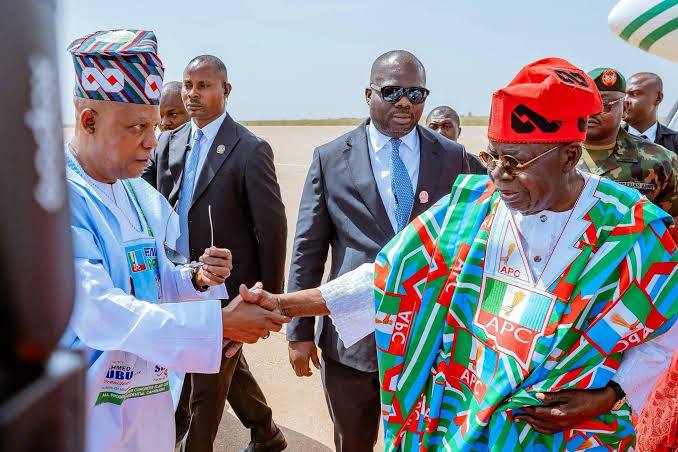
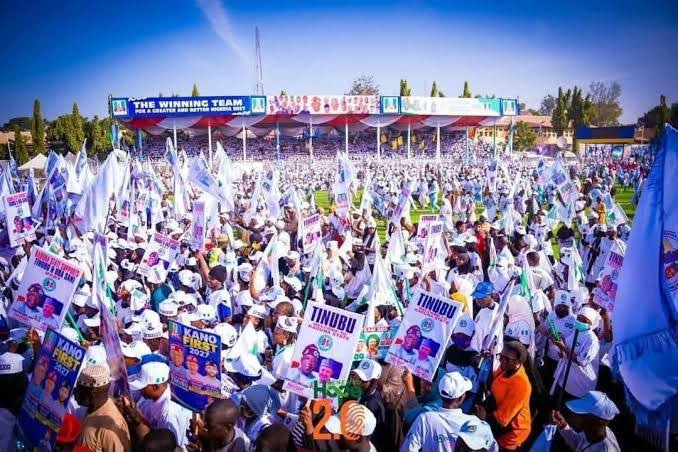
The All Progressives Congress is not behaving like a party that believes it will win the North. It is behaving like a party that fears it might lose it. The decision to launch President Bola Tinubu’s re-election campaign in Kaduna, a state he lost in 2023, was not a show of strength. It was an admission that the North is no longer a safe inheritance, and that the 2027 election will be decided in the same region that once delivered Muhammadu Buhari to power with mechanical certainty.
The arithmetic is unforgiving. The three northern geopolitical zones contain 56.01 million of Nigeria’s 103.43 million registered voters, or 54.2 per cent of the national register. The North-West alone has 25.08 million, making it the country’s largest electoral bloc . In 2023, the North gave Tinubu 63.6 per cent of its total votes . No candidate can win the presidency without performing strongly there. But the North that voted for Tinubu in 2023 is not the North of 2027.
https://www.youtube.com/watch?v=RWUz8U5y1VAThe Cracks in the Monolith
The most important political statement about the North in this campaign cycle did not come from a candidate. It came from Sola Ebiseni, an APC chieftain, who told Channels Television that “the North is no longer the monolithic North” . Ebiseni argued that the political destinies of the Middle Belt, the North-West and the North-East are distinct, and that treating the region as a single voting bloc is a “political mistake” .
His conclusion was startling, even for a ruling party loyalist: “Every zone of the North is looking forward to 2031. They’ve conceded 2027 to Tinubu” . Whether or not that claim is accurate, the fact that an APC chieftain felt compelled to make it reveals the anxiety beneath the surface. If the North has truly conceded 2027, why is the President launching his campaign in Kaduna rather than in the South-West or the South-South, where his support is more secure?
The answer lies in the fragmentation of the northern vote. Unlike 2023, when Tinubu faced a divided opposition, 2027 presents a three-way contest in the North. Atiku Abubakar, the ADC candidate, draws his support from the same northern networks that have sustained him through five presidential bids. Rabiu Kwankwaso, Peter Obi’s running mate on the NDC ticket, commands the Kwankwasiyya movement, which remains one of the most disciplined political followings in the North-West . And Tinubu, the incumbent, has the machinery of the state.
Amaechi’s Claim and the Atiku Machine
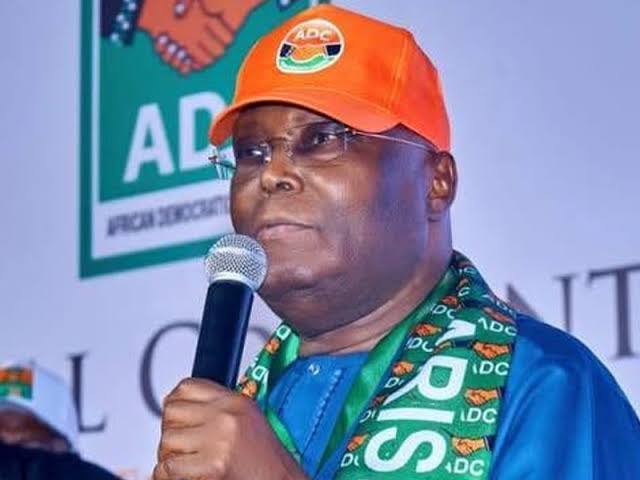
Rotimi Amaechi, Atiku’s running mate, has been blunt about the President’s northern prospects. In a town hall meeting in Cross River State, he argued that Atiku’s northern origin gave him an advantage that Tinubu could not match . Nyesom Wike, the FCT Minister, mocked the setting, claiming fewer than 200 people attended . But Wike did not address the substance of the argument.
The substance is this: Atiku has spent a quarter of a century building political relationships across the North. He was vice president for eight years. He has contested every presidential election since 2007. His political network, built through the Peoples Democratic Party and now deployed through the ADC, is deeper than any other northern politician’s. If there is a candidate who can split the northern vote, it is Atiku.
But Atiku has a problem that Amaechi’s confident prediction ignores. He is not Muhammadu Buhari. Festus Keyamo, the Minister of Aviation, made this point with characteristic bluntness: “Atiku Abubakar thinks he is the Buhari of 2015, who swept the Northern votes. He thinks that was a display of ethnic support. He fails to realise that his corruption-laden past puts him poles apart from a Muhammadu Buhari” . The comparison is politically motivated, but it contains a truth. Buhari’s northern support was built on a reputation for personal integrity that transcended party lines. Atiku does not have that reputation. He has networks, but networks are not the same as devotion.
The Kwankwaso Factor: Kano Is Not Enough
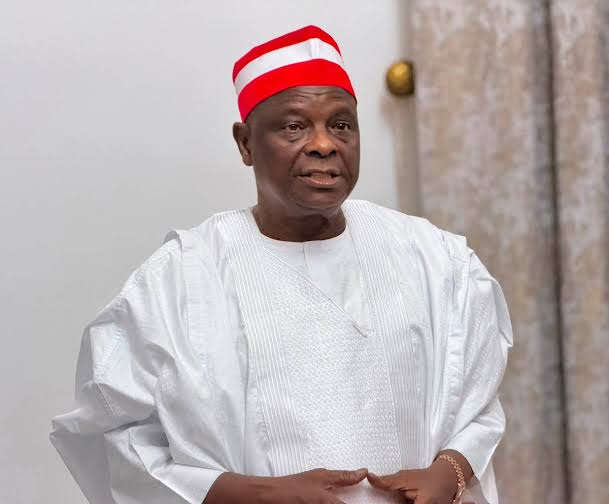
The Obi-Kwankwaso alliance was designed to solve a problem that Peter Obi could not solve alone. In 2023, Obi won the South-East and pockets of the South-South and South-West, but his northern support was negligible. Kwankwaso, with his red-cap army, was supposed to deliver the North-West, or at least Kano.
The numbers suggest that assumption may be flawed. In 2023, running on the NNPP platform, Kwankwaso won only Kano State, managing more than 20,000 votes in just five other states, none above 100,000 . His influence is concentrated, not national. And since 2023, his base has fractured. Governor Abba Kabir Yusuf, his son-in-law and political protégé, defected from the NNPP to the APC, taking 22 state lawmakers, federal legislators and 44 council chairmen with him . Kwankwaso now faces a battle for Kano against Ganduje, his former deputy and longtime rival, and against the governor he helped install.
Yusuf Datti Baba-Ahmed, Obi’s 2023 running mate, has said publicly what many analysts have whispered: “It is very unlikely that the North will rally around Obi and Kwankwaso” . He questioned the logic of the alliance, asking why Kwankwaso did not support Obi in 2023 and what had changed. “You have a vice-president who is older than you in age, education, political profile,” he said. “Who is going to be the president, actually?” .
The Southern Candidates and Their Northern Calculations
The 2027 election features three major southern presidential candidates, each relying on a northern running mate to balance the ticket.
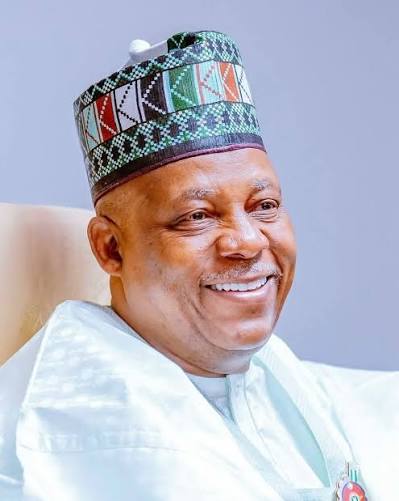
Tinubu (South-West) with Kashim Shettima (North-East): The incumbent’s calculation is that the North-East, Shettima’s home region, will deliver for him, alongside the governors and party structures he controls. The APC has 33 governors, and all northern states except Bauchi are APC-controlled . The presidential election comes two weeks before the governorship elections, creating a “bandwagon effect” that Ardo, convener of the League of Northern Democrats, argues could benefit Tinubu .
Atiku (North-East, but running as a northern candidate) with Amaechi (South-South): Atiku is not a southern candidate in the conventional sense. His political identity is northern, and his base is northern. Amaechi’s role is to secure the South-South and provide a southern Christian presence on the ticket. Whether Amaechi can deliver his home region is doubtful, given his estrangement from Wike, who controls Rivers State’s political machinery.
Obi (South-East) with Kwankwaso (North-West): The NDC’s calculation is that Obi’s southern support, combined with Kwankwaso’s northern network, can create a coalition that neither could build alone. But the alliance faces the same problem that has plagued every opposition coalition in Nigerian history: the two principals are rivals as much as partners, and their supporters may not transfer their loyalties.
The Violence and the Symbolism
The APC’s fears are not merely electoral. They are physical. In the run-up to the Kaduna rally, videos circulated showing individuals tearing down Tinubu’s campaign posters . Keyamo dismissed these as staged by Atiku’s camp, but the symbolism is potent regardless of who orchestrated it. The tearing of posters is a language of rejection, and it is being spoken in the North.
The North that gave Tinubu 63.6 per cent in 2023 is “basically in revolt,” Ardo acknowledged. But he added a crucial qualification: “Not wanting Tinubu does not mean that it’s going to get Tinubu away, because everything will depend on the mobilisation” . The APC’s advantage is not affection. It is structure. It has governors, lawmakers, local government chairmen and party officials at every level. The opposition has grievances, but grievances do not organise themselves.
The Verdict
The North is not a single political personality. It is a region of distinct zones, rival elites and competing grievances. The APC’s campaign to lock it down is an acknowledgment that the old certainties are gone. The North that voted as a bloc for Buhari is not the North that will vote in 2027. It is a contested landscape, and the candidate who wins it will not be the one who assumes it is his by right. He will be the one who fights for every vote, in every state, with the recognition that the North owes no man its loyalty.






Leave a comment