

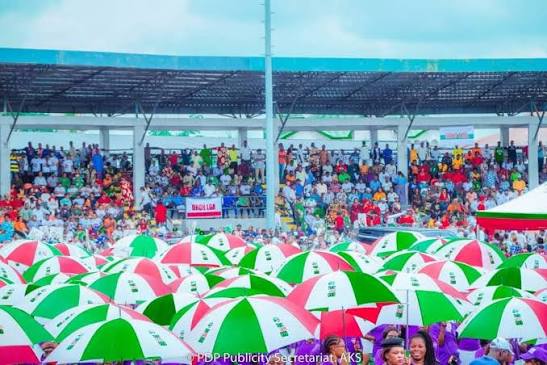
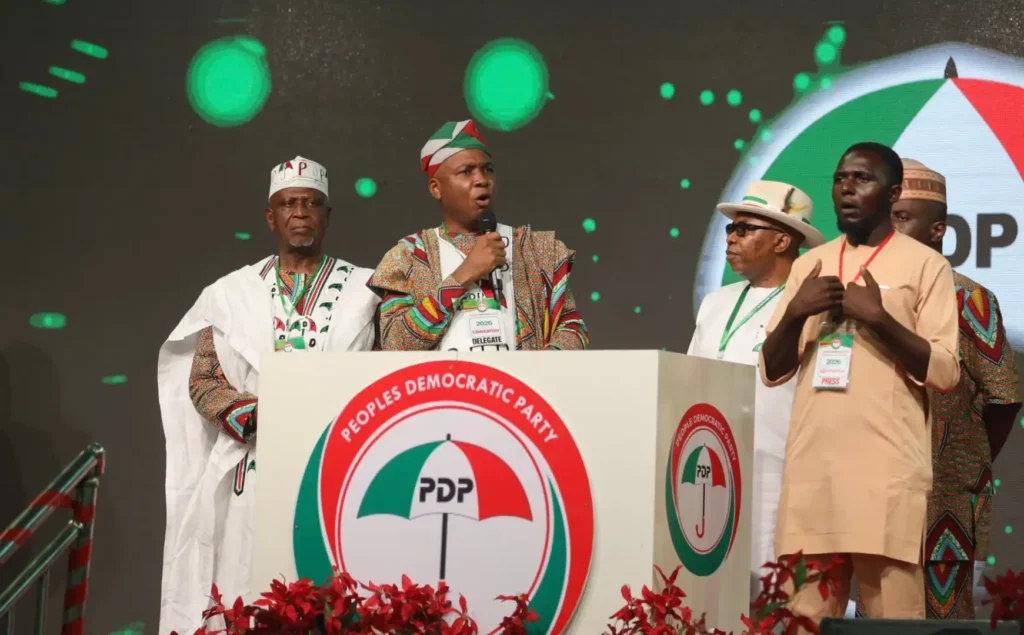
The Peoples Democratic Party was not killed by its enemies. It was dismantled by the men who swore to protect it, one defection at a time, one broken promise at a time, until nothing remained but a name on a ballot and a memory of what might have been.
The Beginning: A Party Built for Power
The PDP was born in August 1998, forged in the crucible of Nigeria’s transition from military rule. It was a coalition of the G-34, political associations, retired military officers, academics and businessmen, chaired by Alex Ekwueme with Jerry Gana as secretary. Its founding ambition was breathtaking in its arrogance: to rule Nigeria for sixty years.
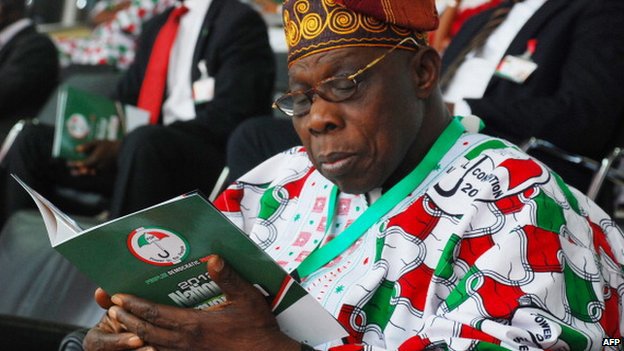
Under Former President Olusegun Obasanjo, the party came close to making that boast a reality. Obasanjo did not merely win elections; he built a political machine that extended PDP’s reach into every corner of the federation. In the South-South, he cultivated governors who owed their positions to him, men who would later become the party’s stalwarts and, eventually, its gravediggers.
Adams Oshiomhole, the former APC national chairman, described Obasanjo’s method bluntly: “By 1999, President Obasanjo took over ANPP. He appointed the chairman as his adviser and called the governors to move. By 2003, he rigged out all the south-west governors… and planted PDP in the south-west” . Only Bola Tinubu in Lagos resisted, and that resistance would eventually birth the party that destroyed the PDP .
The cracks appeared toward the end of Obasanjo’s tenure, but they were hairline fractures, easily ignored by a party drunk on power .
The Middle: Yar’Adua, Jonathan and the Rotation Wars
Umaru Musa Yar’Adua’s presidency was brief and defined by illness. His death in 2010 elevated Goodluck Jonathan, a southerner from Bayelsa, to the presidency. It was here that the fault line that would eventually split the party wide open first appeared.
The PDP’s unwritten rule was rotation: the presidency would alternate between North and South. Jonathan’s decision to contest in 2011, and again in 2015, broke that bargain . Northern political elites who felt the presidency had been “stolen” from their region began to mobilise. Their grievance was not merely about zoning; it was about access to power and the spoils that come with it.
The 2013 Nigeria Governors’ Forum election became the flashpoint. Rotimi Amaechi of Rivers, backed by 19 governors, defeated Jonah Jang of Plateau, who had 16. But a faction rejected the result and backed Jang. The split was not merely about who chaired a forum; it was a proxy war for control of the PDP itself.
Then came the walkout. At the PDP national convention on 31 August 2013, Atiku Abubakar and seven northern governors, known as the G-7, staged a dramatic exit. They cited impunity, lack of internal democracy and the heavy-handedness of National Chairman Bamanga Tukur. Within months, five of those governors—Amaechi, Rabiu Kwankwaso, Murtala Nyako, Aliyu Wamakko and Abdulfatah Ahmed—defected to the newly formed APC . They did not leave alone. Federal legislators followed, and the PDP’s majority in the National Assembly began to crumble.
The APC was formed in February 2013 from a merger of four major opposition parties, including the Action Congress of Nigeria, the All Nigeria Peoples Party, the Congress for Progressive Change and a faction of the All Progressives Grand Alliance . But its engine was the PDP defectors. The party that was supposed to rule for sixty years had become the primary supplier of talent to its own opposition.
The Betrayers: Saraki and the Men Who Wore Two Faces
The 2015 election was the reckoning. Goodluck Jonathan lost to Muhammadu Buhari, and the PDP’s sixteen-year reign ended. But the betrayal that sealed the party’s fate was not merely electoral defeat. It was the conduct of men who had once sworn loyalty to the PDP and then used the party’s own structures to destroy it.
Bukola Saraki is the archetype. A former PDP governor of Kwara State, he defected to the APC in 2013, carrying his political structure with him. When the APC won the presidency in 2015, Saraki did not wait for the party’s direction on who should become Senate President. He worked the phones, courted PDP senators who had survived the APC wave, and engineered his own emergence against the party’s preferred candidate, Ahmad Lawan . The APC had won the presidency, but Saraki had won the Senate. The lesson was not lost on anyone: in Nigerian politics, loyalty to party is optional; loyalty to self is mandatory.
Saraki’s manoeuvre was not an isolated act of ambition. It was the logical culmination of a political culture in which defection is rewarded and party discipline is a fiction. The PDP had spent years tolerating and even encouraging this culture. When its own members began to leave, the party discovered that it had no defence against the very tools it had used to dominate for so long.
The Allure of the APC and the Exodus
The APC did not merely defeat the PDP in 2015. It absorbed it. Former PDP governors, senators and representatives flocked to the ruling party, drawn by the promise of access and the certainty of patronage. Olusegun Mimiko, the former Ondo governor and a longtime PDP stalwart, finally joined the APC in May 2026, citing support for Tinubu’s reforms . His defection was years in the making, but it symbolised the completeness of the transfer. Men who had built their careers in the PDP now praised the APC’s NELFUND initiative and its efforts to decentralise policing.
By the time the gale subsided, the PDP had lost nine governors: Delta, Akwa Ibom, Enugu, Bayelsa, Rivers, Plateau, Taraba, Adamawa and Osun. It had lost 66 federal lawmakers between June 2023 and January 2026 . It had lost its Senate majority, its House majority, and its Governors’ Forum. What remained was a shell.
The Formation that Consumed Itself
The bitter irony of the PDP’s collapse is that the parties now positioned as its alternatives are themselves PDP progeny.
Atiku Abubakar, the ADC presidential candidate, was once the PDP’s vice president and its 2023 standard-bearer. Peter Obi, the NDC candidate, was a PDP governor and a PDP vice-presidential candidate in 2019. Rabiu Kwankwaso, Obi’s running mate, was a PDP governor and one of the G-7 defectors. Nyesom Wike, the man many blame for driving the final nail into the PDP’s coffin, was a PDP governor and remained a PDP member even as he served as a minister in an APC government.
The leading opposition is not an alternative to the PDP. It is the PDP, scattered across new labels. The party’s talent, its networks and its ambitions did not disappear; they simply changed letterheads. What was reduced to a rubble was the institution.
The Legal Battles That Diminished the Ranks
The PDP’s disintegration was accelerated by a series of legal fights that exposed and deepened its divisions.
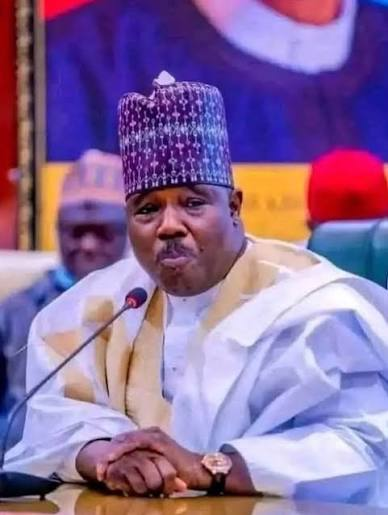
Between 2015 and 2019, the party was consumed by a leadership tussle between Ali Modu Sheriff and the Ahmed Makarfi-led caretaker committee. Conflicting court rulings turned the party’s leadership into a revolving door until the Supreme Court recognised Makarfi in July 2017. The victory was pyrrhic. By the time the court spoke, the party’s structures had been hollowed out, and supporters of the losing faction had defected to the APC.
The 2022 crisis was worse. The G-5 governors, led by Wike, demanded the resignation of National Chairman Iyorchia Ayu, arguing that both the presidential candidate (Atiku) and the party chairman could not come from the North. Atiku refused. The G-5 refused to campaign for him. The PDP lost .
In August 2025, the party finally zoned the 2027 presidential ticket to the South and retained the chairmanship in the North, the exact formula Wike had demanded three years earlier. Lere Olayinka, Wike’s aide, asked the obvious question: “Has PDP not come back to eat its own vomit?” . The correction came too late to save the patient.
The 2026 convention in Ibadan, held despite court orders, produced two national chairmen, two working committees and two sets of candidates. The Supreme Court’s split judgment of three to two justices resolved nothing; it merely gave both factions a legal argument to continue the war.
The Independent National Electoral Commission recognised the Wike-backed faction and published its candidates, including Sandy Onor as presidential candidate . But the faction that controls the ballot does not control the party’s base. The Turaki-led camp, which represents the anti-Wike majority, has no candidates on the list. More than 8,200 aspirants who bought forms under different factions are trapped in political limbo.
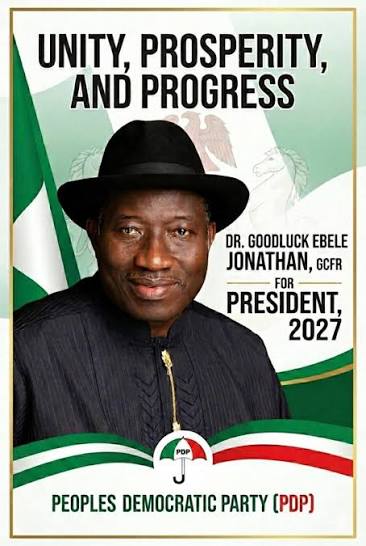
There was even an attempt to woo Goodluck Jonathan back to run for president. The former president declined. The party that had once produced presidents was now begging one to return and rescue it.
The Lessons and the Solution
The PDP’s collapse offers a brutal education in the fragility of power without principle.
First, a party built on elite accommodation rather than ideology cannot survive elite conflict. The PDP’s zoning system was a mechanism for managing ambition, not for serving citizens. When the elites disagreed, there was nothing beneath the arrangement to hold the party together.
Second, defection is a weapon that destroys the wielder as surely as the target. The PDP encouraged defection when it suited its dominance. It had no answer when its own members used the same weapon against it. Until Nigeria’s Constitution closes the loophole that allows lawmakers to switch parties without consequence, no party is safe.
Third, legal victories cannot substitute for political legitimacy. The PDP spent years in courtrooms. It won some cases and lost others. But courts cannot create loyalty, and they cannot rebuild a party that has lost the confidence of its members.
The solution, if there is one, requires the PDP to accept a truth it has resisted for a decade: it is no longer a ruling party. It is a minority force. It must return to the trenches, not as a government-in-waiting but as a genuine opposition. That means recruiting younger Nigerians who have no memory of the PDP’s glory years and no stake in its internal wars. It means being vocal on the issues that matter: the cost of living, insecurity, unemployment, the collapse of public services. It means building research hubs and policy platforms that offer real alternatives to the APC’s governance, not merely criticism. It means creating a parallel structure of intellectual opposition that can hold the government accountable even without legislative power.
Above all, it means reconciliation. The men who left—Wike, Atiku, Kwankwaso, Obi and the hundreds of others—must be invited back, not as conquerors but as prodigals. Some will refuse. Some have built new homes elsewhere. But a party that cannot forgive its own children cannot expect the electorate to forgive it.
Conclusion: The Rubble and the Reckoning
The PDP was not razed by an earthquake. It was demolished brick by brick, by men who put their ambitions above the institution that gave them power. Obasanjo built it as a machine for winning. Yar’Adua and Jonathan inherited it without understanding how fragile it was. Atiku broke the rotation pact. Wike avenged the broken pact. Saraki showed that loyalty was for fools. The governors fled when the ship began to sink. And the courts provided the legal basis that allowed it all to happen.
What remains is a party on the ballot but not in the race. A name without a body. A memory of what might have been.
The PDP’s fate is a warning to every political organisation in Nigeria. Power is not a permanent possession. It is a loan, and the lenders are the people. When a party forgets that, it does not need enemies. It has already become its own grave-digger.






Leave a comment