

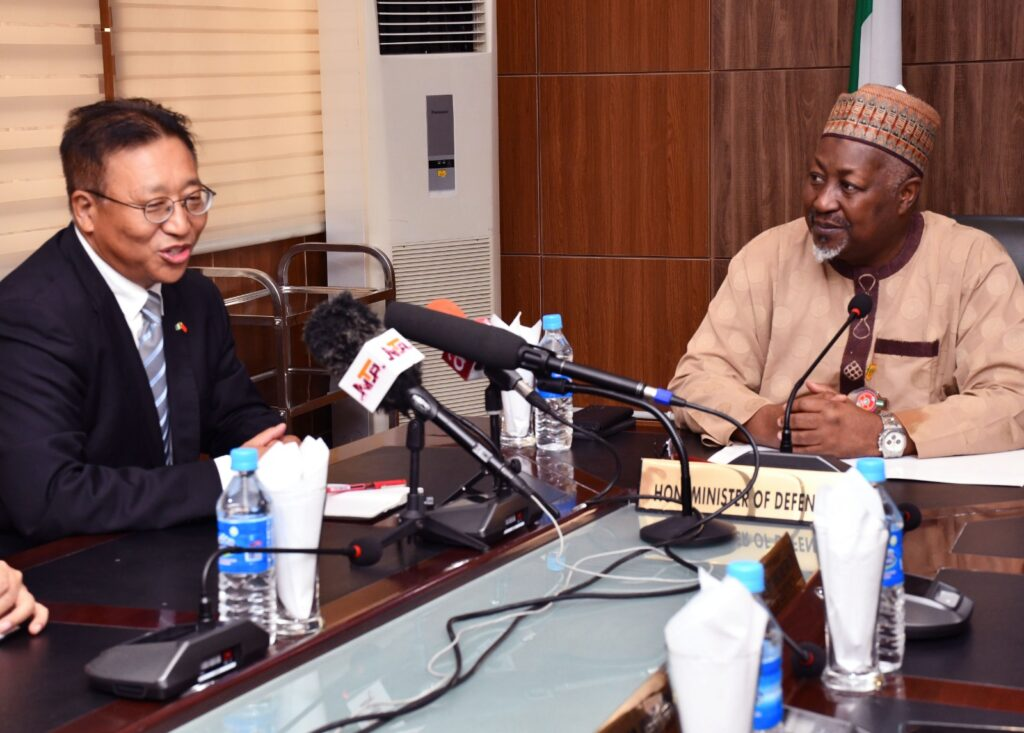
Nigeria is strengthening its Nigeria China defence partnership as the Federal Government pursues advanced military technology, local weapons production, and stronger security cooperation with China.
Defence Minister Gen. Christopher Musa (retd.) made this known during an official visit to China. He led a Nigerian delegation for high-level meetings focused on defence collaboration, technology transfer, and strategic partnerships. The visit forms part of Nigeria’s broader effort to modernise the Armed Forces and improve the country’s ability to tackle evolving security threats.
According to the minister, Nigeria wants partnerships that will help the country become a producer of defence equipment instead of remaining dependent on foreign suppliers.
Nigeria targets defence technology transfer
Gen. Musa said the government remains committed to adopting emerging technologies and artificial intelligence to improve national security. He explained that these innovations would strengthen the Armed Forces of Nigeria and prepare them for modern asymmetric threats.
He stressed that the government’s objective goes beyond purchasing military hardware. Instead, Nigeria wants to acquire technical knowledge that will support domestic manufacturing and long-term self-reliance.
“Our focus is clear; we are committed to partnerships that do not just make Nigeria a consumer, but an active producer,” the minister said.
A statement released by the Minister’s Special Adviser on Media, Leah Katung-Babatunde, explained that the visit aims to deepen bilateral defence relations between Nigeria and China. The trip also seeks to accelerate the modernisation of the Armed Forces of Nigeria while expanding local defence manufacturing.
The government believes stronger industrial cooperation will improve national security and reduce dependence on imported military equipment.
DICON expected to expand local military production
During the visit, Musa toured the China Electronics Technology Group Corporation (CETC) Innovation Centre. There, he highlighted the important role of the Defence Industries Corporation of Nigeria (DICON) in the country’s future defence plans.
He said DICON would expand local production facilities through comprehensive technology transfer agreements. The minister added that Nigeria intends to build a sustainable defence manufacturing sector capable of meeting local security needs.
“Through DICON, we will expand local production lines, drive absolute technology transfer, and achieve sustainable self-reliance in defence manufacturing to secure our nation,” Musa stated.
The government expects these partnerships to create new opportunities for local industries while strengthening Nigeria’s defence capabilities.
NORINCO discussions focus on joint production
The Nigerian delegation also visited the headquarters and exhibition centre of the China North Industries Corporation (NORINCO Group), one of China’s leading defence manufacturers.
During the visit, officials inspected a wide range of military equipment. These included land combat platforms, advanced artillery systems, specialised ammunition, and integrated defence technologies.
After the exhibition, Musa held a closed-door meeting with NORINCO’s president and senior executives. Both sides discussed practical measures to support Nigeria’s defence ambitions.
Key discussions centred on technology transfer, technical capacity development, and the establishment of joint production lines in Nigeria through collaboration with DICON.
The proposed partnership would allow Nigeria to manufacture more defence equipment locally while improving the skills of its military engineers and technicians.
Embassy backs stronger Nigeria-China cooperation
As part of the official programme, Musa also visited the Nigerian Embassy in Beijing. Nigeria’s Ambassador to China, Lt.-Gen. Abdulrahman Dambazau (retd.), welcomed the delegation and praised the minister’s engagement with Chinese defence institutions.
Dambazau described the visit as an important step toward strengthening the strategic relationship between both countries. He also pledged the embassy’s full diplomatic support throughout the week-long mission.
The minister later met Defence Attachés and embassy personnel serving in China. He commended their dedication and encouraged them to continue representing Nigeria professionally across Asia.
He reminded them that military diplomacy plays an important role in protecting Nigeria’s national interests abroad.
Visit aims for long-term security gains
Officials said the working visit was carefully designed to deliver both immediate and lasting benefits for Nigeria’s security sector.
The expected outcomes include stronger military capabilities, modern defence equipment, improved logistics systems, and more reliable supply chains. The government also hopes the partnership will stimulate industrial growth by supporting local manufacturing.
Furthermore, officials believe expanding domestic defence production will improve economic opportunities while enhancing national security.
The Nigeria China defence partnership reflects the Federal Government’s broader strategy of combining international cooperation with local industrial development. By prioritising technology transfer and domestic production, Nigeria hopes to build a more resilient and self-sufficient defence industry capable of responding to current and future security challenges.
Nigeria continues to deepen its defence relationship with China as it seeks advanced technology, stronger military capabilities, and greater local production capacity. Through partnerships involving DICON, CETC, and NORINCO, the government aims to transform the country’s defence sector from equipment importation to sustainable domestic manufacturing. If successfully implemented, these initiatives could significantly strengthen Nigeria’s military readiness and long-term national security.










Leave a comment