

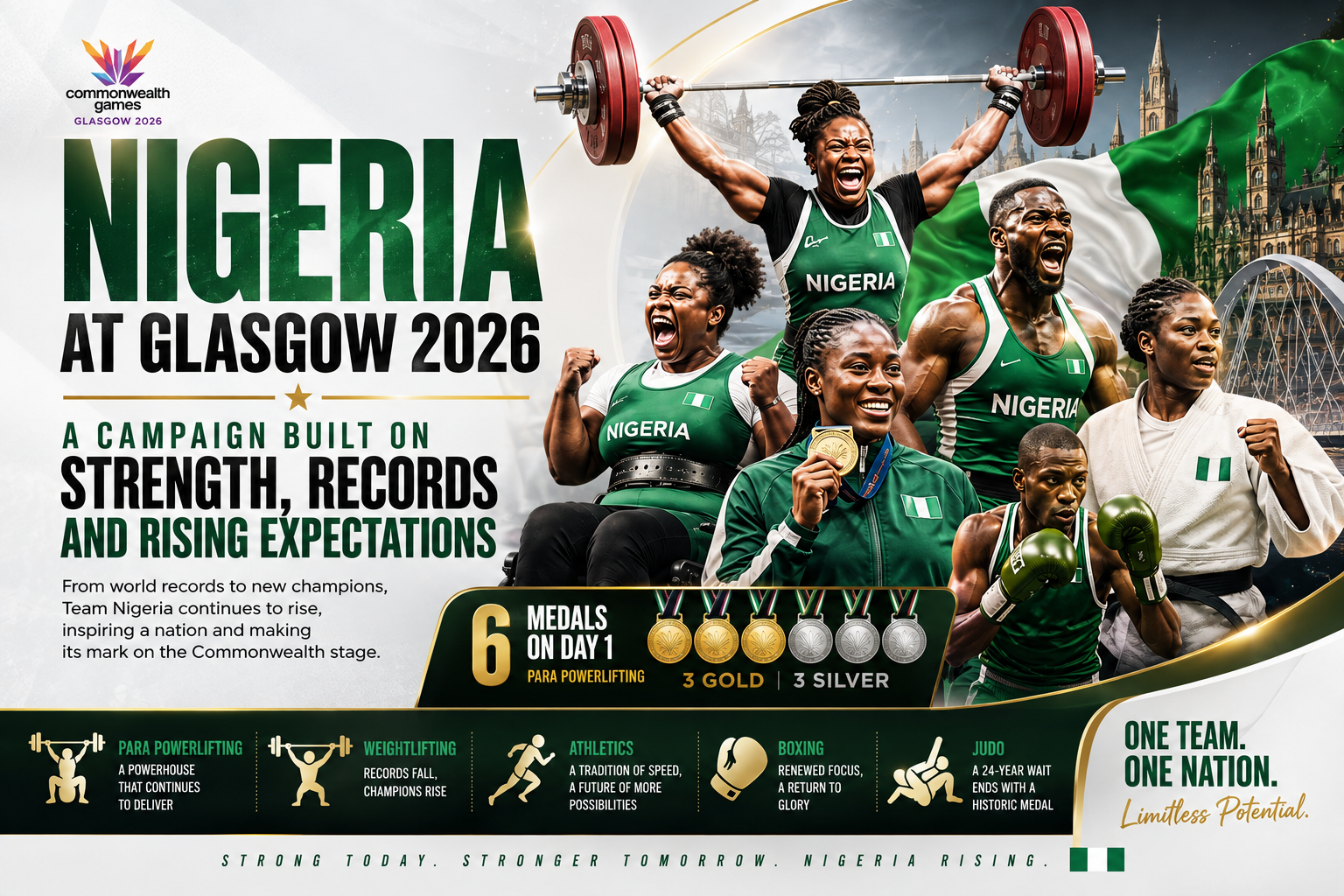
Nigeria at Glasgow 2026 has begun with a mixture of medals, records and performances that have raised expectations for the rest of the Commonwealth Games.
Team Nigeria arrived in Glasgow with an established reputation in athletics, weightlifting and para powerlifting. However, the early results have suggested that the country could make an even broader impact this time around.
Nigeria made an immediate impression when its para powerlifters delivered six medals on the opening day, three gold and three silver. The performance placed the Green and White among the early leaders on the medal table and provided a strong foundation for the campaign.
Para Powerlifting Leads Nigeria’s Medal Charge
Para powerlifting once again proved to be one of Nigeria’s biggest sources of international success.
Folashade Oluwafemiayo produced one of the most memorable performances of the opening stages by winning the women’s heavyweight event with a world-record performance. Her achievement further underlined her position among the sport’s elite.
Esther Nworgu also claimed gold in the women’s lightweight category, while Rilwan Idris secured gold in the men’s heavyweight event.
Veteran competitors including Esther Onyema, Roland Ezuruike and Rita Ferdinand added further medals, demonstrating the depth of Nigeria’s experience in the discipline.
The results were significant beyond the medal count. They reflected years of investment, preparation and competitive experience in a sport where Nigeria has consistently performed at the highest level.
Weightlifting Extends Nigeria’s Gold Rush
Weightlifting provided another major source of success for Nigeria at Glasgow 2026.
Onome Didih produced a record-breaking performance to win gold in the women’s 53kg category. She lifted 93kg in the snatch and 113kg in the clean and jerk for a combined total of 206kg.
Edidiong Joseph Umoafia added another gold medal in the men’s 71kg category, strengthening Nigeria’s position in the sport.
Rafiatu Folashade Lawal also delivered a historic performance, winning the women’s 58kg title while setting Commonwealth Games records in the snatch, clean and jerk and overall total.
Together, the weightlifters have reinforced Nigeria’s reputation as one of the Commonwealth’s strongest nations in strength sports.
Athletes Carrying Nigeria’s Wider Hopes
While strength sports have produced the early medals, Nigeria’s ambitions extend across several other disciplines.
Athletics remains one of the country’s biggest opportunities. Nigeria has a proud sprinting tradition, and the Glasgow competition provides another platform for established athletes and emerging talents to make their mark.
The challenge, however, is considerable. Nigerian athletes must compete against strong programmes from countries such as Australia, England, Jamaica and Kenya.
Boxing is another sport carrying significant expectations. Nigeria has a long history of success in the ring, and the current generation will be looking to add another chapter to that tradition.
Judo has already provided an encouraging breakthrough. Enku Ekuta won Nigeria’s first Commonwealth Games judo medal in 24 years, highlighting the potential for the country to expand its medal base beyond its traditional strongholds.
Where Nigeria Still Needs to Improve
Despite the positive start, Nigeria at Glasgow 2026 has also exposed some areas that require attention.
Not every athlete has progressed as hoped, while some competitors have faced programmes with greater depth and resources. Swimming, gymnastics, cycling and 3×3 basketball remain among the areas where Nigeria has room to develop greater consistency.
That imbalance presents a wider challenge for Nigerian sport.
The country clearly possesses athletes capable of winning medals at the highest level. However, sustained success across a major multi-sport event requires more than individual stars. It demands strong development systems, deeper talent pools and consistent preparation across a wider range of disciplines.
Key Highlights From Nigeria’s Campaign
- Para powerlifting delivered six medals on the opening day.
- Folashade Oluwafemiayo produced a world-record performance.
- Esther Nworgu and Rilwan Idris won gold medals in para powerlifting.
- Onome Didih and Edidiong Joseph Umoafia added weightlifting golds.
- Rafiatu Folashade Lawal set Commonwealth Games records.
- Enku Ekuta ended a 24-year wait for a Nigerian judo medal.
What Glasgow 2026 Means for Team Nigeria
The story of Nigeria at Glasgow 2026 is bigger than the medal table.
The performances in para powerlifting and weightlifting have confirmed the country’s strength in disciplines where Nigerian athletes have traditionally excelled. At the same time, Enku Ekuta’s judo medal suggests that Nigeria’s competitive reach can continue to expand.
The next step is turning individual success into a broader sporting structure.
Nigeria has the talent and competitive spirit to challenge the Commonwealth’s leading sporting nations. The challenge is ensuring that more athletes across more disciplines have the preparation and support required to do so consistently.
Conclusion
Team Nigeria can take plenty of encouragement from its campaign in Glasgow so far. Medals have arrived early, records have fallen and several athletes have delivered performances worthy of the occasion.
Yet the bigger message is clear: Nigeria’s sporting potential stretches well beyond its traditional strengths.
As the Nigeria at Glasgow 2026 campaign continues, the focus will shift from maintaining the medal momentum to building on it. If the country can combine its established strength with progress in emerging sports, Glasgow could become another important chapter in Nigeria’s Commonwealth Games story.









Leave a comment