

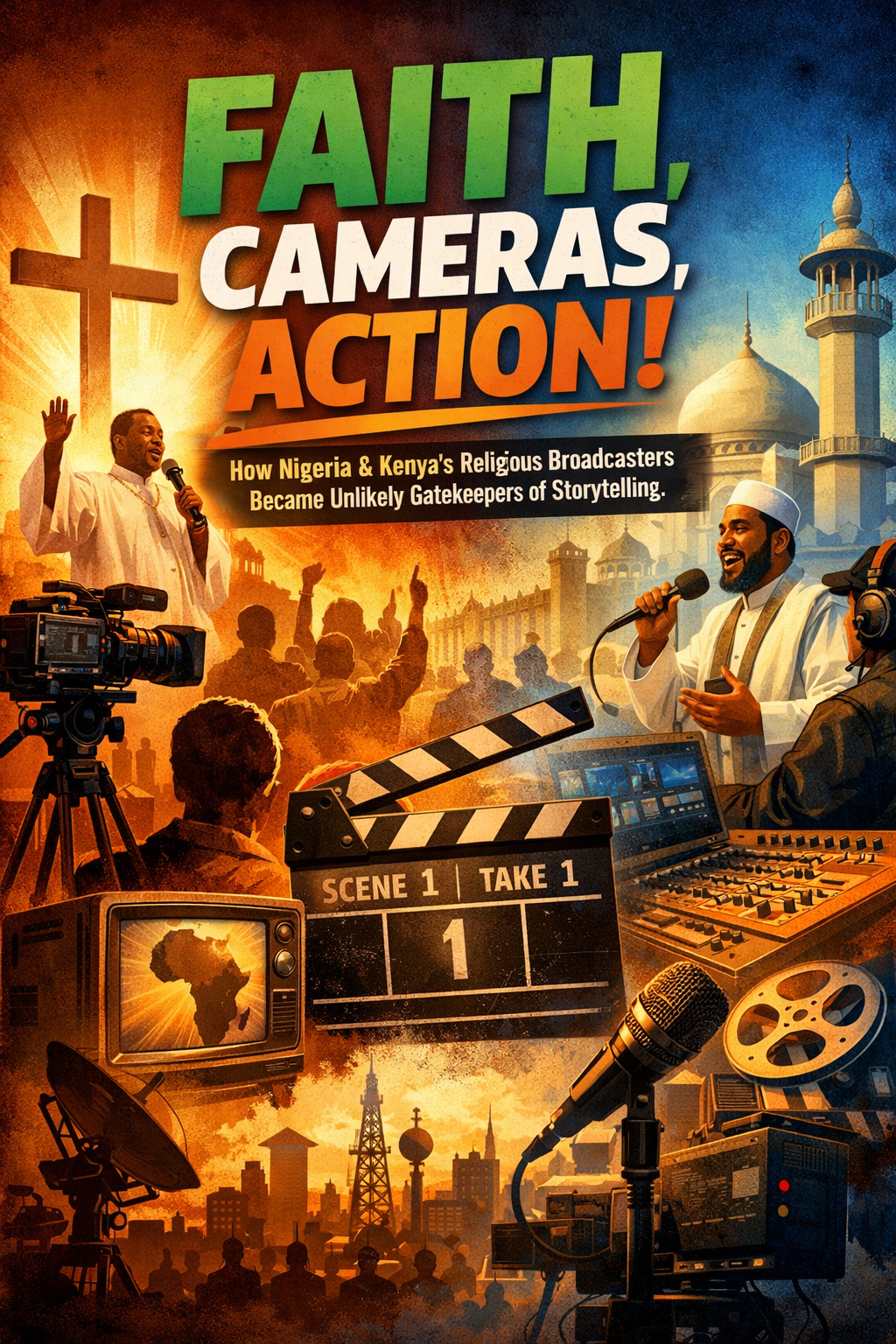
Faith, Cameras, Action: How Nigeria and Kenya’s Religious Broadcasters Became Unlikely Gatekeepers of Storytelling
In 2016, the Nigerian federal government quietly shelved plans to build a USD 10 million film village in Kano.
The reason had nothing to do with budgets or bureaucracy. Muslim clerics had objected, arguing the project would promote immorality.
Kannywood, the Hausa-language film industry that had been operating out of Kano since the late 1980s, would have to keep working without the infrastructure.
The clerics had spoken, and the government listened.
Kenya tells a different story but with the same protagonist.
In 2024, the majority of Kenya’s 394 licensed TV stations were faith-based.
Not a slim majority. The dominant share of an entire national broadcast ecosystem had been claimed by religious broadcasters, many of them operating on heavily subsidised government licenses.
One broadcaster, MBCI TV, ranked as the country’s third-largest distributor of local content while running an explicitly Christian programming slate of talk shows, inspirational films, and children’s content.
By any conventional measure of media economics, this should not be possible. Yet across Nigeria and Kenya, faith-based institutions have become something the industry rarely accounts for: the most structurally embedded gatekeepers in African storytelling.
A Market Built on Faith
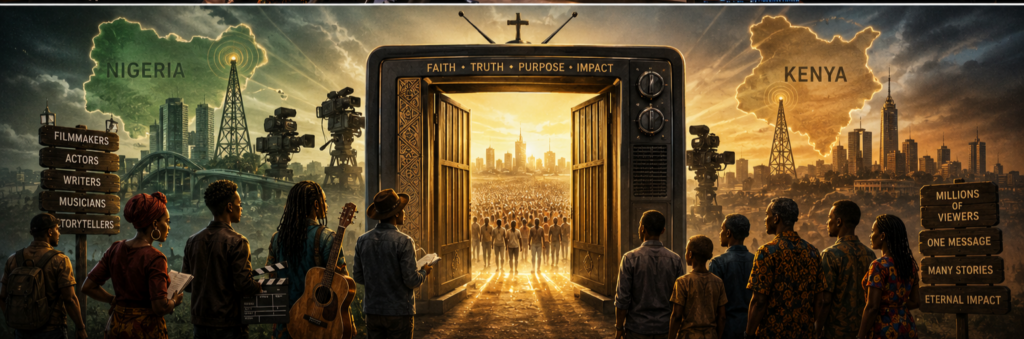
The numbers demand attention. Kenya’s 350 registered faith-based TV stations represent the single largest category of licensed broadcaster in the country.
Of those, 93.7% carry Christian programming, with Islamic channels accounting for the remaining 6.3%.
Most 85% are independent operations unaffiliated with any denomination, running on the goodwill of congregations and the generosity of government licensing policy that heavily subsidises their entry costs. Their audiences are not niche.
Religious and musical content commands a weekly primetime audience engagement rate of 41.6% in Kenya, higher than drama, comedy, or news.
On Sundays particularly, faith-based programming doesn’t compete with mainstream content; it is mainstream content.
In Nigeria, the picture is structurally different but culturally parallel. Faith-based TV stations operate as platforms for spiritual engagement funded primarily through tithes, donations, and religious organisation sponsorships rather than advertising revenue.
They have built loyal, geographically distributed audiences, precisely the kind of reach that commercial broadcasters in Lagos spend millions trying to replicate.
Nathaniel Bassey’s Hallelujah Challenge and Pastor Jerry’s New Season Prophetic Prayers have become mass audience events that regularly pull viewers away from prime entertainment slots.
What this means practically is that in both countries, a significant portion of the population’s daily media consumption is filtered through an institutional lens that has its own editorial standards, its own definition of acceptable storytelling, and its own infrastructure for distribution infrastructure that secular filmmakers and independent producers have largely ignored.
The Censorship Shadow: Ignore them at your peril.
In Kano, the Kano State Film and Video Censorship Board applies Islamic values as a content standard, creating a regulatory environment where filmmakers have faced jail time for content deemed irreligious and where entire genre categories, romance, political satire, anything touching on gender dynamics, require extraordinary negotiation to survive intact.
The federal government’s abandonment of the Kano film village was not an isolated incident but a symptom of a deeper truth: in conservative religious contexts, infrastructure itself becomes a moral statement.Kenya’s version of this dynamic is subtler but no less consequential.
The Kenya Film Classification Board, already widely criticised by industry players as a censorial holdover from the colonial era, operates alongside faith-based broadcasting norms that effectively self-regulate a large portion of what gets aired.
Content that might pass KFCB classification can still find itself unwelcome across the majority of the country’s broadcast spectrum simply because faith-based programmers won’t touch it.
Stories about LGBTQ+ experiences, frank depictions of gender-based violence, narratives that challenge traditional family structures, don’t just face regulatory risk. They face distribution death across the largest segment of Kenya’s broadcasting infrastructure.
The Untapped Pipeline
Yet the same report that documents these constraints also points toward something unexpected: faith-based broadcasters may be the most underutilised distribution infrastructure for progressive storytelling in both countries.
The logic is counterintuitive but grounded in reach. Kenya’s independent faith-based TV stations have loyal rural and peri-urban audiences precisely the demographics that secular streaming platforms and urban-focused productions consistently fail to reach.
“Overwhelmingly, Netflix’s 62,000 Kenyan subscribers cluster in Nairobi.”
Faith-based TV reaches households that have never opened a streaming app and likely never will.For organisations working on gender-equitable storytelling, this creates a genuine strategic opening.
Shows like Citizen TV’s Bi Msafwari have demonstrated that gender-normative conversations can travel through mainstream Kenyan TV without triggering backlash when framed carefully.
Kenya’s own recommendations emerging from the sector analysis are unusually specific: map the 350 faith-based stations, identify progressive early adopters institutions like Mavuno Church, CITAM’s Hope TV, Family TV and build a content matchmaking platform that connects vetted storytellers directly to aligned broadcasters before approaching more conservative stakeholders.
In Nigeria, the NTA’s 100-plus national stations represent a different kind of faith-adjacent infrastructure, government-owned but operating in communities where religious programming norms heavily shape audience expectations.
“Co-producing or syndicating gender-equity programming through NTA, the thinking goes, gets storytelling into living rooms that Nollywood’s Lagos-centric commercial machine never designed to reach.”
The Credibility Economy
There is something else that faith-based media offers that secular producers rarely discuss openly: trust.
In both Kenya and Nigeria, media personas and journalists rank as the most credible content creators in audience surveys, but close behind them, and in many communities ahead of them, are religious figures. Pastors, imams, and faith-aligned influencers command audience loyalty that celebrity culture cannot replicate.
When a faith-based broadcaster airs a drama about domestic violence or a talk show about women’s economic empowerment, it arrives with an implicit institutional endorsement that reframes the content’s social permission.
This is not hypothetical. “Nigeria’s Mata A Yau on AREWA24 and Your View on TVC have both used the talk show format—palatable to faith-adjacent audiences—to carry conversations about social issues like gender-based violence and women’s rights into homes where families would have clicked away from a secular drama tackling the same themes within minutes.”
The gatekeeping, in other words, cuts both ways. The same institutional authority that blocked a film village in Kano is the authority that, carefully engaged, can carry a story about women’s land rights into a northern Nigerian household and have it received as a matter of community concern rather than foreign imposition.
What Comes Next
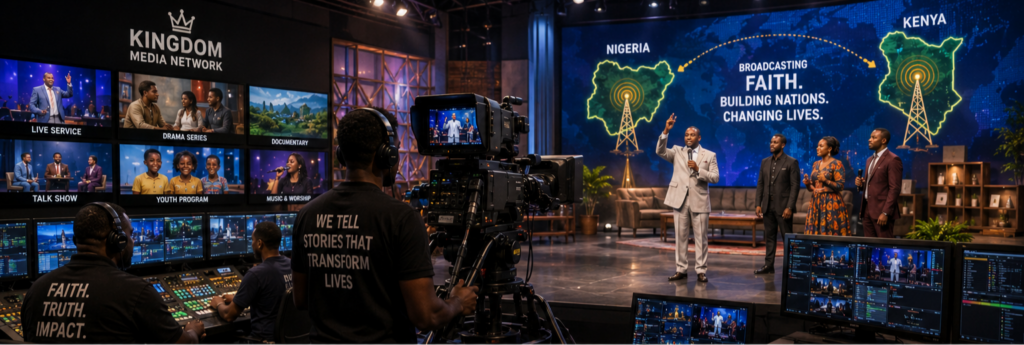
Neither Kenya nor Nigeria has fully reckoned with what it means that faith-based institutions have become so central to their media ecosystems, not in policy, not in industry strategy, and not in the conversations that filmmakers and creators have among themselves.The path forward isn’t simple.
It requires storytellers willing to negotiate editorial constraints they find uncomfortable, broadcasters willing to air content that stretches their programming mandates, and funders patient enough to build relationships rather than just content.
It requires distinguishing between the faith-based station that is genuinely a community broadcaster and the one that is, as Kenya’s own regulatory review notes, merely replaying sermons on a loop with a broadcast license.But the infrastructure is there.
The audiences are there. “In these two countries, where distribution channels rather than kilometres determine the distance between telling a story and hearing a story, that matters more than the industry has yet acknowledged.












Leave a comment