

Nigerians Serving Outside State of Origin: The Indigeneship Contradiction
The debate over Nigerians serving outside state of origin has been reignited by the cases of James Faleke and Senator Solomon Olamilekan Adeola (Yayi), both of whom have built political careers in Lagos while seeking or holding office in other states. This contradiction strikes at the heart of Nigeria’s indigeneship system, exposing a framework that is applied selectively and conveniently rather than as a coherent principle of governance.
The issue of indigeneship arises in local scholarships, appointments, and political representation. It is, however, contradictory and somewhat fraudulent to have someone claim Lagos as their political base while simultaneously vying for governorship in another state.
The Appointive Precedent: 7 Nigerians Who Served Elsewhere
The Nigerian political landscape has a rich history of Nigerians serving outside state of origin in appointive capacities. These precedents demonstrate that competence, not ancestry, can determine who serves in government.
Olumuyiwa Adekeye, a native of Kwara State, serves as Special Adviser on Media and Communications to the Governor of Kaduna State. Joe Igbokwe, from Anambra State, has worked in and around the Lagos State Government for over a decade, currently serving as Special Adviser to Governor Babajide Sanwo-Olu on Drainage and Water Resources. Kabiru Ahmed Abdullahi, from Katsina State but born in Agege, serves as Commissioner for Waterfront Infrastructure Development in Lagos State.
These examples, along with Tijani Nwadei (Delta State serving in Edo), Emeka Onowu (Imo State serving in Rivers), Moses Okezie-Okafor (Anambra State serving in Kogi), and Hon. Oghene Emma Egoh (Delta State representing a Lagos constituency), demonstrate that Nigerians serving outside state of origin can and do contribute meaningfully to governance across the federation.
But appointments are not the same as politically elected offices, where the issue of indigeneship is fierce and contested.
The Elective Office Contradiction

The contradiction at the heart of Nigeria’s indigeneship system is this: a person can serve in an appointive capacity in a state where they are not an indigene, but the moment they seek elective office, their origins become a matter of public disputation.
James Faleke represents a particularly instructive case. Born in Ekinrin Adde in Ijumu Local Government Area of the old Kabba Province, Faleke is an indigene of Kogi State. Yet he has built his political career in Lagos, serving as Executive Secretary of Ojodu LCDA, Chairman of Conference 57 (the body of Local Government Chairmen), and since 2011, as a member of the House of Representatives representing Ikeja Federal Constituency.
In 2015, Faleke was the deputy governorship candidate to Abubakar Audu in Kogi State. They won the election, but Audu died before the results were formally declared. The APC transferred their votes to Yahaya Bello, and Faleke challenged the decision all the way to the Supreme Court, arguing that as the only surviving candidate on the joint ticket, he should be declared governor-elect.
Faleke’s position is emblematic of the contradiction. He maintains a firm political foothold in Lagos while gunning for the governorship of Kogi State. He wants to eat his cake and have it.
The Yayi Case: Born in Lagos, Crowned in Ogun

Senator Solomon Olamilekan Adeola, popularly known as Yayi, is the APC consensus governorship candidate for the 2027 Ogun State election. His indigeneship has been fiercely contested by political opponents, and the controversy has escalated into legal threats and court challenges.
Yayi was born on August 10, 1969, at the Island Maternity Hospital in Lagos, to Mr Ayinde Abdul-gafar Adeola Ogunleye and Madam Abeni Olasunbo Ogunleye . He grew up in Alimosho, attended State Primary School in Alimosho, and later Community Grammar School in Akowonjo, Lagos . His ancestral roots, however, trace to Pahayi and Isaga Orile in Yewa South and Abeokuta North Local Government Areas of Ogun State .
His political career began in Lagos State, where he served two terms in the Lagos State House of Assembly representing Alimosho Constituency II, playing a key role in drafting tax and revenue legislation that contributed to the state’s financial independence . He subsequently served a term in the House of Representatives as Chairman of the Public Accounts Committee, followed by two distinguished terms representing Lagos West in the Senate .
In 2023, Yayi relocated his political base to Ogun State and secured a decisive victory for the Ogun West Senatorial seat . He currently chairs the Senate Committee on Appropriations, occupying a strategic position at the heart of Nigeria’s national fiscal architecture .
Former Nigerian Ambassador Folake Marcus-Bello and Hon. Abayomi Hunye have publicly accused Yayi of not being an indigene of the Yewa region in Ogun State. Marcus-Bello claimed during a live national television appearance that historical and documentary records prove Yayi’s ancestral roots actually trace back to Ekiti State, citing the programme of events of Yayi’s father’s burial in Ekiti State with his Oriki and progeny . Hunye similarly alleged that Yayi is an Ekiti State indigene .
Yayi has strongly dismissed these claims as false, libellous, and politically motivated. Through his Media Adviser, Kayode Odunaro, he issued a 24-hour ultimatum threatening legal action against Marcus-Bello and Hunye if they failed to present evidence . “I watched in utter disbelief as these characters that I hardly know utter assertive and outrageous lies about my origin without any proof,” Yayi stated. “One falsely claimed on TV that I am from Ekiti and when asked where exactly in Ekiti went moronically blank and could not provide an answer” .
Yayi’s stepmother, Aminatu Abiola, released a viral video strongly refuting the claims, asserting that Yayi is a “pure Yewa son” and that his father was from Yewa and was buried in Lagos, not Ekiti .
Traditional councils in Kemta, Ogun State, have affirmed Adeola’s ancestral ties to the community. The Oluwo of Kemta and Baaye of Egbaland, Chief Abayomi Rotimi, declared: “Yayi is one of us. He is our son. We have different political parties here. We have PDP, APC, Accord and others. Whoever is our son is our son, and whoever comes here for us to help, we accept him” .
The controversy has also entered the courtroom. Akinbola Hammed Rotham, the New Nigeria Peoples Party (NNPP) governorship candidate, has sued Yayi to challenge his eligibility and documentary claims concerning his indigeneship status in Ogun State. Rotham obtained documents from INEC through the Freedom of Information process which, he says, raise questions requiring judicial determination .
“This is not about money, influence, political connections or who has the biggest political machinery. It is about eligibility, documentation, truth and the integrity of the electoral process,” Rotham said. “Having money and political influence does not place anyone above the law. Ogun State is not an extension of Lagos, and its governorship cannot be treated as a prize to be transferred to whoever possesses the greatest political machinery” .
The core argument of Yayi’s opponents is that because the Yewa/Ogun West region has never produced a governor since the state’s creation, the political slot should be reserved for actual, indigenous residents. Yayi’s long-standing political career in Lagos State, where he previously served as a Lagos West Senator, is cited as evidence that his roots in Ogun West are illegitimate .
An APC chieftain, Hon. Kayode Oladele, has rejected Marcus-Bello’s claims as “legally indefensible” and “highly libellous.” He argued that the constitutional qualifications for election as governor do not change from one state to another. “Of course Ogun is not Lagos, but both states, like the other states of the federation, operate under the Constitution of the Federal Republic of Nigeria,” he said. “When we begin to divide Nigerians into those who are sufficiently indigenous to seek elective office and those who are supposedly outsiders, even where they satisfy the Constitution, we are travelling down a dangerous road” .
The Lagos Exception: Cosmopolitan but Contested
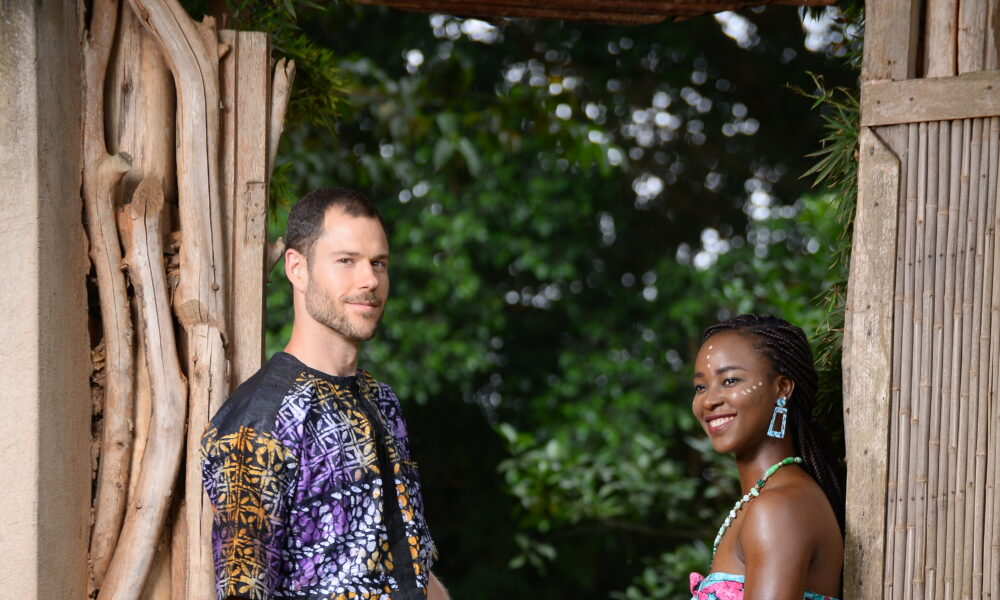
Lagos presents a unique paradox. As Nigeria’s commercial capital and most cosmopolitan city, it has attracted Nigerians from every state and ethnic group. Non-indigenes often overtake indigenes in economic and political influence, leading to a quiet grumble among Lagos indigenes.
it is perhaps that steady but quiet grumble that has made the prominent parties pitch governorship candidates with strong local affinities or compensate with deputies with strong indigeneship roots.
Yet when it comes to scholarships, appointments, and political representation, the indigeneship of a person resonates. The Lagos State Government has appointed commissioners and special advisers from other states, but the governorship has remained firmly in the hands of Lagos indigenes–despite the rumours that state otherwise.
Interestingly, many Ijebus from Lagos—particularly from the Ikorodu side of the divide—also have ancestral extensions in the Ijebu of Ogun State. This overlapping ancestry complicates any simple indigene-settler binary.
Same with the Aworis of Lagos and Ogun, and the Ogu of Lagos and Ogun. There could be a unique crosscarpeting of indigeneship as its suits people around these areas, albeit dangerous.
The Constitutional Question: Ministers and Federal Character
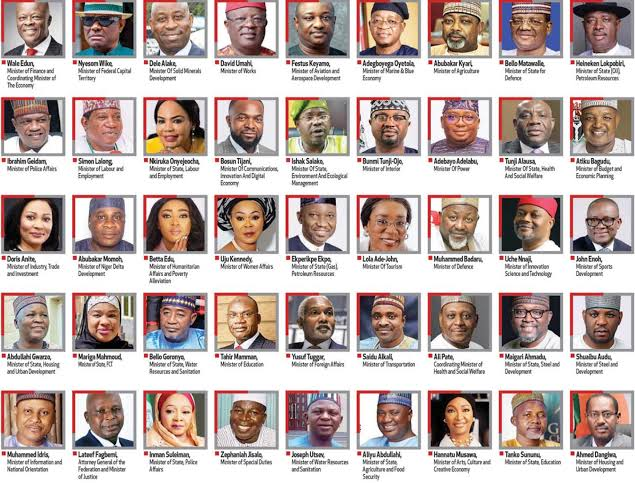
The Nigerian Constitution requires the President to appoint at least one minister from each of the 36 states of the federation. This provision is designed to ensure federal character and national unity.
But the Constitution does not specify that the minister must be an indigene of the state they represent. The constitutional requirement for becoming a governor of a state does not stipulate that candidates must be indigenous to the states where they are contesting.
Section 177 of the 1999 Constitution states that a person is qualified for election to the office of Governor of a State if he is a citizen of Nigeria by birth, has attained the age of thirty-five years, is a member of a political party and is sponsored by that political party, and has been educated up to at least School Certificate level or its equivalent. There is no provision for candidates to be indigenous to the states to qualify to contest .
Could the President then rile the Yorubas in Ogun State by picking a Fulani man from Ogun State as minister? Or choosing a Yoruba man from Kaduna State? Would the Ohanneze Ndigbo be comfortable with a Yoruba man from Imo State as their appointed minister? Will the Deltans, Bayelsans accept an Igbo man to be their minister? Such appointments would likely lead to protests, petitions, and political rancour. The Constitution’s federal character provision is interpreted in practice as requiring indigenes, not residents.
The Faleke Precedent and the 2015 Kogi Election
The 2015 Kogi governorship election remains the most instructive case study in the elective office contradiction. Faleke and Audu won 240,867 votes against incumbent Governor Idris Wada’s 199,514. The election was declared inconclusive due to cancelled votes in 91 polling units. Before the supplementary election could be held, Audu died.
The APC nominated Yahaya Bello, who was first runner-up in the party primary, to inherit the votes received by Audu/Faleke. Faleke rejected the move, arguing that collation of results had been concluded and that as the only surviving candidate on the joint ticket, he should be declared governor-elect. He wrote INEC declaring himself “governor elect.” But the APC ignored his argument and went into the supplementary election with Bello as its candidate.
Faleke challenged the decision in court, telling his party: “I will not disappoint Prince Abubakar Audu. I, James Abiodun Faleke, will not be there for the swearing-in if we don’t finish the case before the Jan. 27, 2016.” He did not present himself for inauguration as deputy to Yahaya Bello.
The Supreme Court ultimately ruled against Faleke. But his case established a precedent: a politician can build a career in one state while seeking the highest office in another.
The Indigeneship Certificate Racket
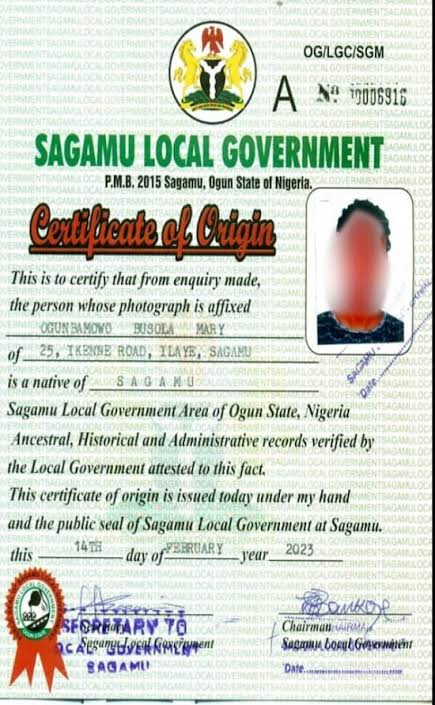
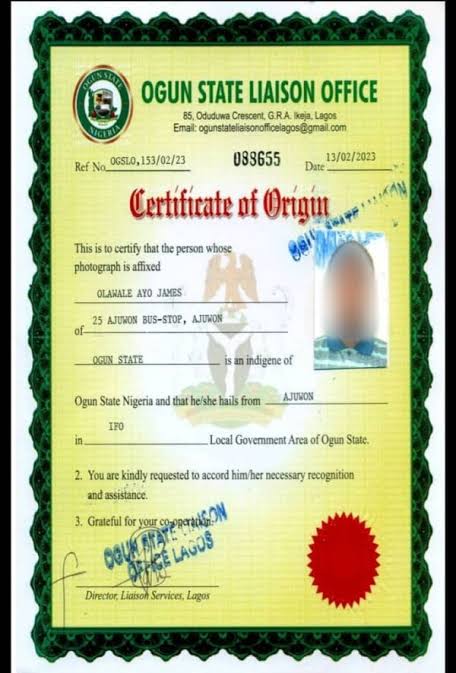
The indigeneship system is further undermined by the ease with which certificates of origin can be obtained. An investigation by TheCable in 2023 revealed that for a fee, a foreigner or non-indigene can obtain a Nigerian certificate of origin without hassle .
A reporter walked into the liaison office at Akute, Ifo Local Government Area of Ogun State, and requested a certificate of origin using a fictitious name, fictitious address, and non-existent parents. The official asked for N10,000 and instructed the reporter to provide his father’s and mother’s names, address, LGA, state, name of father’s compound, and two passport photographs. The certificate was issued the same day, stating that the fictitious applicant “is an indigene of Ogun state from Ajuwon in Ifo LGA” .
At Sagamu LGA, the reporter obtained an official certificate indicating that a non-existent person was a “native of Sagamu LGA.” The certificate claimed: “ancestral, historical, and administrative records verified by the local government attested to this fact.” It was signed and stamped by the secretary to the LGA as well as the LGA chairman .
This racket demonstrates that the indigeneship system is not a rigorous verification mechanism but a bureaucratic formality that can be manipulated by those with money and connections. If certificates of origin can be bought, the entire foundation of the indigeneship debate collapses.
Conclusion: Residency, Not Ancestry
Nigeria has a choice. It can either uphold indigeneship consistently, applying it to every political office in every state, or it can scrap it entirely and replace it with a residency-based system.
If the former, then the Fulanis who have lived in Ogun State for generations should be allowed to field a governorship candidate. The Igbos in Lagos should be able to field a governorship candidate. The Yorubas in Kaduna should be able to field a governorship candidate.
If the latter, then Nigeria takes a significant step toward becoming a true federation, one in which every citizen has the right to live, work, and participate in the political life of any part of the country.
The case for Nigerians serving outside state of origin rests on competence, not ancestry. Majority of human history is migrancy. Even those who claim to be sons of the soil are also migrants by and large. The system that denies Nigerians the right to serve where they live is not a principle; it is a convenience. And it must end.
- Faleke indigeneship controversy
- federal character Nigeria
- indigeneship debate Nigeria
- James Faleke Kogi
- Kogi State governorship
- Lagos cosmopolitan politics
- Nigeria indigeneship contradiction crisis
- Nigerian Constitution ministers
- Nigerian politics 2027
- Nigerians serving outside state of origin
- non-indigenes in Nigerian politics
- Ogun State governorship 2027
- Senator Yayi Ogun
- state of origin vs state of residence
- Yayi indigeneship controversy





Leave a comment