

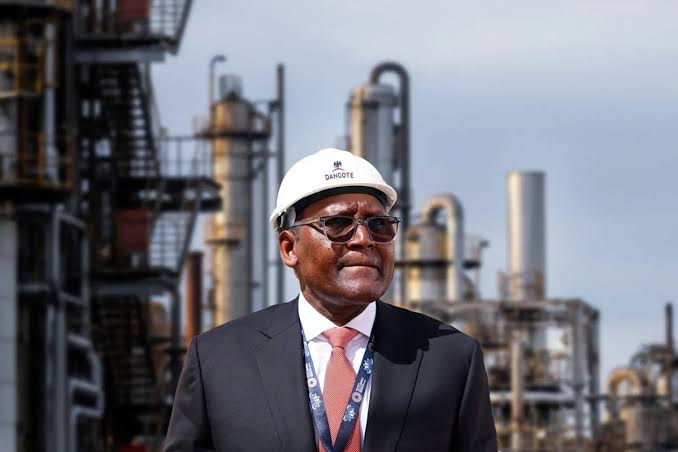
The Dangote Refinery IPO has opened in Nigeria, giving retail and institutional investors a chance to own shares in one of Africa’s biggest industrial projects.
The public offer began on Monday, September 14, 2026. It will run until October 13.
The company is offering 4.1 billion shares at ₦525 per share.
Investors can start with as little as 10 shares. That puts the minimum investment at ₦5,250.
The offer has already generated strong interest across Nigeria. Investment communities, social media platforms and private groups have been discussing the opportunity for weeks.
Many prospective investors are asking how many shares they should buy. Others want to know how to open investment accounts and participate.
However, market observers have warned investors to approach the offer with realistic expectations.
An IPO provides an opportunity to invest in a company. It does not guarantee quick profits.
Dangote Refinery targets bigger production
The proceeds from the offer are expected to support the refinery’s expansion plans.
The company currently targets production capacity of about 700,000 barrels per day. It plans to increase that figure to 1.4 million barrels per day.
That expansion could further strengthen the refinery’s position in Africa’s energy market.
The scale of the transaction has also made the Dangote Refinery IPO one of Nigeria’s most closely watched capital-market events in recent years.
For many Nigerians, it could also become an introduction to direct equity investment.
Investors urged to understand the business
Shareholder activist Adeleke Adebayo said he intends to participate in the offer.
He explained that his decision is partly based on his understanding of the oil and gas industry.
Adebayo also advised investors to put their money into businesses they understand.
He said refining involves buying crude oil, processing it and selling refined petroleum products.
According to him, demand for those products remains significant.
He pointed to petrol, diesel, kerosene and aviation fuel as important parts of the business.
Adebayo also noted that Nigeria’s transport system remains heavily dependent on conventional fuels.
However, he cautioned investors against expecting immediate returns.
He described the refinery as a long-term investment rather than a vehicle for quick profits.
He also pointed to the capital-intensive nature of the business.
Investors, he said, should understand issues such as depreciation and the wider financial implications before committing their money.
Despite those risks, Adebayo described Dangote Refinery and Petrochemicals as a potentially strong long-term investment.
Dangote predicts major growth
Dangote Group President Aliko Dangote has also expressed strong confidence in the company’s future.
He said the IPO goes beyond raising money for the business.
According to him, the offer is designed to widen participation in Africa’s industrial growth.
Dangote said he wants more people to have an opportunity to own part of the enterprise.
He also expressed confidence that the refinery could become Africa’s largest company by size and profitability.
He compared its potential growth with major global companies that expanded significantly after entering public markets.
His comments have further increased attention around the public offer.
Refinery gains international relevance
Dangote Petroleum Refinery Managing Director David Bird highlighted the facility’s growing position in the international energy market.
He said the refinery began production in January 2024 and has since expanded its influence.
Bird noted that the facility surpassed the United States in June to become the largest external supplier of jet fuel to Europe.
He said the refinery retained that position in July.
The development highlights the growing role of the Nigerian facility in international petroleum trade.
It also gives investors another factor to consider when assessing the company’s long-term prospects.
IPO attracts international and Islamic investors
Former United States Assistant Secretary of State for African Affairs Jendayi Frazer said the IPO could create a stronger connection between African industrial production and African and diaspora capital.
She argued that the offer could allow more investors to participate in the value generated by major African assets.
Frazer also described the refinery as an example of what African businesses can achieve through capital, technical expertise and strong partnerships.
Meanwhile, former Jaiz Bank chairman Mohammed Mustapha Bintunbe said the refinery passed an independent Shariah assessment.
He said the screening found the upcoming listing compliant with relevant Shariah investment frameworks.
That could create opportunities for Islamic institutional investors and ethical investment funds to participate.
Strong demand expected from investors
The planned listing could also have a major effect on Nigeria’s capital market.
Analysts expect the refinery’s eventual listing on the Nigerian Exchange to significantly increase the exchange’s overall market capitalisation.
Investor appetite has already been visible.
In July, the company raised $2.5 billion through a private placement.
The exercise targeted institutional investors and high-net-worth individuals.
Demand reportedly exceeded the available offer by 270 per cent.
Market observers believe some investors who could not secure their desired allocation may now turn to the public offer.
Stanbic IBTC, one of the joint lead issuing houses, stockbrokers and receiving banks for the IPO, has also announced an incentive for eligible retail investors.
Qualified investors may receive up to two additional shares at no extra cost, subject to the offer terms.
Investors can subscribe through the Stanbic IBTC Mobile App, Internet Banking or its electronic subscription platform.
How to buy Dangote Refinery shares
Nigerians interested in the Dangote Refinery IPO need to prepare a few things before subscribing.
First, investors need an active investment account with a stockbroking firm.
Existing investors should check that their account details are current.
They also need a Bank Verification Number, commonly known as BVN.
The BVN helps verify an investor’s identity.
Investors without a BVN will need to complete the enrolment process through a commercial bank.
A Central Securities Clearing System account is also required.
The CSCS account is where the shares will be held after allotment.
KYC requirements remain important
Investors must also complete their Know Your Customer requirements.
The process can require information such as BVN details, bank account information and proof of address.
Investors who already have approved KYC details generally do not need to repeat the process.
However, anyone with incomplete verification should resolve the issue before subscribing.
Completing these requirements early can also help investors avoid delays when demand increases.
Minimum investment starts at ₦5,250
The minimum subscription is 10 shares.
At ₦525 per share, that means an investor needs at least ₦5,250.
Additional subscriptions must be made in multiples of 10 shares.
For example, 100 shares will cost ₦52,500.
An investor seeking 200 shares will need ₦105,000.
Investors should still consider their financial position before subscribing.
Strong public interest should not pressure anyone into investing more than they can comfortably afford.
Dangote’s ₦10,000 prediction attracts attention
One of the biggest talking points around the offer is Dangote’s prediction about the company’s future share price.
The businessman has suggested that the shares could eventually rise from the ₦525 offer price to ₦10,000.
He used a ₦5 million investment as an example when explaining the potential upside.
If the shares eventually reached ₦10,000, such an investment could become worth more than ₦50 million.
Dangote has also mentioned the possibility of shareholders receiving dividends.
However, investors should treat the projection as a forecast.
It is not a guarantee that the shares will reach ₦10,000.
The eventual market price will depend on the company’s financial results, growth, market conditions and investor demand.
What happens after the IPO?
The next major stage will be the listing of the shares on the Nigerian Exchange.
Once listed, the shares will trade in the secondary market.
Their price will then be determined by market forces.
Strong demand could push the shares above the ₦525 offer price.
However, the shares could also trade below the IPO price if investors become less optimistic about the company.
Investors should therefore understand that owning shares comes with market risk.
Those who miss the IPO may still buy the shares after listing.
However, they will have to purchase them at the prevailing market price.
A major moment for Nigeria’s capital market
The Dangote Refinery IPO is bigger than a single company’s fundraising exercise.
It is also a major test of Nigeria’s capital market.
The low minimum subscription has opened the door for ordinary Nigerians who may have previously viewed the stock market as an arena for wealthy investors and institutions.
For first-time investors, the offer could provide an opportunity to learn how equity ownership works.
At the same time, investors need to look beyond the excitement surrounding the refinery.
The company’s future performance will ultimately determine whether the investment delivers strong returns.
For now, however, the opening of the Dangote Refinery IPO marks a major moment for Nigeria’s investment community.
The offer puts a stake in one of Africa’s most ambitious industrial projects within reach of a much wider pool of investors.









Leave a comment