

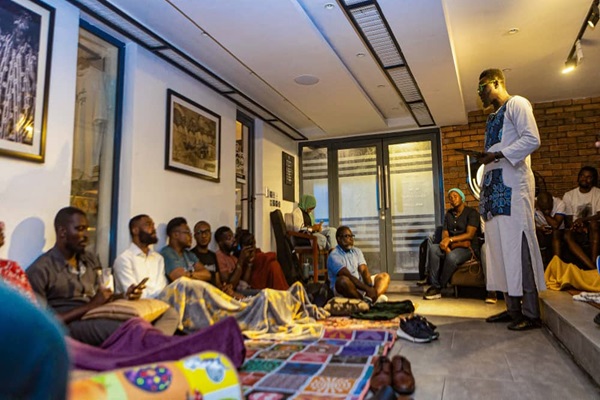
What can demography possibly teach a room already burdened by the anxieties of living? In Yoruba we say, the child is wise and so is the elder: such is the formula by which the world was created. I am reminded, again, of that familiar cadence in Yoruba rhetoric exchange where the elder does not answer a question directly but redirects it into the deeper valley of reflection. Any serious engagement with demography must return us to the human element – those subtle, often unspoken negotiations between men and women that statistics attempt, but frequently fail, to capture. It is within this delicate intersection that controversy is born; and it is also where a platform like Griots and Bards (GAB) finds both its urgency and relevance.
Men must be willing to hear the layered concerns of women without immediate defensiveness; women must engage the vulnerabilities of men without dismissal.
Demography, in its barest sense, is not merely about numbers. It is about patterns of existence – birth, death, migration, union, separation. Yet, beneath these measurable indices lies the unresolved tensions between genders, sharpened by modern expectations and complicated further by shifting cultural loyalties. Contemporary society, particularly within urban African spaces, appears to be negotiating a quiet crisis. Men and women speak, but seldom listen; articulate grievances, yet rarely inhabit the emotional geography of the other. What results is a form of social arithmetic where everyone is counting, but no one is accounting? It is against this backdrop that GAB convenes every last Thursday, tucked away in that modest but symbolically charged corner of Ikoyi.
The Rap Joint is not merely a venue, but it is, in the truest sense, a contemporary village square. There is something almost ritualistic about the gathering, which is the hum of anticipation, the quiet clustering of minds before discourse begins, the unspoken agreement that what transpires within that space is both communal and consequential. Here, demography sheds its statistical aloofness and becomes embodied in lived experiences – stories of love, estrangement, ambition, and compromise. Like the recent edition that focused on women’s experiences and how they are being rationalised. It was a controversial take both emotionally and brilliantly charged because of the premises established on the grounds of internalised responses to the status quo.
Do we consider gender complexities a problem? Questions emerge, not as accusations but as provocations. Are men disadvantaged in contemporary relational structures? Do women bear disproportionate emotional labour? Has modernity recalibrated expectations beyond what either gender can sustainably offer? These are not new questions, certainly. But within GAB, they are reframed as shared dilemmas requiring mutual interrogation. A male participant – an engineer by training – argued that societal expectations continue to demand stoicism from men while simultaneously critiquing their emotional withdrawal. A female voice, firm yet measured, countered that women have historically sailed through both expectation and erasure, and that any contemporary discomfort experienced by men must be contextualised within that longer arc of imbalance. What could have devolved into antagonism instead became an exercise in calibrated listening.
Participants begin to see that statistics about marriage rates or workforce participation are, in fact, narratives about human negotiation. The decline in certain demographic indices is not simply a numerical anomaly, but is symptomatic of deeper relational fractures.
The question should be whether we care to problematise the experiences and transformations that have redefined us. And to do that, to have a rounded thematisation of what it is we are confronted with, it is impossible to see from one demographic prism. That is why the GAB heads are composed of different colours of generational hairs, representing age and interest directly proportional to experiences and exposure respectively. To retrieve the fading art of communal reasoning and re-situate it within the demands of contemporary African life: that is a prime purpose of GAB. In doing so, GAB resists the reduction of discourse to digital fragments and instead insists on physical, intellectual, and emotional presence.
What then emerges from the interplay between GAB, demography, and controversy is not resolution – at least not in the conventional sense. Rather, it is a reorientation. Participants begin to see that statistics about marriage rates or workforce participation are, in fact, narratives about human negotiation. The decline in certain demographic indices is not simply a numerical anomaly, but is symptomatic of deeper relational fractures. And if these fractures are to be addressed, they cannot be outsourced to policy alone. They must be confronted within spaces that allow for vulnerability without spectacle. In many ways, GAB functions as a corrective to the excesses of what one might call performative awareness. The contemporary obsession with being right often eclipses the more demanding task of understanding deeply. Within the GAB framework, however, the emphasis shifts. One is not required to abandon conviction, but one is compelled to interrogate it. And in the context of gender relations, this becomes particularly significant.
It is easy to curate arguments that affirm one’s position, but it is considerably more difficult to sit with perspectives that unsettle it. To speak of demography without acknowledging its emotional substratum is to engage in half-analysis. The truth, if one may risk such a definitive term, is that men and women are increasingly occupying parallel interpretive worlds. They experience the same social realities but assign different meanings to them. Without deliberate efforts at convergence, these meanings harden into positions; and positions, when left unexamined, calcify into distance. It is here that the ultimate lesson of GAB reveals itself, not as proclamation but as quiet insistence. If contemporary society must see through the controversies embedded within its demographic realities, then it must first recover the discipline of listening. Not the perfunctory listening that waits for a turn to speak, but the active, almost uncomfortable listening that seeks to understand before it responds. Men must be willing to hear the layered concerns of women without immediate defensiveness; women must engage the vulnerabilities of men without dismissal. Anything short of this mutual concession risks perpetuating a cycle where both genders articulate positions yet withhold assistance.
To conclude, one might say that Griots and Bards is less a platform and more a proposition – a suggestion that the answers we seek may not lie in louder arguments but in deeper engagements. Demography may map our condition, and controversy may animate it; but only honest, structured, and sustained conversation can begin to heal it. Without that, we remain society of parallel solitudes: speaking, perhaps eloquently, but seldom to one another.
Kehinde Folorunsho is a writer, editor and winner of the Ken Saro Wiwa Prize for Book Review.










Leave a comment